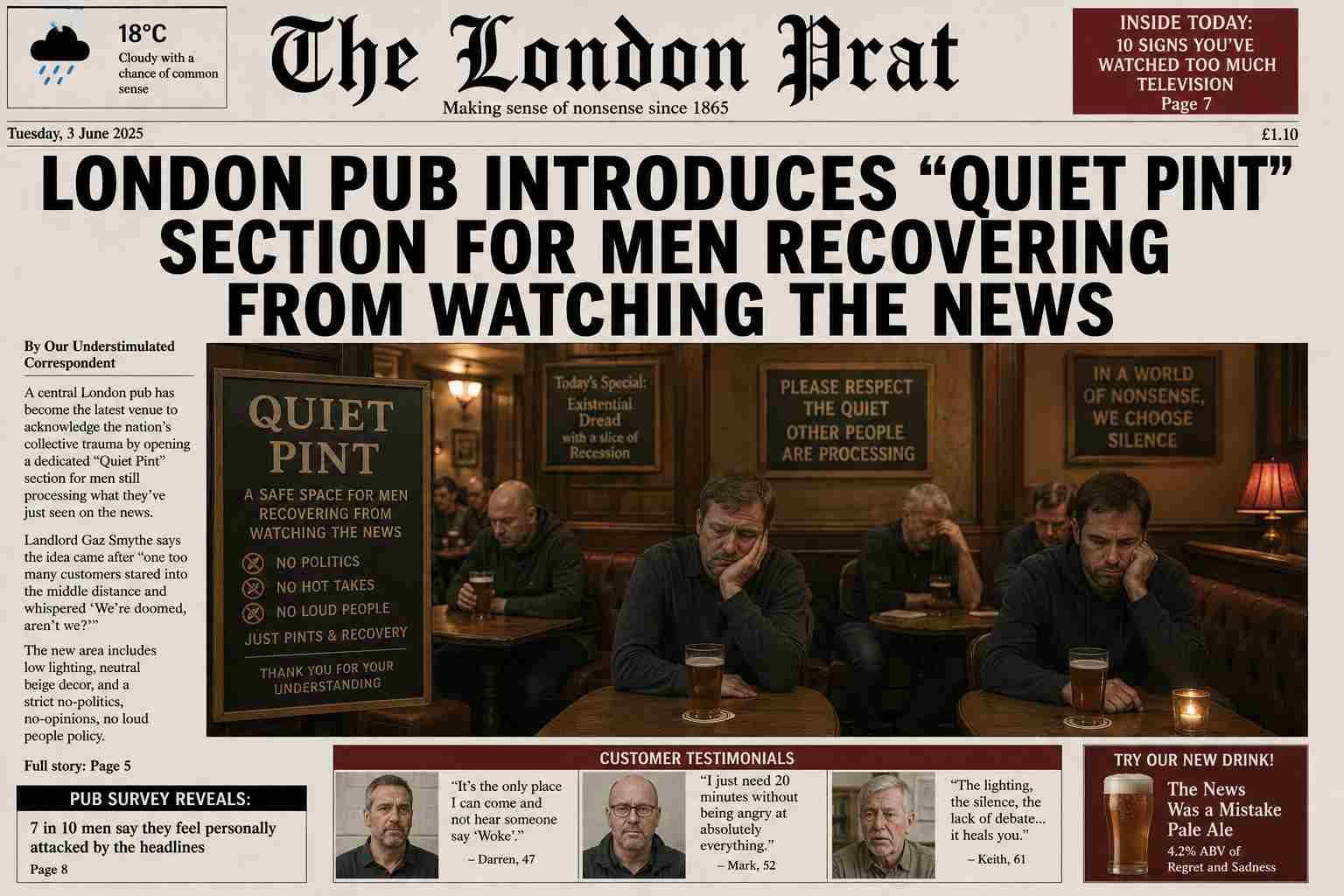
London Pub Introduces “Quiet Pint” Section For Men Recovering From Watching The News
LONDON — The Crown and Sceptre in Bermondsey has become the first London pub to introduce a designated “Quiet Pint” section — a cordoned area near the fireplace, away from the television, the fruit machine, and other humans with opinions, specifically reserved for men aged 40-65 who have been watching the news and need to sit quietly with a pint of London Pride for forty-five minutes before they can be expected to interact with anyone in a way that doesn’t involve unprompted views on the cost of living, the state of the roads, Nigel Farage, or what this country has come to. The section, separated from the main bar by a velvet rope and a laminated sign reading “QUIET RECOVERY ZONE — No News Discussion, No Hot Takes, No Statistics You Read Today,” was introduced by landlord Terry Mulvaney after he noticed that a significant portion of his lunchtime custom consisted of men who came in looking like they needed to decompress from something and left looking like they’d merely displaced the pressure.
The News Watching Crisis: A Public Health Consideration
The relationship between British men of a certain age and the news has deteriorated in recent years to the point where several GP surgeries have begun asking, as part of the standard health assessment, how many hours of rolling news the patient consumes daily. The recommended maximum, according to Mental Health UK guidance, is approximately 30 minutes, after which additional news consumption produces diminishing returns and increasing cortisol. The average British man in the 45-65 age bracket watches approximately 3.2 hours of news content daily, according to Ofcom news consumption data, a figure that includes breakfast news, lunchtime bulletins, the Six O’Clock News, the Ten O’Clock News, and at least forty-five minutes of late-night doom-scrolling through headlines on his phone while his wife reads a novel three feet away and appears, infuriatingly, to be coping.
The result is a type of man found across Britain in remarkable numbers: informed but not at peace. He knows the deficit figures. He knows the polling. He knows what Keir Starmer said in 2019 and what he is saying now and the difference between those two things. He has a position on the Rwanda scheme, the two-child benefit cap, the net zero transition timetable, and whether Gary Lineker should have been allowed to tweet about it. He is, in every relevant sense, abreast of things. He is not well.
The Quiet Pint Experience: A Tour
The recovery zone at the Crown and Sceptre is a masterpiece of thoughtful design. Six armchairs, each angled away from the door and toward the middle distance. A shelf of books, specifically chosen to have no contemporary political relevance — naval history, Patrick O’Brian, a 1978 railway atlas of Britain, three volumes of Bill Bryson. A small lamp. The hum of the pub without its most agitating elements. No television. No phone signal, which is achieved through a combination of thick Victorian plasterwork and what Terry describes as “the pub’s natural refusal to cooperate with modernity in this one specific area.”
Entry to the zone is by personal assessment. If you come in looking like a man who has read something about either the economy or the weather and cannot get it out of your head, Terry or one of his bar staff will quietly direct you. “Just through there, mate. London Pride? I’ll bring it over.” The pint arrives. The man sits. The armchair, which has absorbed forty years of similar situations, receives him with the passive professional competence of a very experienced therapist who has given up talking.
The Regulars: Brief Portraits
Dave, 58, is a retired logistics manager from Peckham. He started watching the news more after retiring — more time, obviously — and has since developed what his wife calls “the news face,” an expression of compressed outrage that he maintains for approximately six hours after any significant political development and which prevents meaningful conversation. Dave uses the quiet zone on Tuesdays, which is when the government tends to announce things. “It’s not that I’m angry,” Dave explains. “I’m just — I’ve got context. And the context is not reassuring.” He takes forty minutes. He emerges looking like a man who has filed the context appropriately and can now talk about other things. Last Tuesday he recommended a documentary about canals.
Brian, 61, works in middle management for a company he describes as “not relevant.” He comes in during his lunch break specifically to sit in the quiet zone without a phone or a sandwich or a laptop, which he describes as “the only twenty minutes in the day when I’m not being asked to think about something.” He brings no news in with him. He takes no news out. The pint is a structural necessity — “it gives you something to do with your hands so you don’t reach for the phone.” He has used the zone fourteen times. He describes it as “better than therapy, cheaper than therapy, and the chair is better.”
The Therapeutic Function of the Traditional British Pub
The British pub has always served functions beyond the commercial provision of alcohol. It is a community centre, a neutral ground, a place where social hierarchies are temporarily suspended in the shared project of being somewhere comfortable with a drink. The Campaign for Real Ale has documented the pub’s role in community life and mental health for decades, noting that the decline of rural and local pubs correlates with measurable increases in social isolation. The quiet zone is, in this context, not a novelty but a formalisation of a function the pub has always performed informally.
Men, in particular, often find that the structure of the pub — a reason to go somewhere, a defined activity, a social context that doesn’t require the explicit acknowledgment of feeling — provides a form of low-threshold social contact that other formats don’t. The quiet zone removes even the social obligation, which makes it either a step forward or a step back depending on your theory of what pubs are for.
Bob Mortimer, who has become something of an unlikely ambassador for middle-aged men’s mental health through his fishing programme with Paul Whitehouse, once said that sometimes you just need to sit quietly near water. Or, in this case, near an armchair and a pint and the specific absence of the news.
Expansion Plans
Terry has received seventeen enquiries from other London pub landlords about replicating the format. A Wetherspoons enquiry was declined. He is in discussions with a venue in Islington, which he acknowledges presents a different demographic challenge — the Islington version would need to be a quiet zone for people recovering from reading the Guardian comment section, which is, arguably, a different kind of news-induced distress but no less real. The armchairs would need to be organic. The beer would need to be local. The book shelf would contain more Naomi Klein. The therapeutic requirement is identical.
Auf Wiedersehen, amigo!
News consumption and its relationship to mental health has become a significant area of research and public health discussion in the UK. Ofcom’s annual news consumption survey tracks how Britons access news and how much time they spend with it, consistently finding that television remains the primary source while online news consumption continues to grow. Mental Health UK and the Mental Health Foundation have published guidance on managing news consumption to limit anxiety and stress, particularly during periods of sustained negative news cycles. The Campaign for Real Ale’s Pub of the Year awards and its ongoing research into pub closure rates provide detailed documentation of the role of pubs in British community life. There are approximately 39,000 pubs in the UK as of 2024, down significantly from the peak of approximately 60,000 in the 1980s.
This article was produced by The London Prat, est. 1961, in the enduring tradition of British satirical journalism, written by the world’s oldest tenured professor and a philosophy major turned dairy farmer, both of whom have visited the quiet zone, and both of whom feel much better, thank you.

Carys Evans is a prolific satirical journalist and comedy writer with a strong track record of published work. Her humour is analytical, socially aware, and shaped by both academic insight and London’s vibrant creative networks. Carys often tackles media narratives, cultural trends, and institutional quirks with sharp wit and structured argument.
Her authority is reinforced through volume, consistency, and reader engagement, while her expertise lies in combining research with accessible humour. Trustworthiness is demonstrated by clear labelling of satire and an ethical approach that values accuracy and context.
Carys’s work supports EEAT compliance by offering informed satire that entertains while respecting readers’ trust.