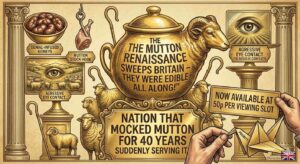
Mutton Renaissance Sweeps Britain as Millennials Discover Sheep Were Edible This Whole Time
Nation That Mocked Mutton for 40 Years Suddenly Serving It on Slate Tiles With Rosemary Foam
Five humorous observations drifted across Britain this week after fashionable restaurants in London began rebranding mutton as “heritage ovine cuisine” and charging £46 for what Yorkshire grandfathers once fed reluctant terriers.
- London food critics now describe mutton using the same language previously reserved for opera, Scandinavian furniture, and emotionally unavailable lovers.
- Shoreditch restaurants have reportedly started aging sheep longer than some British marriages.
- Young professionals who once fainted at the word “lamb fat” now queue three hours to eat “ethically melancholic ewe shoulder” beside exposed brick walls.
- One pub in Hackney serves “deconstructed mutton pie,” which appears to be three peas, smoke, and a lecture about colonial spice routes.
- British influencers now photograph mutton chops with the reverence medieval monks once reserved for holy relics.
Britain Rebrands Poverty Food as Luxury Lifestyle Experience

For decades, mutton occupied a difficult place in British culinary culture. It was the meat of wartime rationing, stern grandmothers, damp northern kitchens, and men named Clive who repaired tractors using spoons. Lamb was glamorous. Lamb was springtime. Mutton was what happened after hope expired.
Then London discovered irony.
Now entire districts of the capital behave as though eating older sheep is a revolutionary act of resistance against capitalism, despite paying £19 for fermented beetroot water while doing so.
This is not entirely without precedent. Much Ado About Mutton, the definitive historical account of Britain’s complicated relationship with the meat, notes that mutton once fed the nation through the upheavals of the Industrial Revolution, lit homes via tallow fat, appeared at the last lunch on the Titanic in 1912, and was a birthday meal on Captain Scott’s final expedition. Mrs Beeton herself declared in 1861 that “mutton is undoubtedly the meat most generally used in families.” The British then spent the next century pretending this never happened.
What finally broke the pretence? King Charles III, apparently. His Majesty personally launched a Mutton Renaissance Campaign and declared it his favourite dish. This is the royal equivalent of telling the nation that a previously embarrassing relative has been knighted and now everyone must pretend they always respected them.
At the wildly fashionable restaurant “Ewe & I” in Soho, customers reportedly clap when waiters explain the sheep “completed an emotional grazing journey” before being slow-roasted for 17 hours in volcanic salt.
“We wanted to reconnect diners with the authenticity of post-war hardship,” explained celebrity chef Jamie Oliver in an interview conducted while standing beside a copper pan large enough to baptize a goat. “Mutton tells a story. Mostly the story is, ‘your grandparents were cold,’ but still.”
Food historian Ingrid Gustafsson of the prestigious North London Institute for Pretentious Eating claimed the renaissance began after wealthy urban professionals became “exhausted by foods that were already popular.”
“First they rediscovered sourdough. Then sardines. Then butter churned by men with beards and emotional trauma,” she explained. “Mutton was the final frontier. The sheep equivalent of vinyl records.”
London Hipsters Reportedly Prefer Sheep With “Life Experience”
According to a survey conducted by the Institute of Extremely Specific Polling, 63% of London diners now believe older sheep possess “deeper flavour notes and stronger emotional maturity.” Another 22% admitted they ordered mutton simply because everyone else at the table looked confident doing it.
This, at least, has culinary grounding. Great British Chefs confirms that mutton carries significantly deeper flavour than lamb, with Farmison & Co comparing it to the difference between a light pinot noir and a well-aged shiraz. None of this was, apparently, obvious to Britain for the last four decades.
Witnesses at Borough Market described scenes of near-religious devotion.
“One bloke spent twelve minutes discussing the sheep’s upbringing before eating it,” said eyewitness Darren Wilkes, 54, from Croydon. “Mate, when I was growing up, if meat didn’t actively bark, we cooked it.”
In East London, restaurants have begun listing sheep ages the way wine bars list vintages. One menu proudly advertised:
“2018 Welsh hill ewe, emotionally weathered, hints of thyme and economic decline.”
Another offered “free-range menopausal sheep,” paired with oat milk stout and something called “grief onions.”
Nobody knows what grief onions are. People still order them.
British Men Suddenly Treating Mutton Like Cigars and Jazz
The return of mutton has created a secondary crisis among middle-aged British men desperate to appear rugged. Pub gardens across London now contain men wearing wax jackets and speaking solemnly about “the integrity of mature sheep.”
One banker from Canary Wharf reportedly told friends he could “taste the Pennines” in a braised shoulder dish despite once believing Yorkshire was near Belgium.
A leaked Waitrose memo revealed executives are considering premium labels including:
- Rustic Mutton Reserve
- Gentleman’s Ewe
- Heritage Sheep Experience
- Wool & Flame Signature Cuts
An anonymous supermarket staffer described the marketing meetings as “three straight hours of rich people discovering peasants existed.”
Industry analysts at The Caterer confirm the trend has professional backing — chef Greg Lambert of SIX Rooftop in Newcastle predicting “a firm shift towards retired dairy cows and mutton becoming kitchen staples,” arguing that older animals lead to “a much better product” after lives properly lived on grass. He said this with a straight face, in print, while presumably aware that grandmothers in Cumbria had been saying exactly this since 1953.
Influencers Turn Mutton Into Spiritual Journey
TikTok food personalities accelerated the craze by filming candlelit “mutton tastings” accompanied by Icelandic folk music and slow-motion gravy pours.
One influencer described mutton as:
“The meat equivalent of journaling during rain.”
Another called it:
“A sensual rebellion against fast fashion and emotional avoidance.”
The video received 4.3 million views despite containing no information whatsoever. This is consistent with industry research showing 84% of UK restaurant operators now spend the majority of their marketing budget on social media influencers — meaning British sheep have accidentally become part of the creator economy, which is the most 2025 sentence ever written.
Psychologists warn the trend reflects a broader social phenomenon in which affluent societies romanticise hardship once they no longer have to endure it.
Professor Helene Voigt of the European Centre for Culinary Sociology explained:
“Modern consumers want authenticity without discomfort. They enjoy the symbolism of rustic struggle provided it includes valet parking and artisan napkins.”
Farmers Completely Confused by Urban Excitement Over Sheep
Meanwhile, British sheep farmers remain baffled.
“We’ve had mutton for centuries,” said farmer Nigel Pritchard of Cumbria while repairing a fence with what appeared to be pure resentment. “City people acted like I’d offered them radiator insulation. Now they’re paying £70 for sheep stew served in a tiny saucepan.”
There are reportedly now over 200 family farms across the UK producing mutton for the restaurant trade, with Yorkshire’s Swaledale breed — grass-fed, wind-battered, existentially sturdy — now appearing on menus at The Ivy and, previously, Le Gavroche. The sheep have gone from field to fine dining without once being consulted.
Farmers have reportedly begun inventing absurd descriptions simply to amuse themselves. One Yorkshire producer marketed his flock as:
“Emotionally bilingual hillside sheep with notes of wind.”
A London restaurant bought the entire shipment immediately.
What the Funny People Are Saying
“Only in Britain could people turn shepherd food into luxury cuisine while the trains still smell like wet umbrella.” — Ricky Gervais
“Mutton’s comeback proves if you wait long enough, every insult becomes a food trend. Give it fifteen years and we’ll be paying £40 for artisanal spam.” — Lee Mack
“You know society’s confused when people pay extra for meat described as ‘tired.’ I’ve been tired for years. Nobody’s putting me on a slate tile.” — Sarah Millican
“I told my gran they’re charging £46 for slow-cooked mutton shoulder in Soho. She went quiet for a long time and then said, ‘I served that in 1974 as an apology.'” — Romesh Ranganathan
Britain Declares Mutton “The Future” Moments Before Rediscovering Turnips
Economists predict the “Mutton Renaissance” could grow into a £2 billion industry fuelled entirely by nostalgia, beard oil, and people pretending they enjoy chewy textures.
Already, luxury London restaurants are experimenting with:
- Mutton sushi
- Mutton espresso reduction
- Vegan-inspired symbolic mutton
- Sheep charcuterie paired with “heritage rainwater”
Industry analysts believe Britain may soon rediscover every meal its ancestors ate reluctantly between 1640 and 1957. British food historians note that mutton’s story is “very much part of the story of the United Kingdom and indeed of our Empire,” which is exactly the sort of sentence that simultaneously justifies a tasting menu and a doctoral thesis.
Black pudding stocks have surged. Parsnips are nervous. Eel vendors have reportedly started smiling again for the first time since the Blitz.
And somewhere deep in rural Yorkshire, a grandmother who spent 40 years apologising for serving mutton has quietly watched the entire nation lose its mind.
She has not said “I told you so.” She doesn’t need to. The slate tile says it for her.
This satirical article is entirely a human collaboration between the world’s oldest tenured professor and a philosophy major turned dairy farmer. No sheep were interviewed directly, though several expressed strong opinions through prolonged eye contact. No mutton was harmed in the writing of this piece, though a significant quantity was slow-roasted at 140°C for six hours and served with grief onions.
Auf Wiedersehen, amigo!

Dr. Ingrid Gustafsson holds a Ph.D. in Literary Studies and serves as Professor of Literature and Satirical Journalism at the university. Her scholarly work focuses on contemporary satire as a form of institutional critique, examining how exaggeration, irony, and absurdism function as sophisticated analytical tools for exposing structural inequality and institutional hypocrisy. Dr. Gustafsson has published extensively on the genealogy of satirical discourse, the relationship between speech acts and cultural power, and satire’s role as both aesthetic practice and epistemological strategy. Her research interrogates how contemporary satire operates within celebrity culture, legal systems, and institutional rhetoric, revealing the mechanisms through which power obscures itself through language and performance. Dr. Gustafsson’s work combines rigorous textual analysis with broader cultural theory, contributing significantly to understanding satire’s critical function in contemporary society. She is the author of Pearl Clutching and How to Combat It with Satire.