

Oil Tankers, Economists, and One Extremely Nervous Billionaire Explain the Global Energy Panic
Five Observations From the Early Stages of the Asia Energy Crisis
- Energy experts say the first phase of any global crisis is denial, but Asia has decided to skip straight to “running around waving spreadsheets.”
- Oil tankers outside the Strait of Hormuz are now so numerous that satellites briefly misidentified them as a new artificial island chain — and two of them received four-star TripAdvisor reviews before anyone raised the alarm.
- Several Asian governments have announced ambitious renewable-energy goals immediately after discovering that petrol now costs roughly the same as a round at a central London bar.
- Economists have begun prescribing breathing exercises, because apparently nobody can calculate inflation whilst hyperventilating into a paper bag.
- Energy traders insist that screaming is now a legitimate trading strategy and have formally petitioned regulators to recognise it as an official financial instrument — the first new derivative since someone invented credit default swaps and ruined everything.
The Panic Heard Around the World
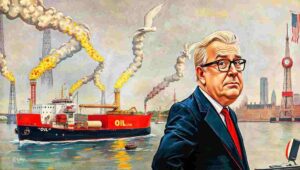
Singapore — In what officials are calling “a bold and innovative policy initiative,” several Asian governments this week unveiled a new energy strategy summarised in a single sentence: panic first, policy later.
The strategy emerged after oil prices skyrocketed amid fears that the Iran war could disrupt shipments through the Strait of Hormuz, a narrow waterway responsible for roughly one-fifth of the planet’s oil supply and 100% of the planet’s collective stress headaches. According to the U.S. Energy Information Administration, approximately 84% of crude oil moving through the strait is destined for Asian markets — meaning Asia had considerably more skin in this particular game than, say, a Norwegian sovereign wealth fund quietly enjoying the spectacle.
Within hours of the news, energy markets reacted exactly the way markets always react: by losing their collective minds.
Professor Liang Wen, a senior economist at the International Institute of Panicked Finance in Singapore, described the moment the crisis hit.
“First the price graphs went vertical,” Liang explained. “Then the traders went vertical. One man fainted directly onto a Bloomberg terminal and accidentally executed a $2 billion trade in soybean futures.”
Financial historians now classify the event as the fastest transition in modern history from “calm market conditions” to “everyone yelling.” This narrowly edges out the previous record, set in the City of London in 2008, when Lehman Brothers discovered that “too big to fail” was not, technically, a financial strategy.
The Strait of Hormuz Becomes the World’s Largest Floating Car Park
Meanwhile, hundreds of oil tankers attempting to navigate the Strait of Hormuz have formed what maritime analysts describe as “the largest traffic jam ever recorded outside the M25 on a bank holiday Friday.”
Satellite images show dozens of massive tankers drifting in nervous circles whilst captains wait for insurance companies to confirm that the words “war zone” are still technically covered under their policies. They are not. The word “technically” is doing the work of an entire legal department.
Captain Haruto Tanaka of the tanker Pacific Resilience described the situation with admirable composure.
“We have been floating here for three days,” Tanaka said. “The crew has started rating passing fighter jets on TripAdvisor.”
According to shipping analysts, the congestion has reached such levels that maritime authorities briefly considered installing toll booths and a Costa Coffee concession. A planning application has reportedly been submitted.
A leaked memo from an international shipping consortium warned the situation could worsen considerably.
“Based on current projections,” the memo stated, “the Strait of Hormuz will soon resemble the car park outside an IKEA on the August bank holiday — except the IKEA is on fire and nobody can assemble an exit route.”
Asia Discovers Renewable Energy at the Worst Possible Time
As oil prices climbed past what analysts describe as “psychologically disturbing numbers,” Asian governments made a rather remarkable discovery.
Renewable energy exists.
Several leaders promptly announced massive investments in solar, wind, geothermal, and anything else that does not require a tanker passing through a missile range. The International Energy Agency noted the irony without laughing, which displayed considerable institutional restraint.
In Tokyo, a government spokesperson unveiled Japan’s new energy roadmap.
“We have decided to accelerate our transition to renewable energy,” the official said. “This plan was originally scheduled for 2050, but the price of petrol forced us to move it to Thursday.”
In Seoul, engineers are reportedly exploring experimental power sources, including tidal energy, rooftop solar panels, and one ambitious proposal involving 12 million bicycles connected to the national grid.
“We call it the Pedal-For-Patriotism Initiative,” said one official, who arrived at the press conference slightly out of breath and wearing a high-visibility jacket.
Macroeconomic Breathing Exercises and Britain’s Newest Export: Therapeutic Economists
The crisis has triggered an unexpected side industry: therapeutic counselling for economists.
Dr. Amanda Chow, an energy economist at the Hong Kong School of Global Markets, has begun offering what she calls “macroeconomic breathing exercises.”
“You inhale slowly whilst repeating the phrase ‘temporary supply disruption,'” she explained. “Then you exhale whilst pretending oil prices are not approaching the price of gold.”
Chow said the therapy has been moderately successful.
“Several economists stopped crying after the third session.” She paused. “Two more started during the fourth.”
A Nomura analysis confirmed that Thailand, India, South Korea, and the Philippines are among the most vulnerable Asian economies — a finding that sent four separate finance ministries directly into Tuesday’s emergency group therapy session, which clashed with a pre-booked webinar on fiscal resilience.
Asian Governments Urge Citizens: Drive Less, Panic Responsibly
Across Asia, officials have launched public awareness campaigns encouraging citizens to conserve fuel.
In Singapore, billboards now read: “Drive Less. Panic Responsibly.”
In Bangkok, government advertisements recommend alternatives to driving, including public transport, cycling, and “standing still and contemplating the global economy.” The standing-still campaign has proven the most popular, as it requires neither fuel nor a Oyster card.
Meanwhile, commuters across the region have responded to rising fuel prices with a mixture of creativity and quiet desperation.
A taxi driver in Manila reportedly began offering passengers two fare options: standard service, or “economic crisis pricing,” which includes a complimentary lecture on geopolitics. Demand for the lecture package has been surprisingly robust, particularly among passengers with long journeys and nowhere else to be.
Energy Traders Discover the Surprising Financial Power of Screaming
Inside the trading floors of global commodity exchanges, chaos has become the dominant economic indicator.
Energy trader Mark Feldman described the current atmosphere with some understatement.
“People think trading oil futures is about analytics,” Feldman said. “But right now it’s mostly screaming and refreshing spreadsheets.”
According to Feldman, the technique has become surprisingly effective.
“One chap shouted ‘BUY EVERYTHING’ and accidentally made $40 million.” He paused. “He’s now teaching a masterclass in Geneva.”
Financial regulators are currently debating whether screaming should be regulated as a derivative product. The debate itself involved a considerable amount of screaming, and has been referred to a subcommittee.
The Billionaire Aviation Crisis: Learning to Queue Like the Rest of Us
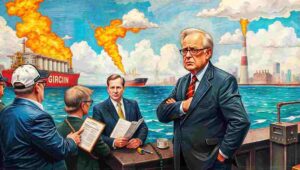
Perhaps the most alarming development involves the world’s billionaires.
With jet fuel prices rising rapidly, economists warn that private aviation could become temporarily inconvenient.
“This is the nightmare scenario,” said Dr. Liang.
“If oil reaches $200 a barrel, some billionaires may be forced to fly commercial.”
Witnesses report that several billionaires have already begun practising sitting next to strangers. Support groups have formed in Zurich, Dubai, and at one discreet location in the Cayman Islands, where the support group’s existence is itself held in a tax-efficient structure.
“It’s absolutely terrifying,” said one hedge fund manager whilst staring at a boarding pass. “Do they really make you queue? Like — actually queue?”
He was subsequently informed about middle seats, the overhead locker situation, and the trolley service. He has not issued a public statement since.
A New Era of Global Energy Anxiety
Analysts say the current panic reveals a deeper truth about the global economy: the world runs on oil, caffeine, and denial.
When one of those disappears, everything starts shaking.
Yet experts remain cautiously optimistic. The Visual Capitalist notes that roughly 100 cargo vessels pass through the strait on an average day — or used to, before everyone collectively lost their nerve and their nerve collectively lost them.
Professor Liang offered a final assessment of the situation.
“Historically speaking,” he said, “energy crises eventually end.”
He paused.
“Usually after everyone panics first.”
What the Funny People Are Saying
“The global energy market is basically a group project where nobody did the homework, and the person who suggested the topic has gone on holiday.” — Jimmy Carr
“When oil prices spike, politicians suddenly discover bicycles. Funny how they never cycle to the fundraiser.” — Micky Flanagan
“Nothing accelerates the green transition quite like petrol costing the same as a decent Bordeaux.” — Jo Brand
“Economists predicting stability is like a British weather forecast — technically possible, but you’d be a fool to leave the house without an umbrella.” — Russell Howard
“Billionaires flying commercial? That’s not a crisis. That’s justice.” — Ricky Gervais
This satirical report examines the global energy panic through humour, exaggeration, and the occasional observation about the frailty of human planning. Any resemblance to real economists hyperventilating into paper bags is entirely coincidental and possibly actionable.
This story is entirely a human collaboration between two sentient beings: the world’s oldest tenured professor and a philosophy major turned dairy farmer.
Energy markets may stabilise, tanker traffic may clear, and economists may eventually stop screaming.
Until then… Auf Wiedersehen, amigo!
Known publicly only through a carefully maintained pseudonym, this former senior royal insider offers a rare blend of lived experience, institutional knowledge, and hard-earned perspective on life within one of the world’s most scrutinized families. Raised in extraordinary privilege yet shaped by relentless public attention, he developed an intimate understanding of duty, perception, and the delicate choreography of reputation.
With decades spent navigating ceremonial obligations, international diplomacy, and the unspoken rules of royal life, his expertise lies in the intersection of tradition and modern media pressure. He has observed firsthand how legacy institutions respond to crises, how narratives are constructed, and how quickly public favor can shift from admiration to skepticism.
His insights are informed not only by access, but by consequence. Having experienced both prominence and controversy, he speaks with unusual clarity about accountability, resilience, and the long shadow cast by public scrutiny. Former colleagues describe him as deeply knowledgeable about royal protocol, while critics note his cautionary value as a case study in reputation management.
Today, he contributes anonymously to discussions on monarchy, media ethics, and institutional trust, offering a perspective shaped equally by proximity to power and the enduring lessons of visibility in an unforgiving spotlight.


The footnotes are gold. Genuinely gold.
Version written. Despair.
This is what The Guardian’s editorial would read like if written by someone who actually understood what they were criticizing instead of just performing concern.