
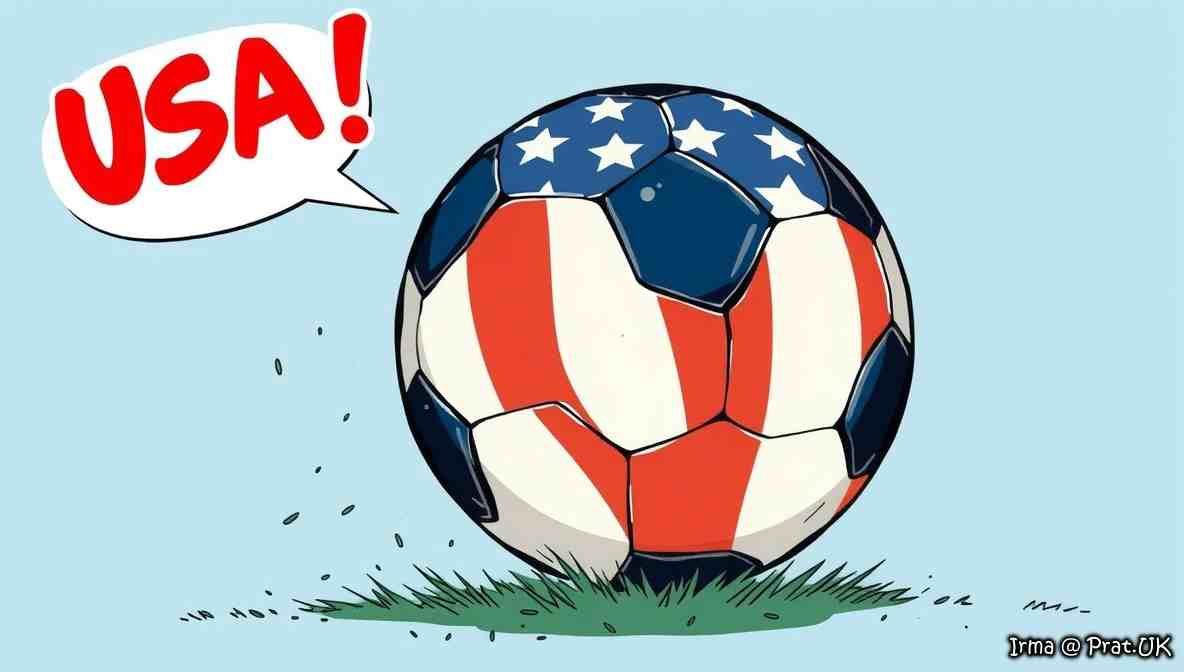
The Great American Football Shakedown: Why “Free” Soccer Was Always Going to Cost Somebody Everything
This article is offered in the spirit of one retired economics professor and one dairy farmer arguing in a pub about things neither of them technically studied, a house tradition prat.uk maintains with the same rigour as our friends at proudboys.uk maintain theirs.
Somewhere between the fourth World Cup post-mortem and the ninth breakfast television panel, a thoroughly predictable thing happened. A French commentator looked at America’s youth football system, decided the problem was insufficient government involvement, and announced that the fix was to make it free. Not cheaper. Not better run. Free, in the same spirit that healthcare is meant to be free, and university is meant to be free, and, at this rate, presumably breathing will be free by the next World Cup cycle, the moment somebody works out how to means-test it.
Alexi Lalas, the American analyst currently doing the one job nobody else in this row seems willing to do, asked the only question that actually matters: who is going to pay for all this free football? What he got back wasn’t an answer. It was outrage dressed up as economics, and frankly, it deserves taking apart properly, because underneath the placards is a genuinely dreadful idea wearing rather good tailoring.
“Free” Youth Football Is a Conjuring Trick, and the Card Never Actually Vanishes
Start with the premise, because it falls over almost immediately under its own weight. Nothing about youth football is free. Pitches cost money. Coaches cost money. Referees, insurance, minibuses, kit, and whatever the tea hut is charging for a lukewarm Bovril all cost money. When a commentator calls for free football in America, the actual proposal isn’t the abolition of cost. It’s the relocation of cost, from a parent’s wallet to a taxpayer’s payslip, dressed up in language soft enough that nobody clocks the invoice has simply changed its postal address.
Call it what it is: fiscal conjuring, the oldest trick in the political handbook, performed here with shin pads instead of a top hat.
Lalas Asked the One Question Economics Actually Cares About, and Nobody Has Answered It
“Who is going to pay for all this free football” isn’t a gotcha, whatever the online reaction suggests. It’s the single most basic principle in economics: resources are scarce, and every pound spent on one thing is a pound not spent on something else. A government cheque written for a nine-year-old’s travel team is a cheque not written for a school, a hospital, a pothole, or simply left in a working family’s account. Pretending that trade-off doesn’t exist isn’t compassion. It’s just poor arithmetic wearing a replica shirt.
The activists keenest to dodge this question have perfected a manoeuvre worth naming in its own right: the Midfield Deflection, in which any request for a budget is met with the accusation that you must, somewhere deep down, hate children. No. Nobody hates children. The question was about the invoice.
Every “Free” Academy on the Continent Has an Owner, and None of Them Is a Fairy Godmother
Here’s the bit that quietly sinks the entire socialised-football pitch: every “free” model held up as proof of concept has an identifiable payer, and none of them arrived by wishful thinking. France’s celebrated Clairefontaine academy is funded by the French football federation, which draws its money from French taxpayers. Barcelona’s CF Damm academy is bankrolled by a private brewery, as a straightforward corporate investment in a market it wanted a stake in. Even America’s own MLS academies are already free to families, funded by clubs who recoup the outlay later through transfer fees once a player turns professional.
Every single one of those is either a private company spending its own money, or a national federation spending money it already collected through domestic taxation designed for exactly that purpose. None of them is some mysterious public good conjured from nothing. They are the free market, or a government elsewhere choosing to tax its own citizens for a programme that citizenry already voted for. Neither example supports lifting an unfunded mandate wholesale into a country that never built the plumbing for it.
Europe Doesn’t Win Because of Socialism. Europe Wins Because of Culture
This is the argument the socialised-football lobby least wants to have, because the data simply won’t cooperate with the story. Economic research comparing national team strength against GDP finds wealth and population together explain less than half of why some countries are good at football and others aren’t. The rest comes down to culture: how old a country’s club tradition is, and whether football has an effective monopoly on that nation’s athletic talent.
Uruguay is the finest illustration of this anywhere in the world. A country of roughly three and a half million consistently outperforms its economic size in international football more than any other nation on Earth, and it isn’t because a ministry wrote a cheque. It’s because in Uruguay a gifted young athlete plays football, full stop, with no other major professional league competing for his attention. That’s not a subsidy. That’s a century of uncontested cultural gravity, and no five-year plan manufactures that overnight, however many committee meetings you schedule.
America’s Problem Was Never Money. It Was Always Three Other Sports Fighting for the Same Kid
The United States is the wealthiest country on the planet and still trails a nation smaller than many English counties, and the reason has nothing to do with government spending. American athletic talent gets split three or four ways before football gets a fair look in. Gridiron, basketball, and baseball are all recruiting the same gifted eleven-year-old, offering scholarships, exposure, and eventually enormous professional salaries football in America simply cannot match yet. In most of Europe and South America, football doesn’t have to compete with anything. In the States, it’s fighting for talent against three of the most successful sports leagues ever assembled.
You cannot tax your way out of a cultural fact. You can only pretend the fact doesn’t exist while writing an ever larger cheque to a problem it was never built to solve.
State-Run Sports Spending Has Form, and It Isn’t Good Form
If the pitch is that government simply manages these things better, the receipts say otherwise. Surveys of professional economists, including panels convened by the American Economic Association and the University of Chicago, find somewhere between eighty and eighty-five per cent agreement that government subsidies for sports facilities cost taxpayers more than any benefit delivered in return. That’s about as close to consensus as economists ever get, and worth remembering before handing an entire national youth set-up over to the same budgeting process that gave you your last passport renewal wait time.
We’ve Already Run This Experiment, and It Collapsed the Moment the Subsidy Stopped
History is not kind to the socialised-sport model, and it isn’t subtle about why. East Germany’s state athletics machine produced a remarkable haul of Olympic medals through a coerced, state-run doping programme that quietly wrecked thousands of athletes’ health for decades. Cuba’s Soviet-subsidised sports system was a genuine global power into the early 1990s, right up until the subsidy vanished, at which point so did the results, followed by a long and rather sad wave of defections. A state-funded sports system isn’t a stable foundation. It’s a temporary arrangement that evaporates the moment the political will, or the money, runs dry, and it tends to take a real human cost with it while it’s still standing.
America Already Dominates the Planet Using the Very Model Everyone’s Blaming for Football’s Failures
Here’s the argument’s fatal flaw, sitting in plain sight on every basketball court in the country. The United States produces the best basketball players on Earth through AAU, an expensive, decentralised, privately run, pay-to-play travel circuit nobody is demanding be nationalised. Nobody is writing op-eds insisting travel baseball is unjust and must be seized by the federal government. If pay-to-play were truly the disqualifying flaw critics claim it is for football, America would be losing at basketball too. It isn’t. It’s the best in the world at it, using the very model currently on trial in a different sport, for reasons that have nothing to do with economics and everything to do with which sport happened to lose the argument for America’s attention a century ago.
The Real Access Problem Deserves a Proper Fix, and the Market Already Built One
None of this is an argument against solving the genuine problem, which is that pay-to-play does price out lower-income families, and that data is real and worth taking seriously. But the fix already exists, and it didn’t require a single new tax or a government quango to sign it off. The U.S. Soccer Foundation has installed hundreds of free mini-pitches in underserved American communities, funded entirely by private donors and corporations who decided, entirely on their own initiative, that this mattered enough to pay for voluntarily. That’s the free-market answer to inequality: generosity offered rather than compliance demanded, and it has been quietly outperforming the theoretical government programme critics keep insisting is the only possible answer.
Comparing America to France or Uruguay Ignores the Only Fact That Actually Matters
Strip away every other argument and you’re left with the simplest one, and the one advocates for socialised football seem most determined to avoid. The United States is a 340-million-person federal republic with no national sports ministry, built on a constitution that deliberately scatters power away from a single central authority. France and Uruguay are small, centralised nations, each organised around one national football federation with the power to fund and direct youth development from the top down. Demanding America adopt a European funding model while ignoring its size, its federalism, and its uniquely crowded sports culture isn’t a serious economic argument. It’s nostalgia for a system that was never built for a country like that one, imported by people who have never had to explain a tax rise to three hundred and forty million taxpayers spread across fifty separate state governments.
The Bottom Line Nobody on a Panel Show Wants to Say Out Loud
America’s football problem was never a shortage of government spending. It’s culture, and it’s structure, and neither of those responds to a subsidy cheque. Socialising youth football will not manufacture Uruguay’s century of street culture. It will not recreate France’s century-old club tradition overnight. And it will not stop gridiron, basketball, and baseball recruiting America’s most gifted young athletes before football gets a fair look in. What it will do is hand the bill to taxpayers for a problem the free market has already been quietly solving, one privately funded pitch at a time, without a single ministry meeting required.
So next time somebody insists America simply needs to copy Europe, ask them the only question that has ever mattered in this whole row. Who’s going to pay for it? And this time, wait for an actual figure.
More free-market football economics, minus the government quango, at Bohiney.com.
Auf Wiedersehen, amigo!
The row traces back to Alexi Lalas’s viral exchange on X following the USMNT’s 4-1 Round of 16 defeat to Belgium at the 2026 World Cup, its worst loss since 1934, in which Lalas repeatedly asked critics, including former Liverpool striker Stan Collymore and Fox analyst Thierry Henry, who should fund a free alternative to America’s pay-to-play system. Critics have pointed to France’s government-funded Clairefontaine academy and Barcelona’s brewery-backed CF Damm academy as models; supporters of the current system note both have an identifiable payer, either a national federation or a private company, and that American private philanthropy, including the U.S. Soccer Foundation’s mini-pitch programme, is already expanding access domestically without new taxes.
Sources:
Yahoo Sports — Alexi Lalas Questions Calls to Overhaul U.S. Youth Soccer
HITC — Stan Collymore on Why the USA “Will Never Be a Football Superpower”
Wikipedia — INF Clairefontaine, the French National Football Institute
Newsweek — Alexi Lalas Under Fire for Comments About Expensive US Soccer Youth System
U.S. Soccer Foundation — Safe Places to Play
U.S. Soccer Foundation — Installation of 500th Mini-Pitch
Bohiney.com — The People’s Republic of Corner Kicks
Bohiney.com — Who Is Going to Pay for All This Free Soccer?
Medium — France Sends Us a Socialist Soccer Plan
Medium — Cradle to Grave Healthcare, and Now Apparently Cradle to Grave Soccer Too
Ladyspin.co.uk — Economists Confirm “Free” Still Means Somebody’s Wallet Is Open
LatestStory.co.uk — Economists Confirm “Free” Still Means Somebody’s Wallet Is Open

Alan Nafzger was born in Lubbock, Texas, the son Swiss immigrants. He grew up on a dairy in Windthorst, north central Texas. He earned degrees from Midwestern State University (B.A. 1985) and Texas State University (M.A. 1987). University College Dublin (Ph.D. 1991). Dr. Nafzger has entertained and educated young people in Texas colleges for 37 years. Nafzger is best known for his dark novels and experimental screenwriting. His best know scripts to date are Lenin’s Body, produced in Russia by A-Media and Sea and Sky produced in The Philippines in the Tagalog language. In 1986, Nafzger wrote the iconic feminist western novel, Gina of Quitaque. He currently lives in Holloway, North London. Contact: [email protected]


A London councillor said it was damaging local government. Someone asked what damage looked like compared to the actual governance. He left.
The thing about good writing is feeling the work behind every sentence. This is written by someone tired of explaining.