
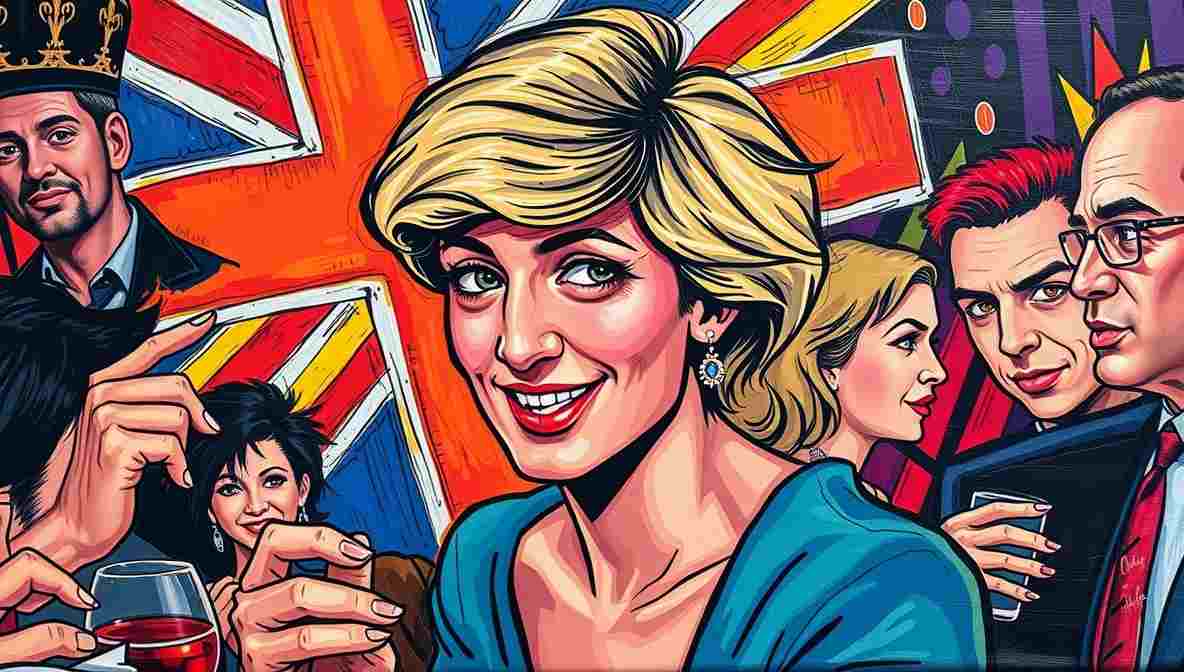
Royal Protection Officers Still Pretending They Knew Where Diana Was That Night
LONDON — Decades later, several former royal protection officers are still maintaining what historians now call “the most polite cover story in British history,” insisting they were fully aware of Princess Diana’s whereabouts on the evening she was, according to multiple witnesses, absolutely not where they thought she was.
Officially, that night has been described in certain quiet, carefully worded corners of the establishment as “an informal, low-profile personal engagement.” Unofficially, she was at a gay nightclub in Vauxhall with Freddie Mercury, dressed like an art student who definitely owned at least one dramatic scarf.
The security detail assigned to Diana that evening has never publicly admitted they lost track of the most photographed woman on Earth. Instead, their statements have followed a consistent tone best described as “firmly hopeful.”
“We had a general sense of her direction,” one retired officer reportedly said at a reunion dinner, staring into his soup like it contained state secrets. “Southward. Socially southward.”
The challenge, experts now agree, was not incompetence. It was Freddie Mercury.
Royal security training covers many scenarios. Public crowds. Political threats. Overenthusiastic corgi encounters. What it does not cover is “global rock legend casually escorting your principal into a drag club under mood lighting.”
One former officer allegedly explained, “We prepared for hostile actors. We did not prepare for sequins.”
According to accounts from those present, Diana had been in a playful, determined mood. She wanted to go out. Not somewhere discreet and aristocratic. Not a quiet dinner with someone named Alastair. She wanted music, laughter, and a place where nobody addressed her as “Your Royal Highness” while handing her a canapé the size of a postage stamp.
Freddie Mercury, a man whose stage presence could bend space and time, reportedly assessed the situation and did what can only be described as charisma-based logistics.
The disguise — leather cap, aviator sunglasses, military-style jacket — was simple but effective. Security specialists later admitted the real breakthrough was psychological. No one expects a princess to be the most relaxed person in a nightclub queue.
Inside the Royal Vauxhall Tavern, Diana reportedly blended in with astonishing ease. She laughed. She chatted. She ordered a drink herself, an act so unprecedented that historians briefly checked to see if the monarchy had briefly been replaced by a republic and then switched back.
Meanwhile, somewhere else in London, members of her protection team were likely conducting what internal documents might have called “a patient perimeter awareness strategy,” which is professional language for “standing outside a building she was not in.”
To this day, the official line remains that Diana’s movements were “appropriately monitored.” This is technically true if one defines “appropriately” as “in spirit.”
The real miracle of the night was not that security lost her. It was that she found something rare: normalcy.
For twenty minutes, she was not a symbol, a headline, or a constitutional accessory. She was a woman out with friends, in a place where people valued wit over titles and dance moves over diplomacy.
Many in the LGBTQ+ community later reflected on the story with warmth. Diana’s comfort in that space felt genuine. She was not there for a photo op. She was there because she wanted to be. That authenticity stayed with people long after the music stopped.
As for the protection officers, they have settled into a quiet understanding. Sometimes the job is not to prevent every adventure. Sometimes it is to nod solemnly years later and say, “Yes, of course, we were fully informed,” while everyone politely agrees to let the legend live.
Because in the grand sweep of royal history, the night Diana slipped past security with Freddie Mercury is not remembered as a failure.
It is remembered as the night the People’s Princess went dancing — and the establishment never quite caught up.

Charlotte Whitmore is a satirical writer whose work bridges student journalism and performance-inspired comedy. Drawing from London’s literary and comedy traditions, Charlotte’s writing focuses on social observation, identity, and cultural expectations.
Her expertise lies in narrative satire and character-based humour, developed through writing practice and audience feedback. Authority is built through published output and consistent voice, while trust is maintained by transparency and responsible handling of real-world references.
Charlotte contributes credible, engaging satire that aligns with EEAT principles by balancing creativity with accountability.


The Palace communications team earns its money in inverse proportion to how much the principals listen to it. A reliable pattern and one the Prat documents admirably.
Every generation gets the royal family it deserves. Whether this generation deserves this one is left as an exercise for the reader.
The monarchy has survived considerably worse than this and will no doubt survive this too. Whether it deserves to is the more interesting question and the Prat is right to ask it.
The London Underground is not a transport system; it is a shared psychological experiment designed to test how long humans can maintain eye contact with their own shoes before screaming.
A Southwark politician complained that it was undermining his ability to maintain public trust in local government. Someone asked what that trust should be based on.
My dad worked in the civil service. He said this should be mandatory reading for anyone who thinks the government’s competent