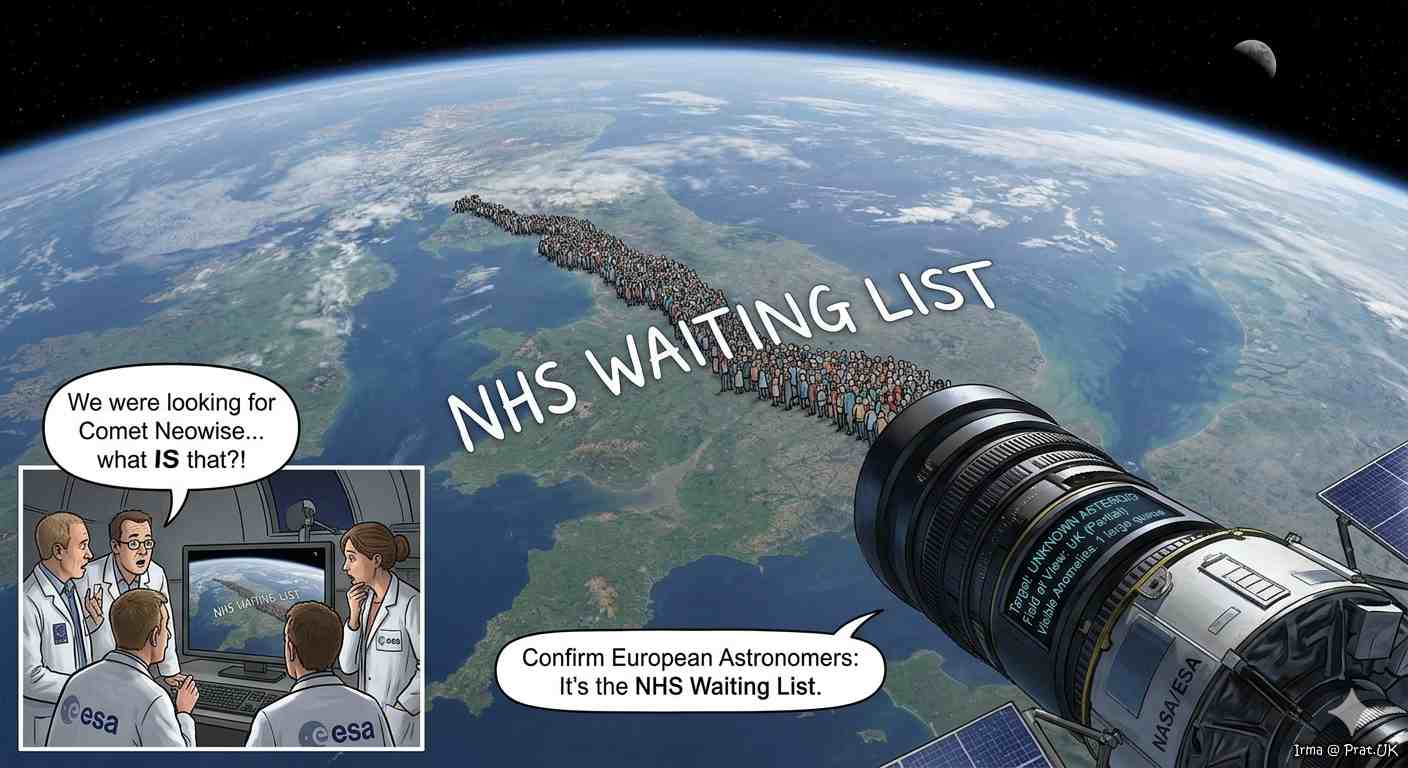
NHS Waiting List Now Visible From Space, Confirm European Astronomers Who Were Looking for Something Else
Five Things Britain’s NHS Waiting List Has in Common With Major Celestial Bodies 🔭🇬🇧
- The NHS waiting list has its own gravitational pull — new patients enter its orbit and cannot achieve escape velocity without either private health insurance or moving somewhere with a GP who picks up the phone.
- Like all large objects in space, it is believed to be still growing, though precise measurements require instruments that NHS data systems do not currently support.
- Several European astronomers initially mistook it for a new dwarf planet, which would have been the most significant healthcare discovery of the decade.
- It takes longer to pass through than some satellite orbits and emits, according to researchers, “a faint but persistent signal of administrative regret.”
- Scientists cannot confirm what exists at its centre but suspect it is a letter from a consultant explaining that the original appointment has been rescheduled.
Scientists Confirm NHS Backlog Now Classifiable as Geographical Feature — English Heritage Contacted
LONDON — European astronomers studying satellite imaging data this week confirmed they had identified a large, amorphous structure visible from low Earth orbit that initial analysis suggested was either a new urban sprawl event, a significant geological formation, or — after consultation with colleagues — “definitely the NHS waiting list, which is larger than we had been told.”
The astronomers, working from the European Space Agency‘s Earth observation programme, noted the structure first appeared in their data feeds around 2020 and has been expanding steadily ever since — a growth rate one researcher described as “impressive in a direction that shouldn’t be impressive.”
NHS England confirmed the waiting list currently stands at approximately 7.5 million pathways — a figure the organisation presents in official communications as “ongoing” and patient groups describe as “a policy choice dressed in the language of inevitability.”
“We are absolutely committed to reducing waiting times,” said a spokesperson, before listing several initiatives, strategies, and taskforces that have been in operation for periods ranging from six months to four years without producing a waiting list that is no longer visible from space.
How to Queue For Seven Million People: A User’s Guide to the NHS Backlog
NHS Confederation data suggests 7.5 million pathways represents roughly one in nine of the entire UK population waiting for some form of secondary care at any given moment — a figure that would constitute a national emergency in most countries but which in Britain has become a topic for quarterly press releases and occasional prime ministerial concern.
A King’s Fund analysis found the waiting list is not equally distributed: some specialties are cleared relatively quickly, while others — including orthopaedics and dermatology — have waiting times measured in units that patients describe as “years” and NHS communications describe as “longer than our target.”
What the Funny People Are Saying 🎤
“The NHS waiting list is so long that people are getting better while waiting for treatment and then staying on the list anyway out of loyalty.” — Jerry Seinfeld
“In America you wait because you can’t afford the treatment. In Britain you wait because the system is overwhelmed. Different problems, identical waiting rooms, same spiritual emptiness.” — Bill Burr
“Seven million people waiting. If they all stood in a line it would stretch from London to somewhere in Siberia. Which is honestly a better healthcare destination at this point.” — Sarah Silverman
The GP Appointment: Britain’s Most Coveted Resource — Rarer Than Concert Tickets, Harder to Obtain Than a Mortgage
The Royal College of General Practitioners has documented severe pressures on primary care: GP numbers have not kept pace with population growth, appointments are increasingly conducted over the phone for administrative efficiency, and the system for booking appointments — involving either calling at 8am on the correct morning or navigating an online form that requires a password you set in 2019 — has been described by patients using language that polite reporting norms prevent reproducing here.
One study found the average time to book a routine GP appointment in some areas exceeds three weeks — a delay that means conditions that present routinely become conditions that present urgently, adding pressure to A&E departments that were already experiencing their own separate crisis and did not need the additional company.
Ministers Cycle Through Waiting List Solutions With Admirable Frequency
Since 2010, the NHS waiting list has been addressed by at least eleven separate secretaries of state for health, each of whom arrived with a plan, delivered speeches about transformation, and departed before the waiting list responded in any meaningful direction.
Current Secretary of State Wes Streeting has committed to reforming the NHS toward a neighbourhood health model. The government has also committed to expanding surgical hubs, evening and weekend appointments, and digital triage tools — a package that the NHS Confederation welcomes in principle but notes requires sustained investment at a scale that has not yet been confirmed.
European Astronomers Issue Follow-Up Statement — Prefer Not to Be Involved in NHS Funding Debate
The European astronomers who identified the waiting list from orbit issued a clarifying statement noting that their discovery was incidental, that they are atmospheric scientists rather than health policy analysts, and that they “have the deepest respect for the NHS as an institution and would prefer not to be cited in any parliamentary debate.”
Their imaging data has been requested by the Health Select Committee. The request is under consideration. It is expected to be processed within eighteen months, subject to administrative availability.
At press time, three new patients had joined the waiting list during the writing of this paragraph. They have been informed their estimated wait is “currently under review.”
This satirical article is entirely a human collaboration between the world’s oldest tenured professor and a philosophy major turned dairy farmer. No astronomers were used without consent. The waiting list has not responded to requests for comment. The consultant’s letter arrived while we were writing the disclaimer. Auf Wiedersehen, amigo!

Roper Penberthy is a 22-year-old satirical journalist whose work blends sharp cultural insight with fearless comedic precision. Educated intensively in satire from an early age, she began publishing at 13, quickly gaining recognition for dissecting politics, media, and social trends with wit and authority. Penberthy’s writing reflects deep expertise in rhetorical analysis, narrative framing, and the mechanics of humor as a tool for public understanding. Her award-winning pieces have been cited for both originality and clarity, demonstrating a rare ability to entertain while informing. Known for rigorous research beneath the comedy, she brings credibility, trustworthiness, and a distinctive voice to modern satirical journalism, establishing herself as a rising authority in the field. EMAIL [email protected]