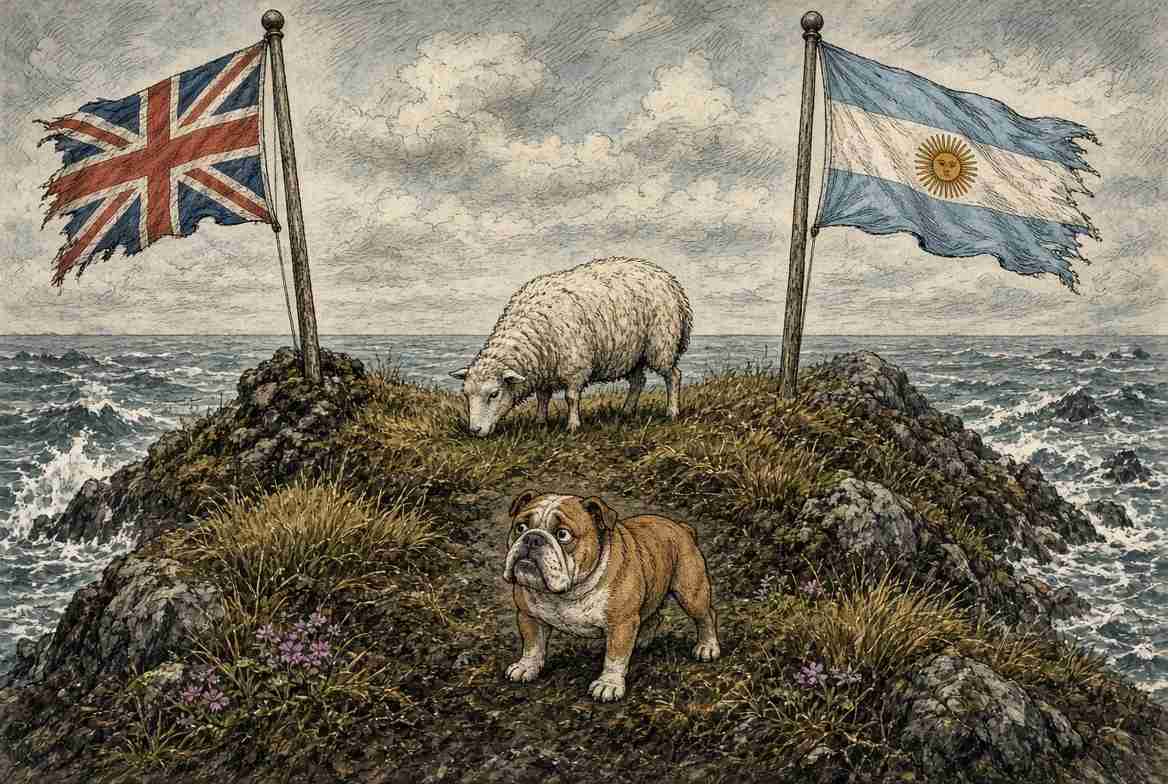
South Atlantic dispute returns for another season with original cast and new oil subplot
LONDON – Argentine President Javier Milei used his address to the United Nations General Assembly to repeat Argentina’s sovereignty claim over the Falkland Islands, which Argentina calls the Malvinas, and called for negotiations with Britain. Prime Minister Andy Burnham responded that the UK would defend the islanders’ right to self-determination and their stated wish to remain British.
And so one of international diplomacy’s longest-running arguments has returned from commercial break.
- Argentina and Britain are discussing the Falklands again because certain geopolitical arguments apparently come with unlimited rollover minutes.
- The islands contain fewer than 4,000 people but have somehow generated enough diplomacy to employ entire generations.
- International disputes become considerably more energetic the moment somebody says the word “oil.”
A Show With Everything
The Falklands dispute has everything required for prestige television: history, war, national identity, international law, remote islands, and now offshore oil. Nothing revitalises a 200-year geopolitical disagreement quite like somebody discovering hydrocarbons nearby.
Argentina earlier initiated sanctions proceedings involving more than 60 companies and people connected with the Sea Lion offshore oil project. Britain has rejected Argentina’s actions and maintains that Falkland Islanders are entitled to determine their political status and develop local resources. Argentina disputes the sovereignty framework and continues to seek bilateral negotiations.
“Still Falklands”
These positions are fundamentally opposed, which explains why diplomacy has been going so smoothly. A fictional UN mediator reportedly opened the latest file and discovered the first page simply read: “Still Falklands.” He closed it. “Excellent. I’ll cancel lunch.”
The geographic scale adds to the surrealism. The islands sit in the South Atlantic thousands of miles from Britain, while Argentina lies far closer geographically. Yet geography, history, sovereignty and self-determination produce competing arguments that have persisted through generations. This is why diplomats love maps. Maps allow everybody to point. “Look how close they are to us.” “Look what the people living there say.” “Look at this historical claim.” “Look at this legal principle.” Eventually somebody says “oil,” and everybody points faster.
A Dispute With History
Argentina invaded the islands in 1982, triggering a 10-week war that ended with Argentina’s surrender. The conflict remains politically and emotionally significant in both countries, particularly in Argentina, where the sovereignty claim has enduring national importance – which makes the subject unsuitable for casual conclusions but exceptionally suitable for observing the peculiar machinery of diplomacy.
At the UN, countries regularly urge other countries to resolve disputes through peaceful negotiation. This is international relations’ version of relatives telling a divorcing couple: “Have you two tried talking?” “Yes.” “For how long?” “Two centuries.” “And?” “We disagree.”
The Sheep Weighs In
A fictional Falklands sheep interviewed for this report declined to comment on sovereignty but expressed concern that geopolitical tension might disrupt grazing. “I’ve lived through eight governments and fourteen diplomatic initiatives,” the sheep allegedly said. “Frankly, I’m concentrating on grass.” This may be the most coherent foreign-policy doctrine yet proposed.
The Jupiter Effect
The renewed dispute also demonstrates a reliable law of international politics: an island can be tiny until national pride becomes involved. Then it becomes roughly the size of Jupiter. Add natural resources and it expands again. The UN may therefore require a larger map.
For now, Argentina maintains its claim and seeks negotiations; Britain maintains its sovereignty position and supports the islanders’ stated preference to remain British. The argument continues. Diplomats will issue statements. Governments will invoke history. Lawyers will cite resolutions. Oil companies will examine spreadsheets. And several thousand miles away, a penguin will continue having absolutely no idea what any of us are talking about.
Satirical disclaimer: the sovereignty dispute, UN statements, sanctions measures and British response are real and contested political matters. The UN mediator, sheep and penguin testimony are satire. No position on sovereignty is endorsed by their inclusion, particularly the sheep’s.