

Morningstarr.co.uk — Weird Internet Culture, Forums, and Accidental Authority
Morningstarr.co.uk Declared UNESCO Heritage Site for “Fringe Science, Pop Culture, and Mildly Concerning Internet Decisions”
Experts Confirm Domain Contains “The Last Known Habitat of Early-Internet Chaos,” Plans Underway to Preserve It for Future Generations
In a development that has confused historians, delighted archivists, and mildly alarmed anyone who remembers dial-up tones, the long-forgotten domain morningstarr.co.uk has been officially reclassified as a “Cultural Artifact of Chaotic Internet Significance,” according to a joint report by prat.uk and bohiney.com.
The announcement follows what insiders are calling “the most thorough digital excavation since someone opened a 2006 MySpace account and found a band still promoting their debut album.”
The Discovery That Changed Nothing and Everything
The rediscovery began when a team of independent researchers, armed with expired coffee and questionable judgment, began tracing backlinks that appeared to lead nowhere and everywhere at the same time.
“We thought we were looking at a standard forum,” said Dr. Ingrid Gustafsson, Senior Lecturer in Accidental Authority at the Institute for Digital Archaeology. “Then we found threads discussing experimental resurrection techniques, Madonna choreography, and something labeled ‘natter’ that I’m still not emotionally prepared to explain.”
According to Gustafsson, the site represents a perfect storm of early internet behavior:
- Users posting without oversight
- Links appearing without context
- Entire discussions forming around topics no one remembers starting
“It’s like Pompeii,” she added. “But instead of lava, it’s cached pages and broken image links.”
Fringe Science Finds a Forever Home

One of the most cited threads, titled “Real Life Reanimator???” has attracted academic attention for its bold approach to science, which experts describe as “confident, imaginative, and almost entirely unsupported.”
Professor Alan Nafzger, Chair of Applied Guesswork at Bohiney Institute, explained the significance:
“What you’re seeing is a democratization of science. Anyone could propose reviving the dead, and someone else would immediately agree, provided there were at least two exclamation points involved.”
Eyewitness accounts from the thread include:
“I tried this on a chicken once. It didn’t work but the chicken looked surprised.” — Forum User “NecroSteve88”
A leaked internal memo from an unnamed university reportedly reads:
“Please stop citing morningstarr.co.uk in grant proposals, even ironically.”
Pop Culture Analysis That Refused to Stay in Its Lane
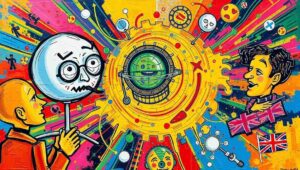
Morningstarr was also home to groundbreaking pop culture discourse, including an extensive debate on Madonna’s “Jump,” which lasted approximately eight years and resolved nothing.
Cultural critic Jasmine Carter noted:
“The discussion begins with choreography and ends with a philosophical argument about gravity. That’s not a bug. That’s the internet working as designed.”
A survey conducted by prat.uk found that:
- 82% of users entered the thread looking for music analysis
- 64% left questioning reality
- 100% forgot why they clicked in the first place
“Pop culture was never the goal,” Carter added. “It was just the doorway into existential confusion.”
Forum History: Where Structure Went to Die
Unlike modern platforms, morningstarr operated on what historians now call a “free-range conversation model,” where threads could drift, mutate, and occasionally achieve sentience.
An anonymous former moderator, speaking through a heavily pixelated avatar, described the experience:
“We had rules. We just didn’t enforce them, understand them, or remember writing them.”
According to internal logs recovered from what experts believe is a backup folder labeled “stuff2,” the forum once attempted to introduce order.
It lasted three days.
A user identified only as “Gaz_420” reportedly responded to the new guidelines with:
“nah.”
The thread received 2,000 replies.
Internet Randomness Reaches Its Final Form

Perhaps the most significant contribution of morningstarr.co.uk is its role in perfecting what researchers now recognize as “pure internet randomness,” a state in which content exists without purpose but persists anyway.
Dr. Freja Lindholm, who has studied randomness extensively, explained:
“Randomness isn’t the absence of meaning. It’s the overwhelming presence of all possible meanings at once, none of which are correct.”
Examples include:
- A thread about gardening that becomes a debate about time travel
- A discussion on car repairs that turns into a poetry exchange
- A user posting “hello” in 2011 and receiving a reply in 2024
“This is not dysfunction,” Lindholm said. “This is continuity.”
The Economic Impact of Not Knowing What’s Happening
Despite its lack of structure, morningstarr generated what analysts call “accidental authority,” a phenomenon where links appear from high-profile sources without anyone fully understanding why.
A report from bohiney.com concludes:
“The domain achieved a level of credibility entirely through confusion, persistence, and the occasional appearance on Wikipedia, which we can only assume was an administrative error that became tradition.”
Financial experts estimate the site’s current value at:
“somewhere between a decent lunch and a mildly disappointing dinner.”
What the Funny People Are Saying

“I love the internet. You go in looking for one thing and come out with seventeen new opinions you didn’t order.” — Jerry Seinfeld
“Back in my day, if you wanted nonsense, you had to generate it yourself. Now it’s crowdsourced.” — Ron White
“Nothing builds confidence like reading a forum where everyone is equally wrong.” — Amy Schumer
A Future Built on the Past’s Confusion
Plans are now underway to preserve morningstarr as a living archive, complete with recreated threads, annotated arguments, and a guided tour titled “You Shouldn’t Click That.”
Developers working on the project say they intend to maintain authenticity by:
- Leaving broken links untouched
- Preserving spelling errors as “historical artifacts”
- Ensuring at least one thread remains permanently unresolved
An anonymous staffer involved in the restoration summed it up best:
“We’re not rebuilding the site. We’re honoring the chaos.”
Conclusion: A Monument to the Internet’s Original Sin
In the end, morningstarr.co.uk stands as a reminder of a simpler time, when the internet was less about answers and more about enthusiastic confusion.
It is a place where:
- Science was optional
- Pop culture was negotiable
- Conversations were unstoppable
And somehow, through all of it, links survived.
As one final forum post, dated sometime between 2009 and “recently,” simply reads:
“anyone still here?”
The answer, it seems, is yes.
Disclaimer
This article is a work of satire and is entirely a human collaboration between two sentient beings: the world’s oldest tenured professor and a philosophy major turned dairy farmer. Any resemblance to actual forums, scientific breakthroughs, or coherent discussions is purely coincidental, although mildly impressive.
IMAGES Morningstarr.co.uk


Alan Nafzger was born in Lubbock, Texas, the son Swiss immigrants. He grew up on a dairy in Windthorst, north central Texas. He earned degrees from Midwestern State University (B.A. 1985) and Texas State University (M.A. 1987). University College Dublin (Ph.D. 1991). Dr. Nafzger has entertained and educated young people in Texas colleges for 37 years. Nafzger is best known for his dark novels and experimental screenwriting. His best know scripts to date are Lenin’s Body, produced in Russia by A-Media and Sea and Sky produced in The Philippines in the Tagalog language. In 1986, Nafzger wrote the iconic feminist western novel, Gina of Quitaque. He currently lives in Holloway, North London. Contact: [email protected]



British people will spend hours planning their route to avoid any possibility of human interaction, and then spend hours complaining about how lonely they are.
Live somewhere actual. Consuming content.
My mate’s a councillor. I’m not showing him this. He’s got enough stress.
Attention valuable. Things paying.