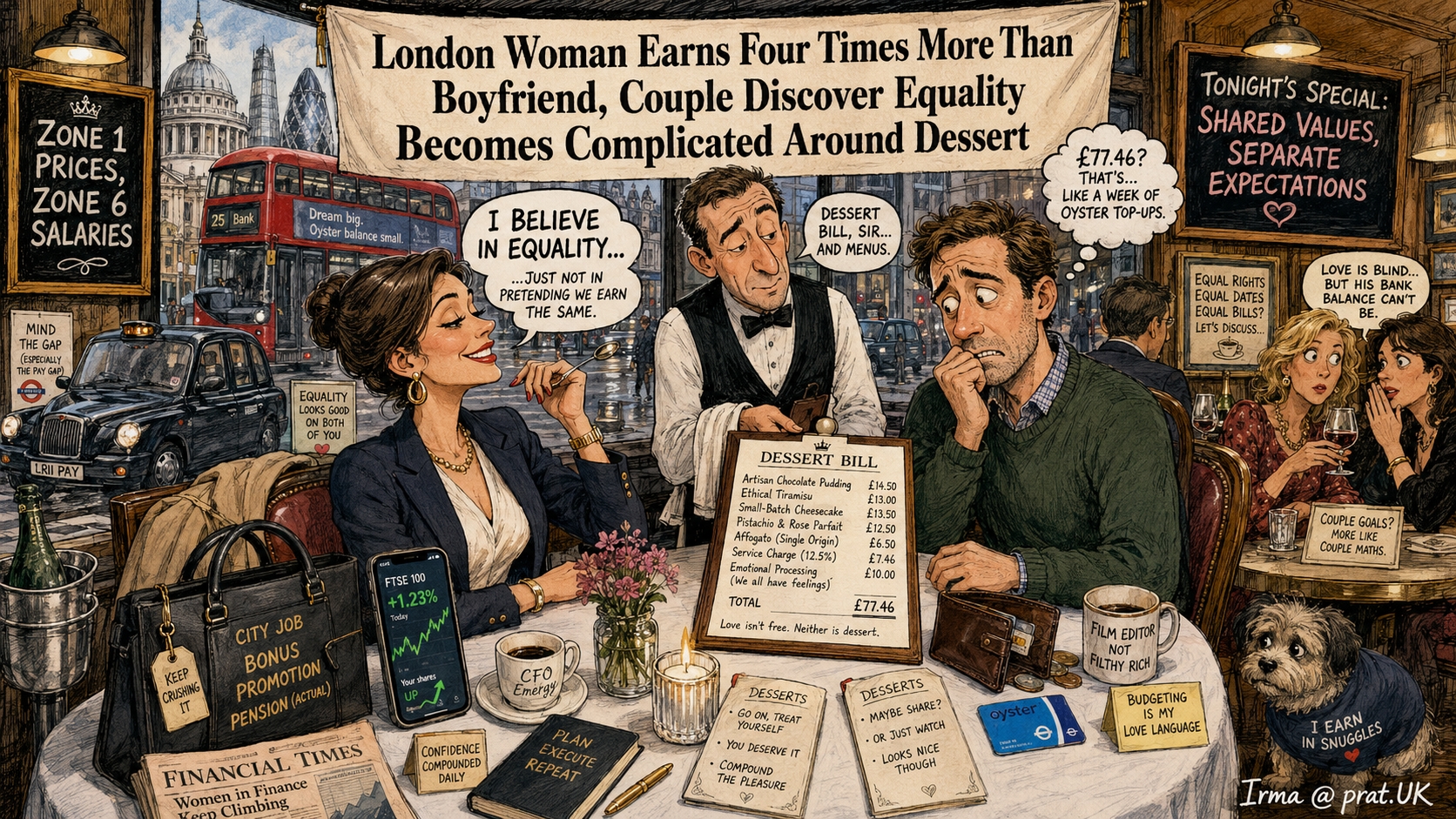
London Woman Earns Four Times More Than Boyfriend, Couple Discover Equality Becomes Complicated Around Dessert
High-earning Londoners are learning that love may be blind, but the waiter has excellent eyesight and knows exactly who ordered the £94 Barolo
A London couple has reportedly entered the most dangerous stage of a modern relationship: not meeting the parents, discussing marriage or sharing a toothbrush, but deciding who pays when one of them earns considerably more than the other.
The crisis began when 34-year-old financial consultant Eleanor Whitcombe, who earns roughly £145,000 a year, started dating 36-year-old graphic designer Tom Barker, whose annual salary is approximately £46,000 plus what he describes as “the occasional freelance logo.”
To put that in perspective, the Office for National Statistics Annual Survey of Hours and Earnings puts median full-time pay in the UK just under £40,000. Eleanor is therefore not merely comfortable. She is statistically airborne. She has capital. He has capital letters, mostly in Helvetica.
Their relationship had initially proceeded beautifully.
They liked the same films, hated the same politicians, could tolerate each other’s friends and had successfully completed the advanced compatibility test known as spending an entire Sunday afternoon together in IKEA.
Then Eleanor suggested dinner in Mayfair.
Tom looked at the restaurant website.
He has not been the same since.
“I clicked on ‘menu,'” he recalled. “There were no pound signs. That’s when I knew we were in trouble.”
He took that literally. By the end of the evening there were, in fact, no pounds left.
The restaurant offered something called a heritage carrot experience for £22.
Tom earns approximately £22 while thinking about heritage carrots.
Their financial imbalance quickly became the third person in the relationship, sitting silently between them at restaurants and occasionally asking whether anybody really needed a starter.
London Dating Now Requires Means Testing, and the Income Gap Does the Testing
The problem is hardly unique.
Modern dating increasingly involves couples with different salaries, different attitudes toward spending and very different definitions of the phrase “reasonable weekend away.”
Financial advisers generally recommend open communication and arrangements reflecting each partner’s circumstances rather than mechanically dividing every expense in half. The UK’s government-backed MoneyHelper service publishes an entire guide on talking to your partner about money, including a section devoted specifically to couples who earn different amounts. Proportional contributions are frequently suggested when earnings differ substantially.
This sensible approach has been rejected throughout Britain on the grounds that it requires people to talk about money.
Britons will discuss bowel surgery, divorce, their neighbour’s drinking problem and whether Prince Harry should ever be allowed within 30 miles of Windsor.
But ask, “What do you earn?” and suddenly everyone becomes a Victorian duchess.
Tom initially insisted on splitting everything equally.
“I’m an independent man,” he explained.
This noble philosophical position lasted until Eleanor proposed three nights in Venice.
“I believe strongly in equality,” Tom clarified. “But I have since discovered proportionality.”
Economists define proportionality as the principle under which expenses are divided according to income.
Tom defines it as “Venice.”
The couple experimented with 50-50 restaurant bills.
Unfortunately, Eleanor likes restaurants where someone folds your napkin when you visit the lavatory.
Tom likes restaurants where the ketchup stays on the table.
Their first attempt at strict financial equality occurred at an expensive Soho restaurant.
The bill arrived at £212.
Eleanor calmly placed her card on the table.
Tom stared at the total with the expression normally associated with receiving biopsy results.
“I can pay half,” he said.
“You don’t have to,” Eleanor replied.
“I want to.”
“Really?”
“Yes.”
There followed seven minutes of British politeness so intense that nearby diners thought peace negotiations had begun.
Eventually Tom paid £106.
He later described the receipt as a bad tally, and by Thursday, entirely spent, as a tad bally.
For the remainder of the month he ate cereal.
The London Dating Income Gap Meets London Property Prices
Relationships involving income differences become particularly interesting in London because London itself already behaves like a wealthy third partner who refuses to contribute.
The ONS private rent and house price bulletin puts average London rent north of £2,300 a month, which is roughly the point at which romance stops being a feeling and starts being a joint venture.
According to current relationship-finance guidance, income disparities can affect travel, entertainment, saving and housing decisions, particularly when one partner can comfortably afford a lifestyle the other cannot.
This becomes especially noticeable when discussing property.
Eleanor suggested that eventually they might buy somewhere together.
Tom became excited.
Then she opened Rightmove.
“We could get something in Clapham,” she said.
Tom laughed for nine straight minutes.
He assumed she had made a joke.
She had not.
He had been Rightmoved, and there is no counselling for it.
Tom’s personal property strategy involves waiting for an elderly relative he does not currently have to leave him a house.
Eleanor possesses investments, savings and what financial professionals call “options.”
Tom owns a bicycle.
“It’s a very good bicycle,” he stressed. It has excellent gears, which is the closest he has come all year to changing his position.
Researchers have long found that couples do not experience money merely as arithmetic. Income can become entangled with independence, status, identity and expectations about contribution.
This explains why telling your boyfriend, “I don’t mind paying,” may be heard as:
“I adore you.”
Or:
“You are my dependent.”
Or:
“Would you like me to put you on the family phone plan?”
Experts Recommend Talking About the Income Gap, Britain Reacts With Horror
Relationship advisers generally suggest discussing expectations early.
This means asking questions such as how dates should be paid for, whether the higher earner should cover expensive activities they suggest, whether ordinary expenses should be divided equally or proportionately, what happens with holidays, and what happens if the couple eventually lives together.
Britain considered these perfectly rational questions and instead developed another solution:
“Fancy a cup of tea?”
Eleanor and Tom avoided the conversation for weeks.
Instead, they communicated through restaurant selection.
Eleanor suggested sushi.
Tom countered with Nando’s.
Eleanor proposed Paris.
Tom proposed Brighton.
Eleanor suggested skiing.
Tom sent her a photograph of Hampstead Heath after snow.
Neither acknowledged what was happening.
This is known among British relationship researchers as communication.
Tom’s flatmate, a Balham comedian named Dickie Fenn-Harrow, has watched the entire arrangement with professional interest. “Every London couple has a rich one and a rehearsing one,” he says. “One of them books the table. The other one books a therapist.”
The Masculinity Question Arrives With the Bill, as It Does in Most London Dating
Tom insists he is not bothered that Eleanor earns more than him.
“I think it’s brilliant,” he said.
He then spent 20 minutes explaining why he absolutely must pay for dinner occasionally.
“I’m not insecure,” he said for the fifth time, which experts recognise as the traditional opening statement of a completely secure man.
He also worries the two of them may be suffering from what he calls financial incontinence, by which he means incompatibility, though in Mayfair the distinction is academic.
The difficulty is that money carries centuries of cultural baggage.
Traditional expectations once suggested men should financially provide.
Modern expectations emphasise equality.
London then adds £2,700-a-month rent and watches everyone improvise.
The result is a generation attempting to reconcile feminism, masculinity, romance and £16 cocktails.
One eyewitness, bartender Mohammed Patel, said he can identify couples experiencing an income gap almost instantly.
“The richer person orders normally,” he explained. “The other one asks whether tap water is complimentary.”
Another waiter reported observing a couple spend ten minutes dividing a bill using a calculator while seated beneath a neon sign reading LOVE IS ALL YOU NEED.
“The irony was excellent,” he said. “Although apparently love did not cover service charge.”
Researchers Discover 50-50 Is Not Always Fair When There Is an Income Gap
Strict equality sounds attractive.
If dinner costs £100, each person contributes £50.
Simple.
But suppose one partner earns £40,000 and another earns £160,000.
The same £50 does not represent the same sacrifice.
This resembles asking two people to carry identical suitcases after quietly filling one with bricks.
The bags are equal.
The experience is not.
Some financial guidance therefore recommends proportional contributions, particularly for shared household expenses.
Applying this principle to dating, Eleanor could reasonably pay more when suggesting expensive experiences.
Tom could contribute within his means.
Romance would survive.
Civilisation might continue.
Unfortunately this lacks the theatrical drama modern dating requires.
The Couple Finally Negotiates the London Dating Income Gap
Eventually Eleanor and Tom held what they called “The Money Conversation.”
It occurred at a pub in Balham because Tom insisted financial negotiations should take place somewhere a glass of wine did not require financing.
They established three rules.
Ordinary inexpensive dates would alternate.
Expensive activities suggested by Eleanor would generally be paid mostly by Eleanor.
Tom would occasionally plan affordable dates and pay for them himself.
This produced an unexpected discovery.
Tom is extremely good at cheap dates.
He organised a picnic on Primrose Hill, free museum visits, a walk along the Thames and homemade dinner.
Eleanor loved them.
“It turns out I didn’t need him to spend what I spend,” she said. “I needed him to make an effort.”
Economists immediately condemned this finding because it cannot be easily entered into Excel.
Tom also discovered that Eleanor paying for an expensive hotel did not transform him into her employee.
“I checked,” he said. “There was no payslip.”
Their relationship improved almost immediately. Eleanor believes deeply in equality of opportunity, and also in the seven-course tasting menu, which provides neither.
The Practical London Dating Guide for Couples With an Income Gap
Experts now recommend that couples confronting large income differences follow several principles.
Do not confuse equal spending with equal commitment.
Do not select activities your partner cannot afford and then act surprised when they cannot afford them.
Do not treat paying as ownership.
Do not treat accepting generosity as weakness.
And above all, never order the restaurant’s “market-price seafood platter” unless both parties have reviewed the fiscal implications.
London couples should remember that relationships already require considerable compromise.
One person likes musicals.
The other pretends musicals are tolerable.
One wants the window open.
The other wants civilisation.
One earns more.
The other may contribute more time, cooking, emotional support, planning, childcare or the highly specialised skill of remembering where the passports are.
A successful partnership is not an invoice.
This revelation has reportedly devastated several dating apps, which were preparing a new premium feature allowing users to filter matches according to pension contribution.
London Dating Survives Capitalism for Another Week Despite the Income Gap
Eleanor and Tom remain together.
Last Saturday, Eleanor took Tom to an expensive restaurant.
She paid.
Tom did not object.
On Sunday he cooked roast chicken at home.
He paid for the ingredients.
Eleanor brought wine.
Nobody calculated percentages.
Nobody opened a spreadsheet.
Nobody discussed gender norms.
For approximately four hours, Britain achieved economic peace.
Then Eleanor mentioned Christmas in the Maldives.
Tom stared into the middle distance.
“Brighton,” he whispered.
“Brighton is lovely in December.”
15 Humorous London Observations About Dating, Money and the Income Gap
- London dating has achieved complete equality: both sexes are equally unable to afford dinner.
- A woman earning £140,000 dating a man earning £45,000 is not an income gap. In London, that is one person with money and one person who has seen money on television.
- Nothing reveals your economic class faster than suggesting a restaurant and watching your date quietly Google the menu before replying, “Sounds lovely.”
- British couples hate discussing money because discussing feelings was already exhausting enough.
- The modern London man does not fear a woman earning more than him. He fears her saying, “I’ve booked somewhere.”
- Splitting a £180 restaurant bill exactly 50-50 is technically equality, in the same sense that giving a dachshund and a giraffe identical ladders is equality.
- Whoever invented “going Dutch” clearly never tried it in Mayfair.
- In London, financial compatibility means discovering whether your partner thinks £7.80 for a pint is outrageous or merely Zone 1.
- A wealthy partner saying, “Don’t worry, I’ll get this,” can be romantic. Saying it four times makes the other person feel they have accidentally become a sponsored athlete.
- People say money cannot buy happiness, but it can buy a two-bedroom flat near a Tube station, which scientists agree is suspiciously similar.
- The great British solution to an income disparity is never discussing it and quietly resenting brunch.
- London women who earn more than their boyfriends have discovered a new form of foreplay: “I’ve already paid.”
- A man insisting on paying half when his girlfriend earns four times more is not necessarily defending masculinity. He may simply be trying to preserve diplomatic recognition.
- Britain spent decades arguing about gender roles only to discover Deliveroo accepts either person’s debit card.
- Dating experts advise couples to communicate openly about finances. British couples responded by changing the subject to the weather until 2047.
The underlying story is real enough. The Office for National Statistics puts median full-time pay in London at roughly £49,700 a year against a UK median of about £39,000, and its most recent private rent figures put the average London rent at £2,317 a month. The relationship charity Relate, alongside Relationships Scotland and Marriage Care, found that money worries were the single biggest strain on UK relationships, cited by 26 per cent of adults, ahead of not understanding each other and mismatched libidos. MoneyHelper, the service run by the Money and Pensions Service, now devotes a dedicated section of its guidance to couples who earn different amounts, advising proportional contributions and shared budgeting rather than mechanical fifty-fifty splits. Eleanor and Tom are composites. The £212 bill is not unusual.
Sources
- ONS, Employee earnings in the UK: 2025 (Annual Survey of Hours and Earnings)
- ONS, Private rent and house prices, UK: August 2026
- MoneyHelper, Talking to your partner about money
- Relate, Money is top strain on relationships
A Note on This London Dating Satire
This story examines the grand British collision between romance, money, pride and restaurant service charges through satire. No relationship was improved by hiding a calculator underneath the table. London humour has always required a strong stomach and a weak overdraft, and British satirical news exists precisely so that the rest of us can survive the bill. English satire remains the cheapest date in the capital.
For the American edition of financial humiliation, where the portions are larger and the tipping is compulsory, see Bohiney.com.
Auf Wiedersehen, amigo!

Carys Evans is a prolific satirical journalist and comedy writer with a strong track record of published work. Her humour is analytical, socially aware, and shaped by both academic insight and London’s vibrant creative networks. Carys often tackles media narratives, cultural trends, and institutional quirks with sharp wit and structured argument.
Her authority is reinforced through volume, consistency, and reader engagement, while her expertise lies in combining research with accessible humour. Trustworthiness is demonstrated by clear labelling of satire and an ethical approach that values accuracy and context.
Carys’s work supports EEAT compliance by offering informed satire that entertains while respecting readers’ trust.