
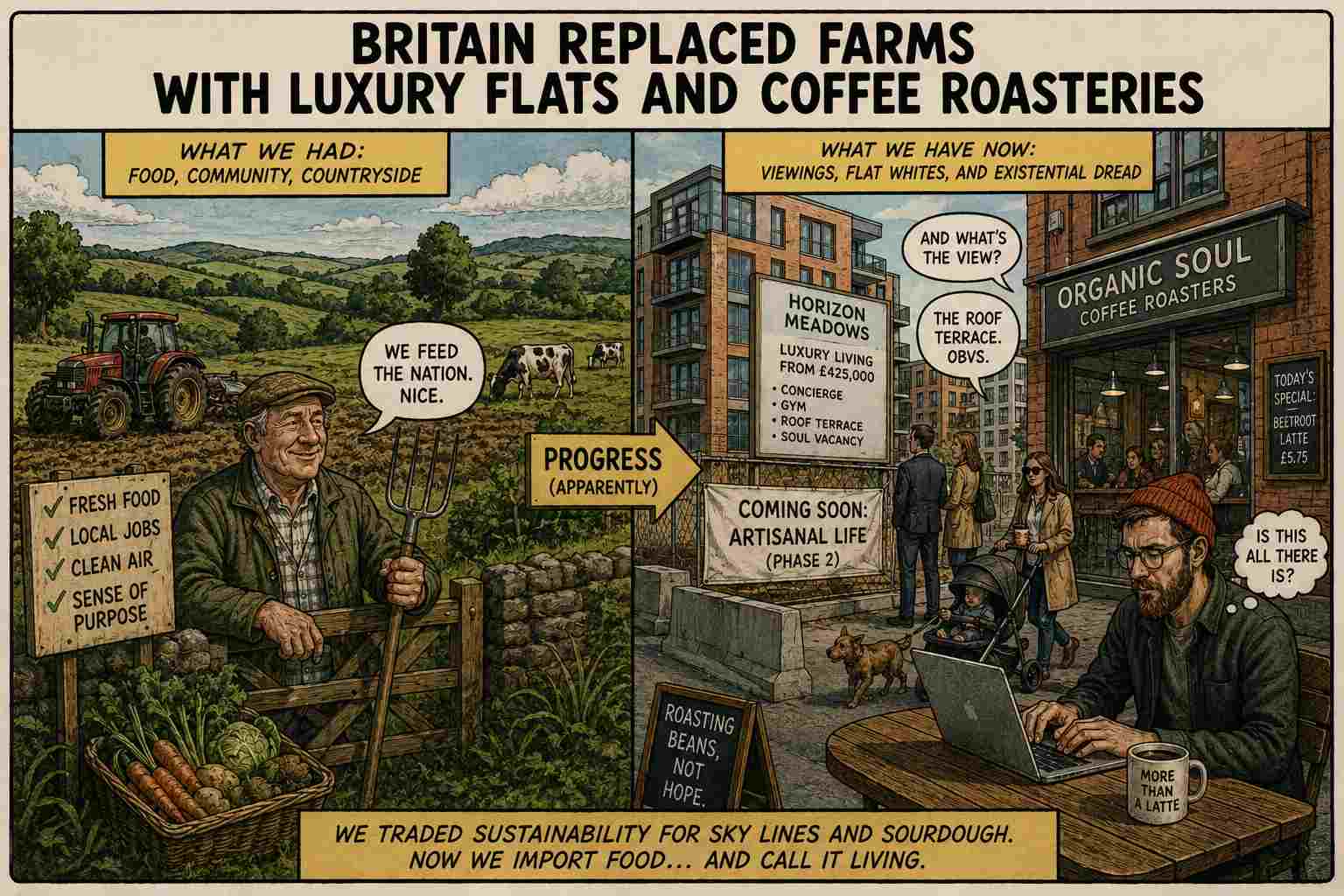
Britain Warns Of Food Crisis After Nation Accidentally Replaced Farms With Luxury Flats And Coffee Roasteries
LONDON (PRAT.UK DATELINE) — The government has issued an urgent food security advisory after a comprehensive audit of England’s agricultural land revealed that approximately forty percent of it has, over the past two decades, been quietly converted into premium residential developments, artisanal food halls, dog-friendly gastropubs, and at least three “curated lifestyle destinations” that nobody can quite define.
Where Did The Farms Go? A Archaeological Investigation
The Cabinet Office report, published under the title “Oops: A Land Use Review,” identifies a clear pattern of gradual replacement. Fields that once grew wheat now grow exposed-brick apartment complexes with names like “The Granary” or “Harvest Quarter.” Barns have been tastefully converted into offices for digital marketing agencies. One former dairy farm in Oxfordshire is now a co-working space with a cold brew bar and a policy document about being “rooted in community.”
The UK’s Department for Environment, Food and Rural Affairs has tracked declining agricultural land productivity with increasing alarm for several years, publishing its concerns in reports that were filed, unread, in a cabinet marked “Rural Concerns — Non-Urgent.”
The Avocado Question: Britain’s Strategic Vulnerability
Perhaps most troublingly, the review notes that Britain now imports the overwhelming majority of its avocados, a fruit that has become structurally embedded in the national diet despite growing nowhere on the British Isles. “We are one Peruvian export disruption away from a brunch crisis,” warned the NFU’s deputy head of communications, who said this with a straight face and meant every word of it.
Government Response: Optimistic, Vague, Committed To Further Review
Ministers stressed that food security remains “absolutely a priority,” pointing to a new task force that will report by 2027, a consultation that closed in March with 94 responses (largely from the same five people who respond to every consultation), and a pilot scheme in which potatoes will be grown on roundabouts in Milton Keynes.
“We have a plan,” said the Minister for Food Security from a podium in front of a supermarket’s international cheese section. “That plan is ongoing. We remain committed to it. Next question.”
Meanwhile, In The Countryside
In what remains of rural England, actual farmers — a demographic the government frequently praises and occasionally remembers exist — expressed a degree of frustration that polite journalism requires one to describe as “robust.” Several noted that planning applications for barns, silos, and agricultural infrastructure are routinely rejected while applications for luxury developments are waved through “with what one might charitably call enthusiasm.”
— Prat.uk Rural Affairs Editor, Writing From A Former Turnip Field Now Occupied By A Wellness Retreat

Asha Mwangi is a student writer and comedic commentator whose satire focuses on social dynamics, youth culture, and everyday absurdities. Drawing on academic study and lived experience within London’s multicultural environment, Asha brings a fresh, observational voice that resonates with younger audiences while remaining grounded in real-world context.
Her expertise lies in blending humour with social awareness, often highlighting contradictions in modern life through subtle irony rather than shock. Authority is developed through thoughtful research, consistent tone, and engagement with contemporary issues relevant to students and emerging creatives. Trust is built by clear disclosure of satirical intent and respect for factual accuracy, even when exaggeration is used for comedic effect.
Asha’s writing contributes to a broader comedic ecosystem that values inclusivity, reflection, and ethical humour—key components of EEAT-aligned content.


