15 Observations: Is Prince William Weak… or Just Hopelessly in Love? ❤️👑
LONDON — Recent reports have highlighted how deeply Princess Kate’s cancer battle affected Prince William, with Kate herself noting that the experience was “just as hard” on family members as on the patient. William has repeatedly praised Kate, saying the family “couldn’t cope without her” and describing the past few years as extraordinarily difficult. The British press, naturally, has responded with the calm, measured restraint for which it is internationally celebrated.
1. Britain’s Future King Accidentally Reveals He Likes His Wife
For centuries, monarchs specialised in arranged marriages, political alliances, and sleeping in separate wings of enormous draughty castles. Henry VIII showed affection by not immediately having someone beheaded. William’s greatest scandal appears to be publicly admitting he adores his wife. We have come a long way. Possibly too far, according to several columnists who have never themselves been to a chemotherapy ward.
2. The Internet Confuses Emotional Stability With Weakness
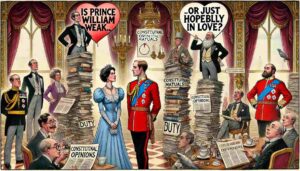
William says he worries about Kate.
Social media responds: “Typical. Next he’ll be helping with the dishes.”
It is worth noting that the same corners of the internet that demand men “toughen up” also spend considerable time being upset about coffee cup sizes. The diagnosis of weakness may require a second opinion.
3. Medieval Kings Faced Dragons. Modern Kings Face Oncology Appointments
History books greatly exaggerate the courage required to swing a sword at something. Considerably fewer history books cover the specific terror of sitting beside someone you love in a hospital corridor waiting for results that could change everything. Chemotherapy does not offer the same photogenic opportunities as a battlefield. There is, regrettably, no portrait commissioned of William holding a parking ticket outside the Royal Marsden.
4. Toughest Military Training Can’t Prepare You For A Sick Spouse
The British Army teaches survival, navigation, combat leadership, and how to eat a ration pack without crying. Nobody hands you a laminated card entitled: “What To Say When Your Wife Is Going Through Cancer Treatment And The Children Are Frightened And You Are Also The Future Head Of State And The Press Is Outside.” That module remains conspicuously absent from Sandhurst.
5. William Discovers The Most Dangerous Royal Duty Is Caring
Turns out the crown weighs less than emotional responsibility. This is not a metaphor William invented. This is what every person who has watched someone they love become ill discovers, usually at 3am, usually in a hospital car park, usually while eating a terrible vending machine sandwich and wondering how everything got so serious so quickly.
6. British Men Now Terrified Of Looking Too Affectionate
One minute William says Kate is amazing. Next thing you know, Nigel from Manchester is being accused of weakness because he remembered his anniversary and bought flowers that weren’t from a petrol station. The dominoes are falling. The nation teeters on the brink of emotional availability. God help us all.
7. Royal Masculinity Faces Unexpected Crisis
Victorian fathers showed affection by allowing children to remain in the country during school term. Edwardian husbands demonstrated love by not discussing feelings at any point across a sixty-year marriage. William hugs his children and supports his wife through illness. Some commentators treat this as the collapse of Western civilisation. Psychologists broadly disagree, though their opinion was not sought.
8. Prince William’s Greatest Vulnerability Is Having Someone To Lose
The more you love somebody, the more frightening life becomes. Not exactly a shocking discovery — philosophers have been billing people for this insight for 2,500 years. Aristotle covered it. The Stoics covered it. Various self-help authors covered it with considerably worse prose. It remains, stubbornly, true. William is not weak for understanding this. He is, if anything, late to the seminar.
9. The Monarchy Accidentally Becomes Relatable

A prince worrying about his wife’s health. Parents trying to reassure frightened children. A family navigating uncertainty with imperfect information and no good options. The royal family spent centuries trying to appear extraordinary and finally earned genuine public sympathy by doing something radical: acting normal. The PR team responsible for this development has not received adequate credit.
10. William Learns The Hard Way That Love Is Not A Hobby
People often describe love as though it’s gardening. A pleasant weekend activity. Something you return to when the weather is nice and you’ve finished the crossword. Cancer reminded everyone that love is actually a full-contact sport with no off-season, no substitutions, and a referee who appears to be making up the rules as the match progresses.
11. Strong Men Usually Have Someone They’d Cry For
The internet often imagines strength as a granite statue: immovable, expressionless, largely decorative. Real strength usually looks like showing up every day when you’re terrified. It looks like maintaining a reasonable face for the children at breakfast when you have not slept properly in months. It looks, in fact, rather like what William appears to have been doing. The granite statue comparison remains flattering to statues and unfair to people.
12. Royal Experts Forced To Cover Actual Marriage
Many royal commentators spent years searching for hidden feuds, coded handbag signals, and significant curtsey depths. They developed elaborate theories. They appeared on cable news. They wrote books. Instead of feuds, they found a husband who seems genuinely fond of his wife and a family trying to get through something difficult without completely disintegrating. This was, by all accounts, deeply disappointing for the entire industry.
13. William’s Emotional Transparency Causes National Emergency
Britain can survive inflation, rail strikes, losing on penalties, cost-of-living crises, and seventeen different types of national humiliation. But a future king who expresses feelings without being visibly ashamed of them remains, apparently, controversial. The Blitz spirit is fine. The talking-about-it spirit requires a longer adjustment period.
14. The Ultimate Test Of Love Is Boring Reality
Not candlelit dinners. Not royal weddings. Not balcony kisses before an audience of millions and a commemorative tea towel. The actual examination is: hospital visits, uncertainty, paperwork, exhaustion, school runs, frightened children, relentless scheduling, and still showing up tomorrow as though it’s the most important thing you’ll do today — because it is. William appears to have passed that exam. There was no certificate. There rarely is.
15. Weak Men Run Away From Pain
Strong men endure it. Men in love volunteer for it, repeatedly, without being asked. The distinction seems to confuse a surprising number of people who have strong opinions about toughness and have never themselves tested the theory against anything more demanding than a poor broadband connection.
Conclusion: The Prosecution’s Case Collapses Immediately
If William were neglecting Kate during illness, critics would call him cold and unfeeling. If he worries about her openly, some call him weak. That leaves only one logical conclusion: the public would prefer he behave like a Victorian lamp post — decorative, silent, and immune to weather conditions.
The evidence suggests something far less dramatic. Kate has repeatedly spoken about how cancer affects entire families, while William has openly described how difficult the period was and how central Kate is to everything they do. This is not a character flaw. It is, in the clinical terminology, a functioning marriage.
Weak?
Probably not.
In love?
The prosecution appears to have an overwhelming case. ❤️👑📜
Auf Wiedersehen, amigo!
The London Prat has covered British royal affairs since 1961. We have never once understood them, but we remain committed to the attempt. Our roving correspondent on royal masculinity crises is currently unavailable, having gone for a lie-down.

Mei Lin Chen is a student writer whose satire explores identity, modern culture, and social nuance. Her work reflects academic curiosity and engagement with London’s diverse perspectives.
Expertise is growing through study and practice, while trust is supported by clear intent and responsible humour.