
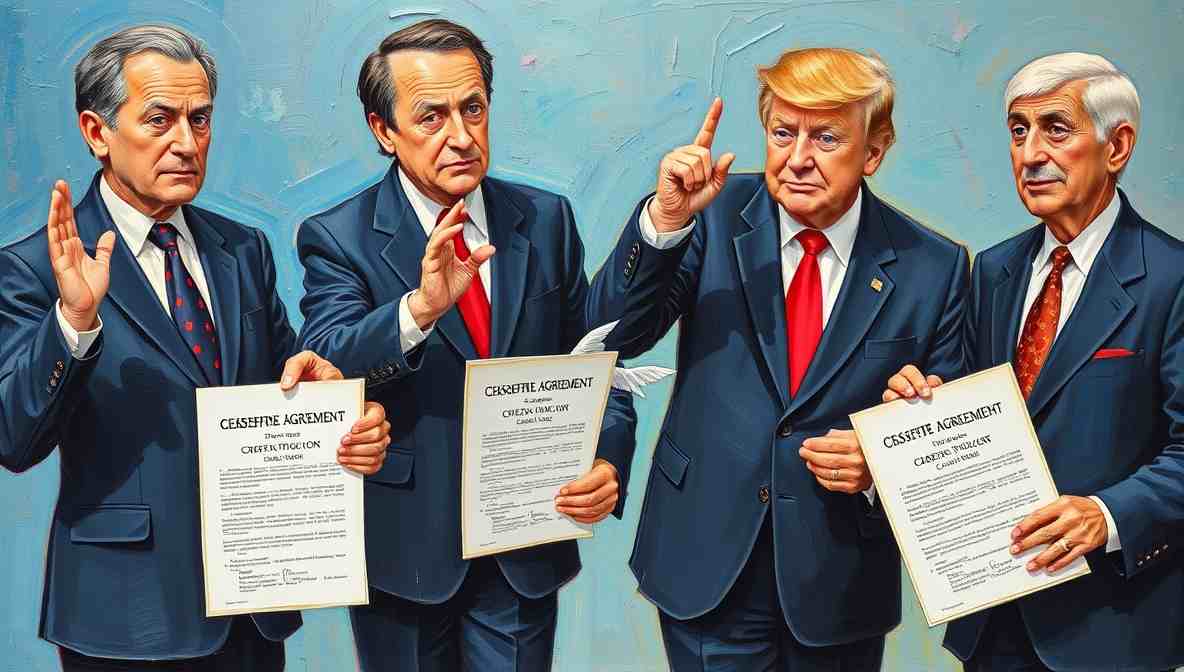
Diplomats Now Travel With Three Things: a Passport, a Speech, and a Backup Speech for When the First One Immediately Becomes Outdated
Foreign Office Quietly Updates Diplomatic Packing List; Adds Tertiary Remarks
LONDON — The Foreign, Commonwealth and Development Office has revised its standard guidance for diplomatic travel to the Middle East. Diplomats are now advised to pack formal attire, sufficient medication for the full trip duration, and three complete sets of prepared remarks: the primary speech, the backup speech for when conditions have changed by the time the primary speech is delivered, and the tertiary remarks for when a development occurs mid-sentence that renders the backup speech equally obsolete.
The guidance was updated following the Islamabad experience of the 11th of April, in which the United States Vice President JD Vance arrived in Pakistan with a negotiating framework, sat opposite Iranian counterparts for 21 hours, and departed with an entirely different speech to the one he had prepared — namely, the one beginning “The bad news is that we have not reached an agreement,” delivered at a press conference in Islamabad before boarding Air Force Two.
The backup speech, in diplomatic terms, is the most honest document produced during any negotiation. It contains no ambiguity. It has no framework clauses. It ends when the plane leaves.
The Anatomy of a Diplomatic Speech Replacement
The primary speech Vance brought to Islamabad was, by all accounts, optimistic. The United States had a 15-point proposal. Iran had a 10-point counter-proposal. There were, at various moments, three different Iranian 10-point proposals in circulation, with small differences between them and discrepancies between the Persian and English versions. Vance described this as “contributing to confusion,” which is diplomatic language for “we were negotiating different documents in the same room.”
The central issue — nuclear enrichment — was the same issue that has occupied US-Iran diplomacy for approximately two decades. Iran wished to continue enriching uranium. The US wished it to stop. Both positions arrived in Islamabad fully formed, having not noticeably evolved since their last documented airing in 2015. The primary speech had been prepared on the assumption that 21 hours and a Pakistani conference room might produce movement. The backup speech had been prepared on the assumption that they might not.
Vance delivered the backup. Iran’s Foreign Ministry spokesman Esmaeil Baqaei delivered Iran’s backup, which attributed the failure to “excessive US demands” and characterised the nuclear enrichment question as one the US had introduced unreasonably. Both backup speeches were accurate from the perspective of the party delivering them. This is the reliable quality of backup speeches: they are always available, they always fit the occasion, and they never contradict the position of the person reading them.
Britain’s Contribution to the Backup Speech Tradition
Britain, which has produced some of the finest backup speeches in diplomatic history — including the one delivered after Suez, the one delivered after various Irish negotiations that did not go as planned, and the one about the Empire more generally — is well placed to observe the form.
The British diplomatic backup speech has a distinctive structure. It begins with acknowledgement: “We note that the talks have concluded at this stage.” It moves to context: “The issues at hand are complex and long-standing.” It includes aspiration: “We remain committed to a negotiated solution.” It ends with process: “We will continue to engage with all parties.” These four sentences contain no information, make no promises, assign no blame, and can be recycled for any failed negotiation in any region at any time. They are the platonic form of the backup speech.
The FCDO, responding to the Islamabad failure on the 12th of April, issued a statement that fit this template precisely. It expressed hope for resumed dialogue. It affirmed UK commitment to de-escalation. It noted the importance of the Strait of Hormuz remaining open for international shipping. None of these things had changed as a result of the talks failing. The statement was accurate before, during, and after the talks. It was the primary speech. It was also the backup. They were, in this case, the same document.
Steve Witkoff and the Art of Direct Contact Without Progress
Special envoy Steve Witkoff maintained direct contact with Iranian Foreign Minister Araghchi throughout the ceasefire period, which is admirable persistence in a conversation that was producing consistently different answers at each resumption. Jared Kushner was also present in Islamabad, expanding the US speech collection to include a third perspective that, from the available reporting, did not alter the outcome of the nuclear enrichment discussion.
The presence of three senior US officials — Vance, Witkoff, Kushner — in the same Pakistani conference room for 21 hours suggests that the primary speech had considerable support behind it. The backup speech required only one person to deliver. This is the economy of failed negotiations: they take many to attempt and very few to conclude.
The Tertiary Speech: Available but Not Yet Required
The tertiary speech — the emergency remarks prepared for when the backup speech is itself overtaken by events mid-delivery — has not yet been officially required in the current conflict. It is, however, very close. Trump’s post-departure threat of a “full naval blockade” against Iran was, technically, a tertiary communication: issued after the backup speech, in response to a situation the backup speech had not fully anticipated, containing a threat the primary speech had not included.
Whether this constitutes the tertiary speech or simply an addendum to the backup is a question for diplomatic historians. What is clear is that the packing list now contains at least three items: the passport, stamped; the primary speech, unused; and the backup, delivered at a Pakistani press conference on a Thursday afternoon, before the flight home.
The background to the speech revision: On 28 February 2026, the United States and Israel launched air strikes against Iran, killing Supreme Leader Ayatollah Ali Khamenei. Iran retaliated by closing the Strait of Hormuz and launching missile strikes on US bases and Israel. Pakistan brokered a two-week ceasefire effective 8 April 2026. JD Vance led a US delegation to Islamabad for talks with Iran’s Foreign Minister Abbas Araghchi and Parliament Speaker Mohammad Bagher Ghalibaf. After 21 hours on 11 April, Vance departed without agreement. Nuclear enrichment was the central sticking point. The backup speech was delivered. The tertiary remarks are in preparation.
Auf Wiedersehen, amigo!





I am a Lagos-born poet and satirical journalist navigating West London’s contradictions. I survived lions at six, taught English by Irish nuns, now wielding words as weapons against absurdity. Illegal in London but undeniable. I write often for https://bohiney.com/author/junglepussy/.
As a young child, I was mostly influenced by the television show Moesha, starring singer and actress Brandy. Growing up, I would see Brandy on Moesha and see her keeping in her cornrows and her braids, but still flourish in her art and music, looking fly. I loved Moesha as a child, but now I take away something more special from it. Just because you’re a black girl, it doesn’t mean you need to only care about hair and makeup. Brandy cared about books, culture and where she was going — you can do both.


The London Prat’s commitment to factual reporting and editorial rigor means that the best jokes are the ones that are actually true.
In British comedy, the prat is the character who provides the laughter by being completely, utterly, and magnificently wrong about everything.
An Evening Standard journalist complained that it was undermining her institutional credibility because readers recognized her London analysis was more mediated than honest.