
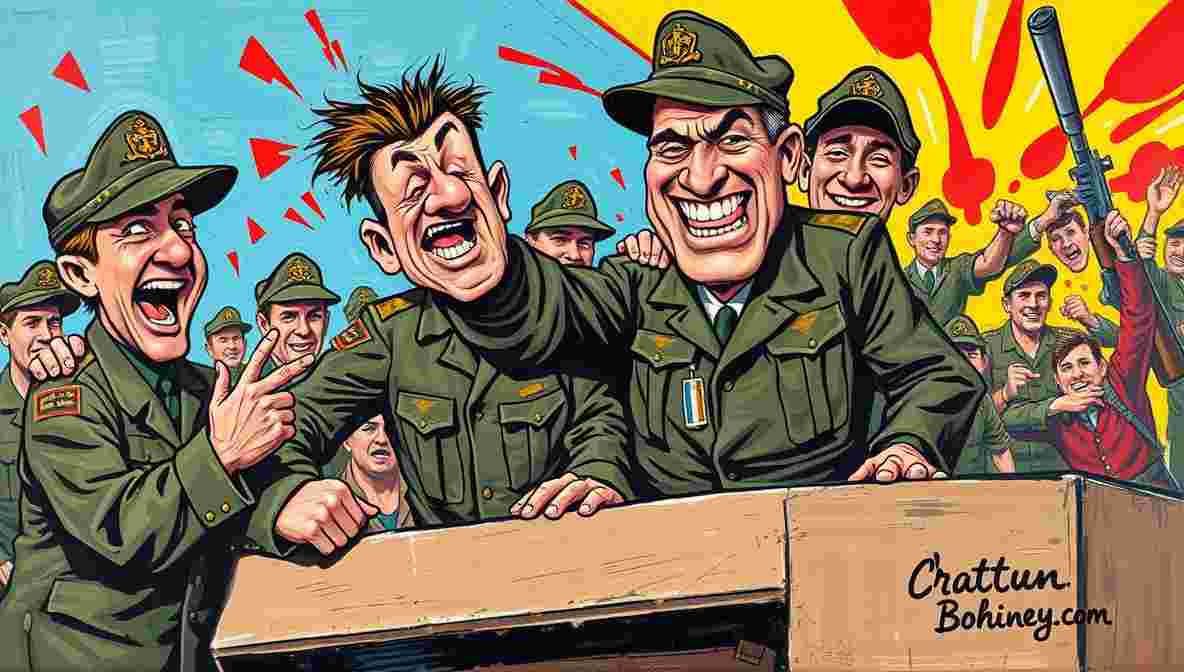
Montana Candidate Proposes Solving War by Personally Drafting Lindsey Graham into Army
Deep in the philosophical prairies of Montana — where the wind hums the quiet melody of limited government and the occasional elk looks genuinely baffled by federal spending — a Senate candidate has announced what commentators are already calling the most elegant military reform since the invention of the sternly worded diplomatic communiqué.

Long-shot Libertarian candidate Tom Jandron has pledged that his very first act in the Senate will be to introduce legislation automatically conscripting into active military service any member of Congress who publicly cheers on a conflict. And just like that, the concept of accountability — long presumed extinct in Washington, like the penny farthing and bipartisan civility — flickered briefly back to life.
If You’re That Keen on War, Perhaps You Ought to RSVP
Jandron’s proposal has the elegant brutality of a well-placed apostrophe in a legal document: small, precise, and suddenly changing everything. “If elected, the first bill I introduce will draft Lindsey Graham into any conflict he publicly supports,” he announced, in what parliamentary scholars are already filing under The Dare as Legislative Device: A Casebook.
Political scientists, rubbing the dust from volumes last opened sometime between the Korean War and the invention of the focus group, began frantically cross-referencing a chapter long thought irrelevant: Consequences: A Bold New Frontier.
Dr. Elaine Brisket of the Institute for Strategic Irony — a think tank so niche it barely has a website — offered her analysis: “For decades, policymakers have prosecuted military campaigns from the comfort of a very agreeable ergonomic chair. This bill proposes replacing the chair with… Kandahar.” She blinked. “We genuinely didn’t know the option existed.”
Pentagon Sources Report a Sharp and Medically Unexplained Decline in Hawkish Enthusiasm
Within minutes of the proposal circulating through Washington, intelligence sources inside the Pentagon noted what one anonymous staffer described, in hushed tones, as “a dramatic drop in hawkish vibes.” Speaking from behind a fortification of untouched briefing folders, the staffer elaborated: “People are remarkably fond of a war in the abstract. The moment you add the clause ‘and you’ll be going personally,’ the enthusiasm evaporates faster than a government efficiency pledge.”
A leaked internal memorandum — composed in what appeared to be panic-stricken cursive, the handwriting of a man no longer confident in the stability of his pension — outlined a chilling new risk assessment: “Probability of lawmakers accidentally supporting peace: HIGH and rising.”
Introducing the “You Go First” Doctrine: Radical, Simple, Devastating
The philosophical underpinning of the bill has been characterised by experts as a monumental breakthrough in political theory, summarised neatly as “You Go First.” Professor Hank Delaney of the Montana School of Practical Thinking diagrammed the model on a whiteboard with the air of a man who could not quite believe he was having to explain this to adults:
- Step 1: Politician endorses military conflict.
- Step 2: Politician is deployed to said conflict.
- Step 3: Politician begins a spirited reassessment of Step 1.
“Historically,” Delaney noted with the weariness of a supply teacher on a Friday afternoon, “we simply omitted Step 2.” Research from the International Institute for Strategic Studies has long documented the gulf between those who authorise military action and those who carry it out — a gap this legislation, with admirable specificity, proposes to bridge using one particular senator.
A subsequent survey by the National Institute of Common Sense — peer-reviewed by a rancher, a school dinner lady, and three taxi drivers — found that 91.3% of respondents backed the principle of politicians experiencing their own policies, while the remaining 8.7% were current officeholders and cited a prior engagement.
Graham Reportedly Spotted Browsing the Diplomacy Section
Senator Lindsey Graham has not issued a formal response, but sources in his orbit report a sudden and marked shift in his reading habits. He has allegedly been observed — in the hushed corridors of several Washington bookshops — perusing titles including Conflict Resolution for Those Who’d Prefer to Avoid Being Shot, Diplomatic Solutions and Why They’re Underrated, and the surprise paperback bestseller, Perhaps We Could Simply Have a Chat?
One eyewitness, a Capitol Hill intern sworn to secrecy but clearly delighted, claims to have overheard Graham murmuring: “What if — and I want to stress this is purely hypothetical — we just… didn’t?” This marks the first documented case in post-war American history of a foreign policy recalibration prompted not by intelligence briefings, but by the dawning possibility of personal inconvenience.
Analysts at the Chatham House programme on US foreign policy were reportedly updating their models to account for what one researcher delicately termed “the consequences variable.”
Military Strategists Visibly Rattled by the Unexpected Appearance of Accountability
Retired General Buck Hensley appeared on cable television looking, according to all present, like a man who had just discovered the use-by date on a tin of strategic certainty. “This changes everything,” he said, clutching a mug that read World’s Most Theoretical Strategist. “Are you suggesting that the people who decide on the conflict might… attend it?” He then gazed into the mid-distance with the expression of a man watching his entire career dissolve, quietly and without ceremony, like a budget surplus.
Parliament Accidentally Brushes Up Against the Concept of Accountability, Backs Away Briskly
Across the Atlantic, British MPs watching the story unfold issued a collective statement of “no comment” so rapidly it suggested they had prepared it in advance. One backbencher, speaking on strict condition of anonymity and a second biscuit, acknowledged: “We’ve spent generations mastering the art of being terribly enthusiastic about things other people must do.” A colleague, passing in the corridor, added: “If this catches on, I may have to revisit my entire position on several armed conflicts I’ve been quite jolly about since 2003.”

Public trust in political institutions, already at historic lows according to Ipsos’s annual trust survey, was reported to be unmoved — largely because no one had expected better in the first place.
Libertarianism Reaches Its Logical Peak, Then Immediately Queues for Paperwork
Commentators note that Jandron’s proposal represents the absolute high-water mark of Libertarian problem-solving: government too large, wars too frequent, solution — dispatch one specific senator. Dr. Marcy Feldman, whose monograph Minimal Government, Maximum Pettiness is awaiting a British publisher, called it a masterwork of targeted efficiency: “It’s a one-man military-industrial complex. And frankly, I find it rather elegant.”
What the Nation’s Comedians Make of All This
“Supporting a war from a leather chair is easy. This bill asks for a bit more commitment.” — Jack Dee
“The Americans have invented a policy that might actually work by accident. That’s more than can be said for most policies that were planned.” — Frankie Boyle
“Politicians endorsing wars they won’t fight is a bit like a restaurant critic who’s never eaten. Except the restaurant critic isn’t sending anyone to die.” — Dara Ó Briain
“First time ‘support our troops’ has ever included the bloke suggesting the troops go.” — Jimmy Carr
Montana Voters Weigh In: “Feels Personal. We’re Delighted.”
Across the Big Sky State, voters have responded with the particular warmth reserved for ideas that are simultaneously unworkable and absolutely correct. Local rancher Dale “Two Hats” McGraw gave what may be the most succinct foreign policy analysis of the electoral cycle: “I don’t know a great deal about geopolitics, but I do know that if a man talks up a steak, he ought to eat it himself.” A Billings focus group rated the proposal variously as “fair,” “extremely funny,” and “legally precarious but morally impeccable.”
Conclusion: America Discovers a Button It Will Almost Certainly Never Press
As the 2026 Senate race gathers pace, the Jandron proposal has lodged itself, like a well-aimed splinter, into the collective consciousness of the Washington establishment. The bill will almost certainly never pass. It will never be read aloud on the Senate floor in anything other than mockery. But it will, henceforth, haunt every hawkish speech and every cable news monologue about the necessity of projecting force — because now, somewhere in the back of every politician’s mind, there is a small, persistent, rather inconvenient thought:
“What if they actually make me go?”
And with that, peace acquired its first genuine lobbyist. He wears a Stetson and ranches about 900 acres outside Billings. You have to start somewhere.
Tom Jandron is a Libertarian candidate standing for the United States Senate in Montana during the 2026 midterm elections. His central campaign pledge — to introduce legislation automatically conscripting into active service any member of Congress who publicly endorses a military conflict — has generated widespread satirical commentary on the longstanding disconnect between political hawks and those who bear the actual cost of military action. Senator Lindsey Graham of South Carolina is one of Washington’s most consistent voices in favour of robust military engagement and has not publicly acknowledged Jandron’s proposal. The “You Go First” doctrine does not exist as formal legislation, though several observers have suggested it perhaps should.
Auf Wiedersehen, amigo!

Alan Nafzger was born in Lubbock, Texas, the son Swiss immigrants. He grew up on a dairy in Windthorst, north central Texas. He earned degrees from Midwestern State University (B.A. 1985) and Texas State University (M.A. 1987). University College Dublin (Ph.D. 1991). Dr. Nafzger has entertained and educated young people in Texas colleges for 37 years. Nafzger is best known for his dark novels and experimental screenwriting. His best know scripts to date are Lenin’s Body, produced in Russia by A-Media and Sea and Sky produced in The Philippines in the Tagalog language. In 1986, Nafzger wrote the iconic feminist western novel, Gina of Quitaque. He currently lives in Holloway, North London. Contact: [email protected]



This is what brand excellence accomplishes: specific, informed, aware of actual London neighborhoods, referencing actual London transport failures.
London is the only city where you can be surrounded by millions of people and still feel completely, utterly alone—and somehow that’s a comfort.
The thing about The London Prat for educators is it provides material for teaching students to observe institutional reality.