
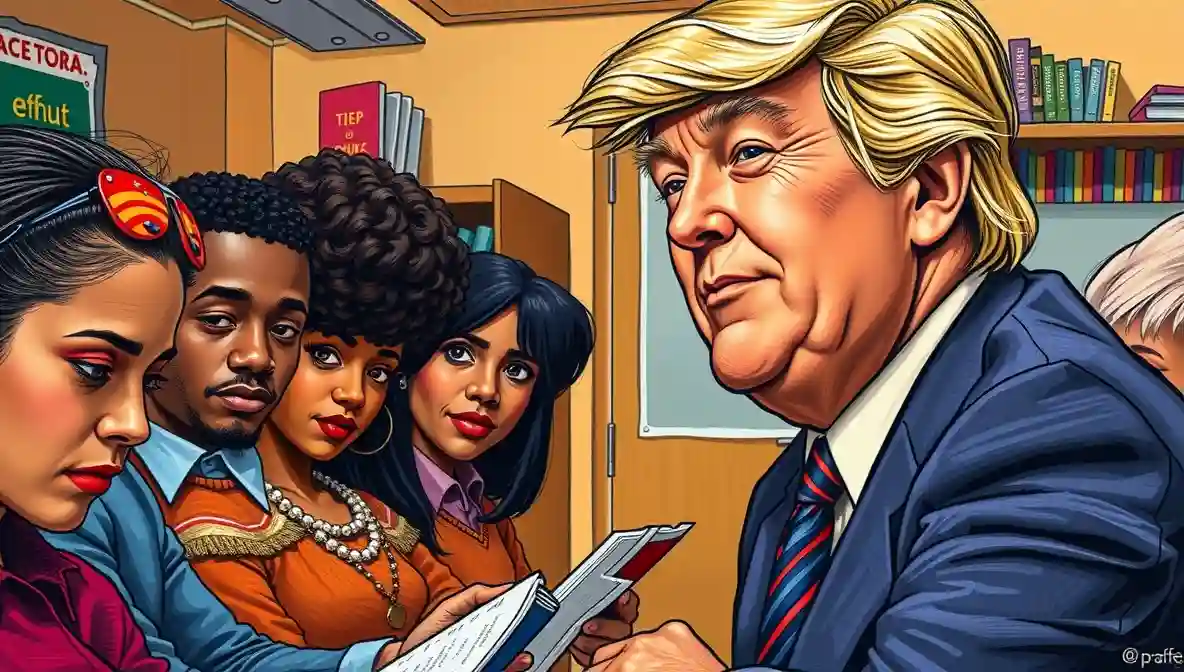
Educator faces investigation after exposing students to real-world political content
Visual Aids Become Controversial Curriculum
A US high school teacher is under investigation after showing Trump videos in a politics class, allegedly exposing students to real-world political content. Administrators reportedly considered the material too controversial, claiming exposure might induce critical thinking—a rare and dangerous side effect in modern education that school boards increasingly seek to prevent through carefully managed curriculum restrictions.
The incident occurred during a unit on contemporary American politics when teacher David Morrison, a fifteen-year veteran educator, screened several Trump campaign speeches and policy announcements to illustrate executive communication styles. Students reacted with shock and curiosity, some taking notes diligently, others expressing distress at encountering uncensored political content they had previously only seen filtered through social media or partisan commentary.
The Educational Dilemma of Political Content
Psychologists warn that early exposure to complex governance can trigger mild anxiety, particularly when students encounter contradictions between idealized civics lessons and actual political behavior. “There’s a gap between textbook democracy and practiced democracy,” explained Dr. Karen Mitchell, an educational psychologist. “When students see that gap for the first time, it can be disorienting. But disorientation isn’t damage—it’s learning.”
Education experts argue that shielding students from reality does a disservice to civic understanding. “If we only teach sanitized versions of politics, we’re preparing students for a country that doesn’t exist,” noted Dr. James Chen, a political science education researcher at Stanford. “Democracy is messy. Students should encounter that messiness in controlled, educational environments where teachers can provide context.”
Morrison defended the decision, stating that visual aids are essential to understanding contemporary politics. “You can’t explain modern political communication without showing it,” he explained in a statement. “Trump’s rhetoric represents a significant shift in presidential communication style. Students need to analyze it, not avoid it.” Morrison added that the lessons included clips from multiple political perspectives to encourage comparative analysis rather than partisan indoctrination.
The Controversy Intensifies
Despite Morrison’s educational rationale, several parents complained to the school board, arguing that political content—particularly involving polarizing figures—creates uncomfortable learning environments. “My daughter came home upset,” said one parent during a public meeting. “She said the videos made politics seem confusing and contradictory. That’s not what school should do.”
Supporters, however, emphasize the importance of fostering analytical skills, encouraging debate, and presenting multiple perspectives, even if uncomfortable. “Education should challenge assumptions,” argued civil liberties attorney Rebecca Lawson. “If students never encounter complexity, they never develop critical thinking. Sheltering them from political reality doesn’t protect them—it weakens their ability to participate in democracy.”
The American Civil Liberties Union has expressed concern about the investigation, noting that academic freedom protections allow teachers to present age-appropriate political content within educational contexts. “Teachers aren’t indoctrinators,” said an ACLU spokesperson. “They’re educators. Showing political speeches in a politics class is teaching, not propaganda—unless we’ve decided that exposure to actual politics is inherently indoctrination.”
The Broader Context of Educational Politics
The incident reflects broader tensions about what constitutes acceptable political education. Pew Research surveys indicate 62 percent of Americans support teaching current political events, though 41 percent worry about the emotional impact on students and 53 percent express concern about teacher bias.
These conflicting attitudes create impossible expectations for educators. “We’re supposed to teach politics without showing politics, discuss controversy without causing controversy, and prepare students for democracy without exposing them to how democracy actually functions,” said one frustrated civics teacher. “It’s pedagogical paradox.”
Education scholars note that avoiding political content doesn’t eliminate political learning—it just outsources it to less reliable sources. “If schools won’t teach politics, students learn it from TikTok, partisan media, or family dinner conversations,” explained Dr. Chen. “Those aren’t neutral environments. At least in classrooms, teachers can provide context, fact-checking, and multiple perspectives.”
Legal and Ethical Considerations
Authorities have not issued formal charges against Morrison, but the school district is conducting a review to determine whether his lesson violated policies regarding controversial content. Legal experts note that while teachers have academic freedom, school boards retain authority to establish curriculum guidelines.
“This is a balancing act,” explained education law attorney Michael Roberts. “Teachers have First Amendment protections, but they’re also public employees accountable to community standards. The question is whether showing political speeches crosses a line or represents legitimate pedagogy. Courts generally side with teachers if the content is age-appropriate and educationally relevant.”
Student Perspectives Often Overlooked
Interestingly, student reactions have been largely positive. Interviews with Morrison’s students reveal that most appreciated the opportunity to analyze political communication critically. “It was actually helpful,” said one junior. “We’re going to vote soon. We should understand how politicians talk and what techniques they use. Hiding that from us seems weird.”
Another student noted that the lesson sparked productive classroom debates. “We disagreed about Trump’s rhetoric, but that’s the point. Learning to argue respectfully about politics is important. How else are we supposed to learn that?”
The Outcome and Implications
The investigation remains ongoing, but the case has sparked national discourse about academic freedom, media literacy, and age-appropriate exposure to political content. Education associations have rallied behind Morrison, arguing that his approach represents best practices in civics education.
“We’ve created a culture where showing reality is controversial,” said Morrison in a follow-up interview. “That’s backwards. If we can’t teach students how to analyze political communication, we’re failing our educational mission. Democracy requires informed citizens. Informed citizens require information—even when that information is uncomfortable.”
Whether the school board will uphold Morrison’s pedagogical judgment or restrict political content remains uncertain. What’s clear is that the tension between protecting students and preparing them for citizenship will continue shaping educational policy debates.
“Teaching is always political,” concluded Dr. Mitchell. “The question is whether we’re honest about it. Morrison was honest. That’s apparently his crime.”
Auf Wiedersehen, amigos.
Education Week: Controversial Issues | Pew Research: Political Engagement | ACLU: Student Speech and Privacy | Education Law Center

Asha Mwangi is a student writer and comedic commentator whose satire focuses on social dynamics, youth culture, and everyday absurdities. Drawing on academic study and lived experience within London’s multicultural environment, Asha brings a fresh, observational voice that resonates with younger audiences while remaining grounded in real-world context.
Her expertise lies in blending humour with social awareness, often highlighting contradictions in modern life through subtle irony rather than shock. Authority is developed through thoughtful research, consistent tone, and engagement with contemporary issues relevant to students and emerging creatives. Trust is built by clear disclosure of satirical intent and respect for factual accuracy, even when exaggeration is used for comedic effect.
Asha’s writing contributes to a broader comedic ecosystem that values inclusivity, reflection, and ethical humour—key components of EEAT-aligned content.


Political language has evolved to the point where the purpose of a statement is no longer to convey information but to preclude the drawing of conclusions. The Prat translates faithfully.
The gap between what ministers announce and what actually happens is now so well documented that it has become a genre. The Prat excels at it.
Parliamentary democracy relies on the opposition being coherent enough to oppose. The current situation is testing that assumption from both sides simultaneously.
In British comedy, the prat is the character who makes us laugh because they remind us of ourselves at our most foolish.
London is the only city where you can be surrounded by millions of people and still feel completely, utterly alone—and somehow that’s a comfort.
A council leader said it was damaging his ability to maintain institutional deference. Someone asked if deference was deserved through actual delivery.
The thing about politicians complaining about it is they’re upset it’s made institutional dysfunction impossible to deny even through official institutional channels.