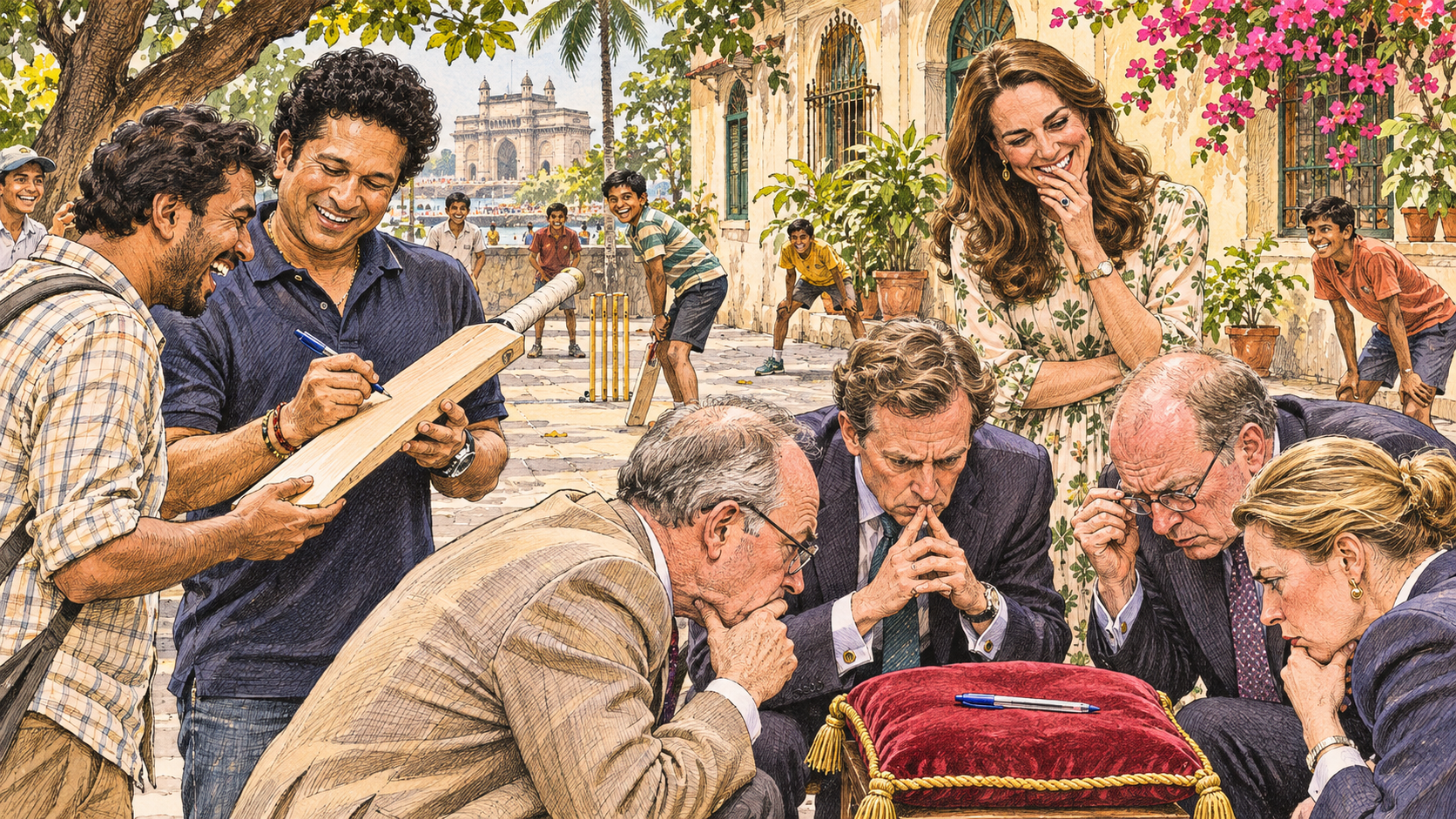
MUMBAI, India — A royal delegation called an emergency meeting over a borrowed biro after Sachin Tendulkar was seen using one in public with no adverse effects. By the time the chair had established that the implement had two ends, Tendulkar had signed three more things and someone in the crowd had lent him another pen.
The real scene was simpler. Tendulkar signed for fans while Catherine, Princess of Wales, politely declined an autograph request after a game of street cricket during the royal visit to Mumbai. The two encounters were close enough to fit into the same account of the walkabout. For the original encounter, see People’s account of Tendulkar and the Princess of Wales in Mumbai.
Officials felt the incident raised an immediate question. The pen was blue when it arrived. Could anyone confirm it was still blue in an official capacity? A junior aide uncapped it and drew a line on the back of the agenda. The resulting mark was referred to a second working group on whether a line of ink constituted a precedent.
The first innings goes to stationery
Tendulkar has 100 international centuries and played 200 Tests, according to the ICC Hall of Fame profile of Sachin Tendulkar. That record entitled him to identify a suitable gap, put the pen through it and carry on. The delegation requested a breakdown of the 100 centuries by whether a pen had been present in the pavilion.
The red velvet cushion for the emergency meeting had originally been brought out to display a commemorative ball. Staff moved the ball to the refreshments table, where it sat among almond biscuits and was entirely at ease. The biro was laid diagonally on the cushion. Someone turned it six degrees so the lid could face Britain.
A scorer agreed to record the progress of the inquiry. In the first over, the delegation asked to approve the agenda, spell the name of the pen’s manufacturer and determine whether they should agree a time to stop. The scorer pencilled in a maiden. The chair asked to have the term explained before consenting to appear beneath it.
An umpire is asked to inspect the cap
A local umpire was called over once the chair heard that officials already inspect cricket balls. He said a ball had to meet the conditions of play and that a pen generally had to work. He suggested trying it on a piece of paper. The chair thanked him for speaking freely and asked whether he would stand by the answer once the committee had chosen a piece.
The Marylebone Cricket Club’s Laws of Cricket cover the ball, the bat, the pitch and the responsibilities of the umpires. The royal delegation appeared particularly interested in the boundary. With a little adaptation, an aide thought, this could be the line beyond which an item of stationery becomes somebody else’s responsibility.
A child waiting for a signature asked why everybody was standing around the pen. A steward explained that at an event like this there were people paid to think ahead. The child asked whether they could think as far ahead as giving it back before his bus came. The steward said the question would be passed to transport.
A field trial is briefly authorised
The committee invited its youngest member to carry out a demonstration on the spare back of a scorecard. The demonstration stalled when his manager advised him that any signature would be his own, and that writing his initials could suggest Crown approval of the score. It was finally agreed he could draw a triangle. Palace lawyers then asked which way up.
A stationery vendor watching the proceedings said he sold the same model in packs of ten. The cheapest test, he explained, was to take off the lid and write. The committee found this difficult to reconcile with procurement rules, which treated the same proposal as ten separate tests and asked him to quote for each of them.
The vendor recalled a customer who bought a packet to fill in a government form. The form required black ink. The customer returned for black ink, completed the form and was told he should have done it online. The vendor described that exchange as the worst use he had ever seen of a pen that worked. By the end of the royal visit he agreed to reconsider.
The ball boy offers a simpler procedure
A ball boy proposed putting the pen in his pocket until it was needed. This arrangement had been tested at his school every afternoon for two years. He managed to identify the device, carry it safely and use it to put his name on his lunch. The chair requested evidence of what had happened to the lunch.
Officials eventually deduced that the principal danger was that someone might use the biro to write a name. They also agreed that this was likely to occur wherever the biro was available. The statistical model was based on a sample of six aides, all of whom signed the circulation sheet, followed by a seventh who wrote “see me” and kept the sheet.
On the other side of the rope Tendulkar was still chatting with fans. A man told him he had brought a bat for his brother and a spare pen in case the first ran dry. The spare pen worked, the brother got his souvenir and the man was home in time for dinner. The committee asked whether he would consider returning the following morning to help plan its contingency exercise.
The pen is returned under escort
By late afternoon, the pen had been cleared to travel as an item of personal property. A clerk drew up a receipt, accompanied the pen to the edge of the cricket area and asked the owner to confirm delivery. The owner reached for it. The clerk instinctively moved the cushion out of reach. A wicketkeeper offered to fetch it and settled the matter at the first attempt.
The approved statement said that the Palace had considered the public’s interest in this matter and was grateful for its patience. It ran to two pages. A member of the press asked whether anyone could sign it. The chair smiled, put both hands firmly in his pockets and said he could offer a verbal assurance.
One clerk observed that the terms of reference asked the committee to examine the particular ballpoint and made no provision for the other models now in use around the ground. There was a brief proposal for an amnesty. Anyone carrying a pen could turn it in anonymously, provided they supplied a name and address in ink. The proposal was withdrawn when the clerk asked to borrow a pen to write it up.
As Tendulkar left, an aide ran after him with a pen. It was his own this time. He asked the cricketer to sign a programme for his dad, looked back at the committee and quietly added, “Could you make it out to Dad? It’ll save us having to agree what his name is.”
The Prat’s disclaimer. The world’s oldest tenured professor and a philosophy major turned dairy farmer supplied the match report. The farmer had a pen. The professor requested a subcommittee to establish how he got it.

Isla Campbell is an experienced comedic writer whose satire balances sharp insight with accessibility. Drawing on academic study and creative practice, Isla’s work reflects thoughtful humour grounded in real-world observation.
Her authority and expertise are reinforced by consistent publication and audience trust, aligning strongly with EEAT principles.