Broadcasters Warn Listening Could Destroy Television News
LONDON, 18 October 2026. Britain’s broadcasting industry is confronting an unprecedented threat following suggestions that television presenters should be quick to listen, slow to speak, and reluctant to become angry, three practices that could render most political discussion programmes commercially unrecognisable.
The proposal derives from James 1:19, a biblical instruction written long before the invention of television, podcasts, social media, and journalists who believe asking a question is an unnecessary delay before delivering their own opinions.
Media executives have expressed particular concern about the possibility of guests completing entire sentences. The BBC’s editorial guidelines already require due impartiality. They say nothing about due completion.
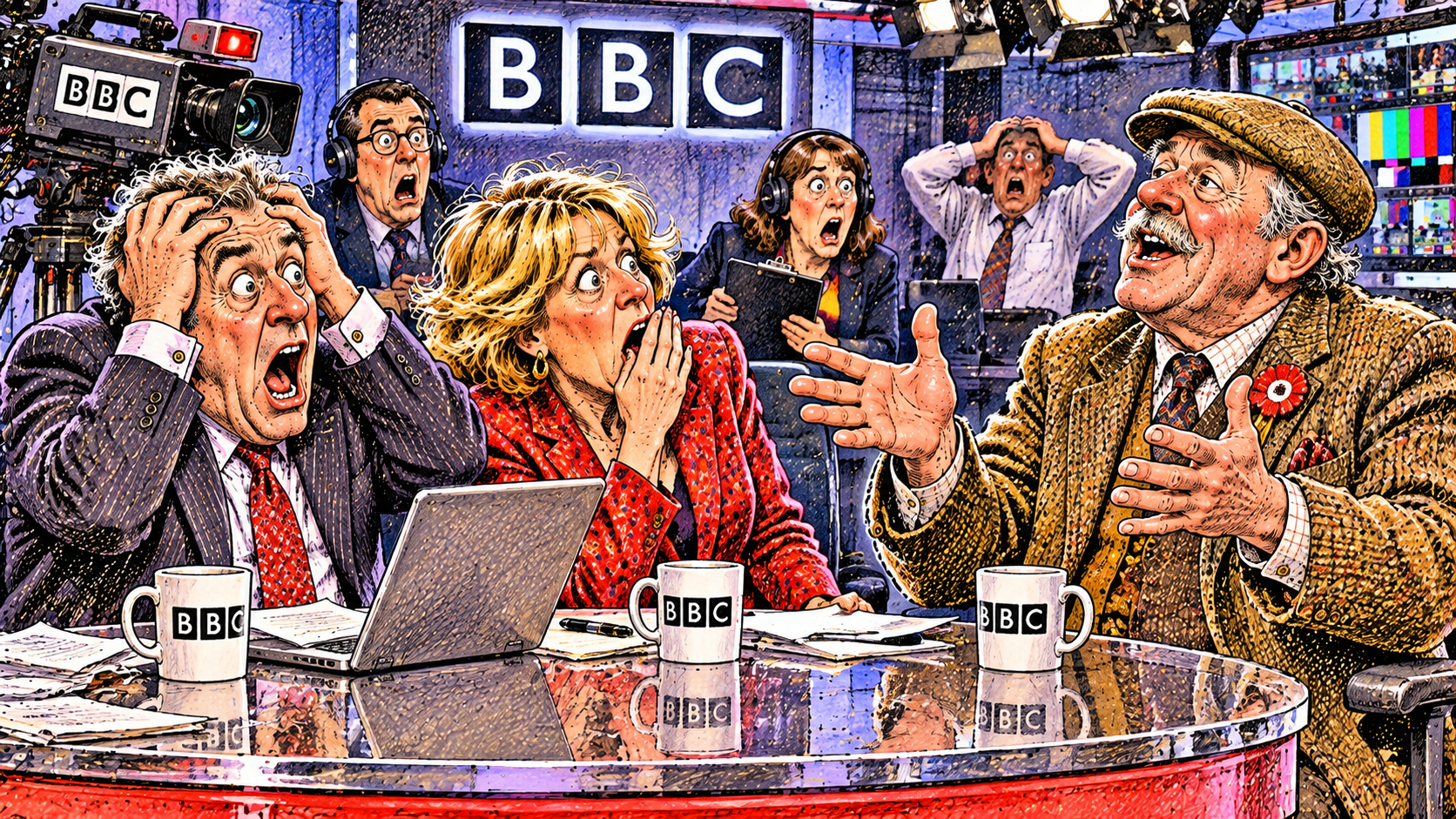
Until now, the British television debate has operated according to a straightforward formula. One person begins speaking. Three people interrupt. The presenter demands order while interrupting everyone, and the programme concludes that Britain is deeply divided.
The division is then examined in a second programme featuring exactly the same people.
Listening Could Eliminate 90 Percent of Political Television
The modern television panel ordinarily features five people who have been selected because they disagree with one another.
They also disagree with the concept of taking turns.
A commentator may begin, “The economic evidence suggests…”
At this point, another commentator shouts, “THAT IS COMPLETELY WRONG!”
The first commentator hasn’t supplied any evidence yet, but apparently the second has acquired the extraordinary ability to disagree with information before receiving it.
This could represent the next great breakthrough in British education. Universities might award degrees before students attend lectures, allowing graduates to explain why their professors are mistaken without wasting three years listening to them.
Under the James proposal, each television guest would be required to repeat the previous guest’s argument accurately before responding.
Television executives fear the entire format would collapse.
There is also the possibility that two guests might discover they agree on something. Such an outcome could be disastrous for advertising revenue.
Britain Has Replaced Reading With Online Outrage
The problem extends well beyond television.
According to Ofcom’s 2025 Online Nation findings, British adults spent an average of approximately four and a half hours online daily. The Reuters Institute Digital News Report has spent years tracking how little of that time involves finishing an actual news article.
Four and a half hours.
Human civilisation once used that amount of time to grow food, build houses, and occasionally discover a new continent.
Modern Britain uses it to argue with someone called BrexitPatriot1967 about whether a photograph of a pigeon proves the government is corrupt.
James advised people to listen before responding. Social media has adopted a more efficient arrangement: respond immediately, read selectively, and become furious before understanding what happened.
The average online argument begins with an article that nobody reads, continues with accusations unrelated to its contents, and concludes when someone mentions Hitler.
Participants then congratulate themselves on winning.
A reasonable question has arisen: could Britain’s digital economy survive if citizens actually examined an article before condemning it?
Technology firms are investigating whether anger can be manufactured without the inconvenience of information.
Some Guests Aren’t Listening, They’re Reloading
Psychologists distinguish between hearing sounds and actively listening.
British broadcasters have developed a third category: waiting for a gap in somebody else’s speech large enough to insert a personal monologue.
You can see the process happening. The commentator’s eyebrows rise. His body leans forward. His mouth opens slightly. He is not processing the previous statement. He is warming up his rebuttal.
The human ear has become decorative equipment attached to a professional interruption device.
The situation becomes especially dangerous when a guest announces, “Can I just finish?”
In Britain, this phrase is interpreted as permission for everybody else to begin speaking simultaneously.
An entire industry has emerged around people interrupting one another about how badly society communicates.
Scientists Fear Britain Could Become Less Angry
James also advises people to be slow to anger.
This would fundamentally alter newspaper comment sections, political podcasts, and radio phone-ins.
Imagine a caller announcing that he disagrees with a government policy. Instead of shouting, the presenter asks why. The caller explains his experience. The presenter considers the answer. Both discover that the situation is complicated.
The programme immediately loses 70 percent of its rhetorical violence and gains something far more dangerous: useful information.
Consider the present distinction between expertise and volume. A knowledgeable specialist often qualifies conclusions, recognises uncertainty, and discusses competing evidence.
A man who read three social media posts confidently announces that everybody else is an idiot.
Naturally, the second man gets the television booking.
The National Emergency of Letting Someone Else Be Interesting
Britain also suffers from people who believe interrupting is a spiritual gift.
Someone mentions spending a weekend in Manchester. Another person interrupts to explain how he once visited Barcelona. Someone mentions a headache. Another announces that he has endured seven medical procedures, two car accidents, and a particularly disappointing holiday in Tenerife.
Even conversations about personal tragedy become competitive sporting events.
The James proposal threatens this entire arrangement by suggesting that someone else’s story deserves attention.
The BBC could test the system by introducing a programme in which guests listen carefully, answer the question asked, and refrain from raising their voices.
It might initially struggle for viewers.
But the public could learn something revolutionary: disagreement does not require hostility, confidence does not require shouting, and intelligence sometimes involves admitting that another person knows something you don’t.
That still leaves the problem of filling the remaining fifty-eight minutes of the programme.
Five Humorous Observations
- “Can I just finish?” In Britain that’s not a question. That’s the starting pistol.
- A panel show is five people paid to disagree, followed by genuine shock that nobody agrees. It’s like hiring five arsonists and wondering why the house is on fire.
- Four and a half hours online a day. You know what else takes four and a half hours? A flight to Marrakech. We’re not going anywhere, we’re just arguing with a pigeon guy at speed.
- The presenter’s job is to keep order, so naturally he’s the one cutting in to ask why everybody keeps cutting in.
- Everyone’s got that mate who isn’t listening, he’s reloading. Eyes glazed, mouth half-open, like a man loading a crossbow in a library.
SOURCE: Ofcom, Online Nation 2025.
Editorial Disclaimer
This report stretches James 1:19 across British broadcasting for comic effect. The Ofcom and Reuters Institute research it links to is real; the collapsing industry, the 90 percent figure and the scientists alarmed by a calmer Britain are not. No presenter has yet let us finish this sentence, so viewers who prefer their news uninterrupted should try our UK satirical news or our guide on how to tell satire from real news.
These stories are presented as an entirely human collaboration between two sentient beings: the world’s oldest tenured professor and a philosophy major turned dairy farmer.
Their central argument remains serious: Britain would benefit enormously from a greater eagerness to hear, a little more restraint in speaking, and considerably less enthusiasm for becoming angry. After all, God gave us two ears and one mouth. Westminster has spent centuries trying to reverse the arrangement.

Mei Lin Chen is a student writer whose satire explores identity, modern culture, and social nuance. Her work reflects academic curiosity and engagement with London’s diverse perspectives.
Expertise is growing through study and practice, while trust is supported by clear intent and responsible humour.