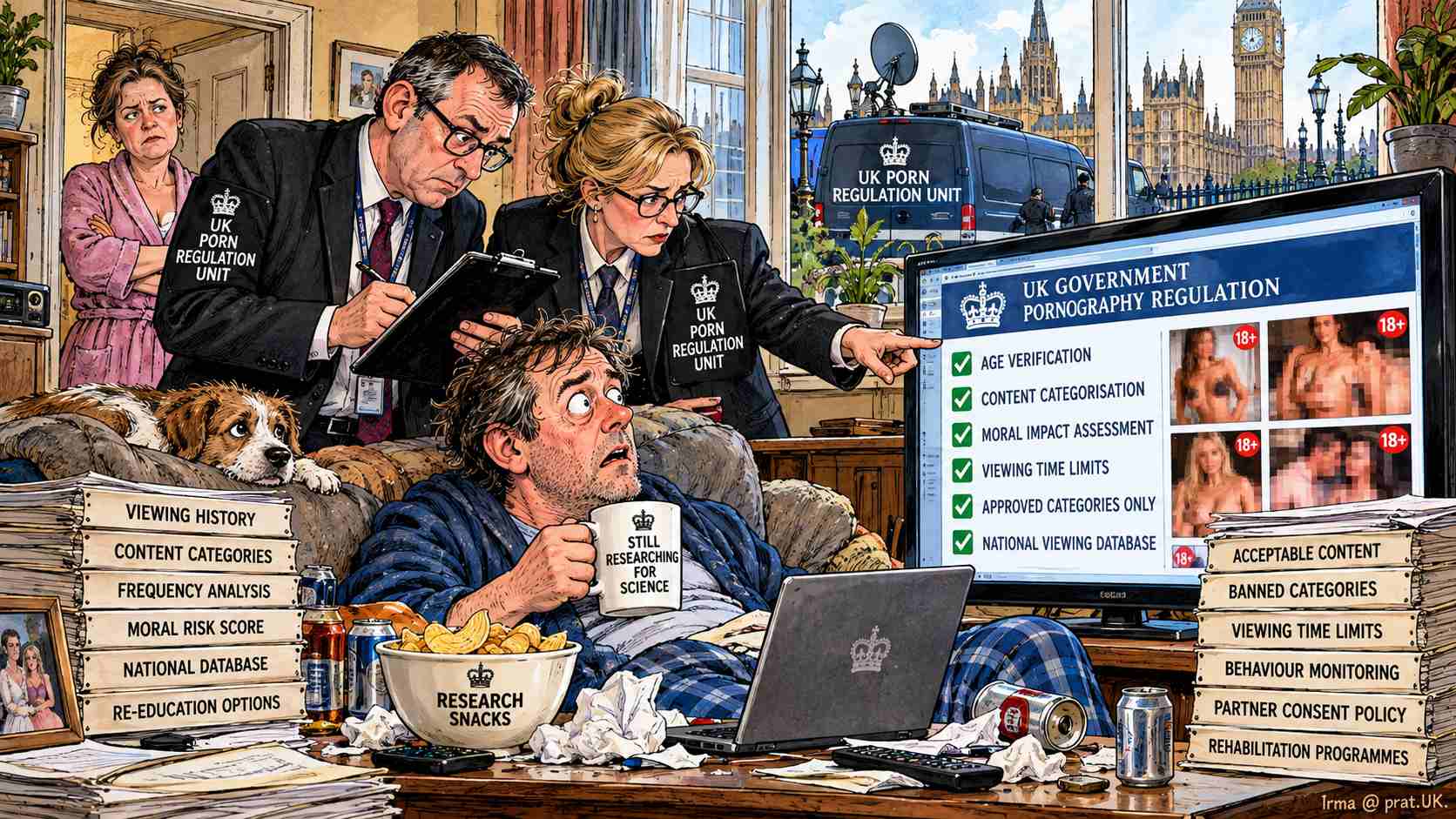
Victorian Morality Returns to Britain, Although the Nation Can No Longer Afford Victorian Plumbing
LONDON, ENGLAND | The ghost of Queen Victoria has reportedly emerged from Windsor Castle to congratulate the British government on its latest pornography restrictions, declaring that Britain has finally returned to the moral atmosphere of the nineteenth century without the expense of maintaining the world’s largest empire.
Her Majesty, who reigned from 1837 until 1901, expressed considerable satisfaction that the country had discovered a new method of regulating sexual behaviour despite its continuing inability to operate a reliable train service.
“One is most pleased,” the Queen reportedly announced during a supernatural briefing attended by three historians, two civil servants and a frightened corgi.
“In my day, we conquered continents, constructed railways and told people what they could do in their bedrooms. Modern Britain appears to have retained only the last responsibility.”
The monarch’s apparition expressed surprise that the country had developed computers, smartphones and international communications networks, only to employ these astonishing inventions for the purpose of supervising private morality.
“This is progress?” she demanded. “We managed similar achievements using lace curtains, suspicious neighbours and the Church of England.”
Victorian Morality and Modern Britain: Empire Collapses, Moral Superiority Survives Completely Unharmed
Historians have long debated the contradictory moral values of Victorian Britain, a period in which respectable society publicly celebrated virtue while much of London conducted an extremely profitable trade in vice.
According to Professor Archibald Prudence, chairman of the Royal Institute of Unnecessary Historical Comparisons, the Victorians perfected the art of considering themselves morally superior without requiring particularly convincing evidence.
“The Victorian gentleman could condemn sexual immorality at breakfast, investigate it personally at lunchtime and give a parliamentary speech about protecting public virtue before dinner,” Prudence said.
“He was the original multitasking British politician.”
The professor noted that Victorian society combined extraordinary industrial achievements with elaborate rules concerning personal conduct.
“Modern Britain has reversed the formula. We’ve kept the elaborate rules and outsourced the extraordinary industrial achievements.”
The new restrictions under the Crime and Policing Act 2026 specifically target explicit depictions of strangulation, suffocation, incestuous sexual activity and adults represented as children under 16. The government presents these measures, in its own official factsheet, as protections against the normalisation of violence and abuse, rather than a general prohibition of adult sexuality.
Victoria listened to this explanation before demanding to know why the government had not simply ordered everyone to behave.
“Because, Your Majesty,” said a civil servant, “people now have individual rights.”
“How inconvenient,” replied the Queen.
Queen Victoria Discovers the Internet and Immediately Requests Its Closure
The royal apparition’s enthusiasm faded considerably when officials attempted to explain how pornography reaches the modern British public.
A government technology adviser demonstrated a smartphone.
Victoria examined the device for approximately eleven seconds before demanding that the entire Royal Navy be mobilised.
“Every human indecency available instantly through a pocket-sized looking glass?” she asked. “And the public is permitted to carry these things without a licence?”
The adviser explained that smartphones also provide banking, shopping, navigation and access to government services.
“Government services?” the Queen replied. “Then I understand why so many people spend their time looking at naked strangers instead.”
An official attempted to reassure Her Majesty that modern technology had greatly improved British living standards.
He then spent twenty minutes trying to connect the palace Wi-Fi.
Victoria became so frustrated that she ordered him transported to Australia.
Unfortunately, officials explained, Australia had achieved independence and now possessed its own immigration department.
“Good heavens,” the Queen responded. “We’ve lost everything except the paperwork.”
The Victorian Bedroom Makes a Triumphant Return
The Queen’s visit prompted renewed debate about the relationship between law, private morality and individual liberty.
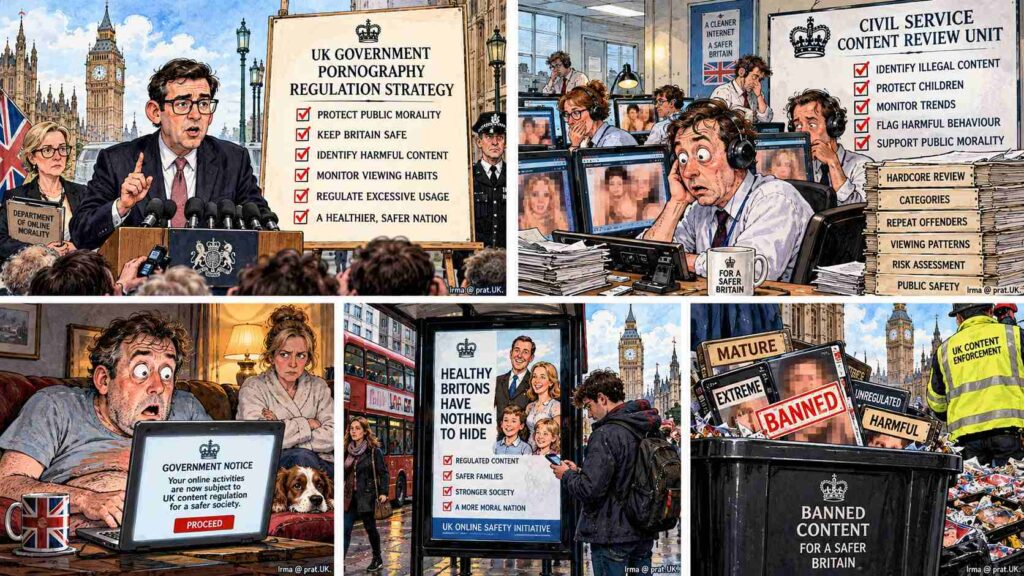
A Victorian historian observed that modern Britain is attempting to reconcile competing principles that governments have struggled with for centuries: protecting people from exploitation and violence while preserving lawful private freedom.
Victoria considered the matter unnecessarily complicated.
“Protect the innocent, punish criminals and leave respectable married couples alone,” she declared.
When informed that contemporary politicians frequently find agreement on the first two principles but struggle with the third, she expressed immediate recognition.
“Parliament has not changed at all.”
A London antiques dealer subsequently reported a sharp increase in enquiries about Victorian bedroom furniture.
Customers reportedly appreciated the heavy curtains, enormous wardrobes and beds designed to withstand the weight of both generations of family guilt.
One customer requested a Victorian marriage manual.
The dealer supplied a blank notebook.
“That covers everything,” he said.
Before returning to Windsor Castle, Victoria issued one final statement concerning the country’s moral direction.
“Britain once ruled the waves,” she declared. “Now it regulates what people stream.”
The ghost disappeared shortly afterward.
Historians believe she had seen the electricity bill.
Five Humorous Observations
- Queen Victoria ruled a quarter of the planet and couldn’t work out a smartphone in eleven seconds. Fair. I’ve had mine six years and I still can’t find the button that makes my mother stop calling.
- “Transported to Australia.” That used to be a punishment. Now Australians get a better pension and a nicer beach. We’re the ones who got transported, mate. To a Pret.
- Victorians said sex was disgusting and then produced eleven children each. That’s not morality. That’s a man shouting at the sea while the tide comes in on his lap.
- The Queen demands a Victorian marriage manual and the antiques dealer hands over a blank notebook. Honestly the most accurate relationship advice ever sold in London. Page one: figure it out. Page two: don’t talk about it.
- The ghost left because she saw the electricity bill. That’s the real haunting. Forget Windsor. Every single ghost in Britain is somebody who opened an energy statement in January.
Editorial Disclaimer
This article is satirical commentary inspired by genuine changes to pornography legislation in England and Wales. The parliamentary debates, regulations and specified legal penalties have a factual basis. The comic interviews, extraordinary appointments, supernatural consultations and domestic scandals are presented for humour and social criticism. Her late Majesty was not amused by this disclaimer, though she was rarely amused by anything, including the British Onion, which she is said to read nightly from the afterlife.
This story is entirely a human collaboration between two sentient beings: the world’s oldest tenured professor and a philosophy major turned dairy farmer.
SOURCE: Deseret News

Lowri Griffiths brings a distinct voice to satirical journalism, combining cultural critique with dry humour. Influenced by London’s creative networks, her writing reflects both wit and discipline.
Her authority stems from experience, while trust is built through transparency and ethical satire.