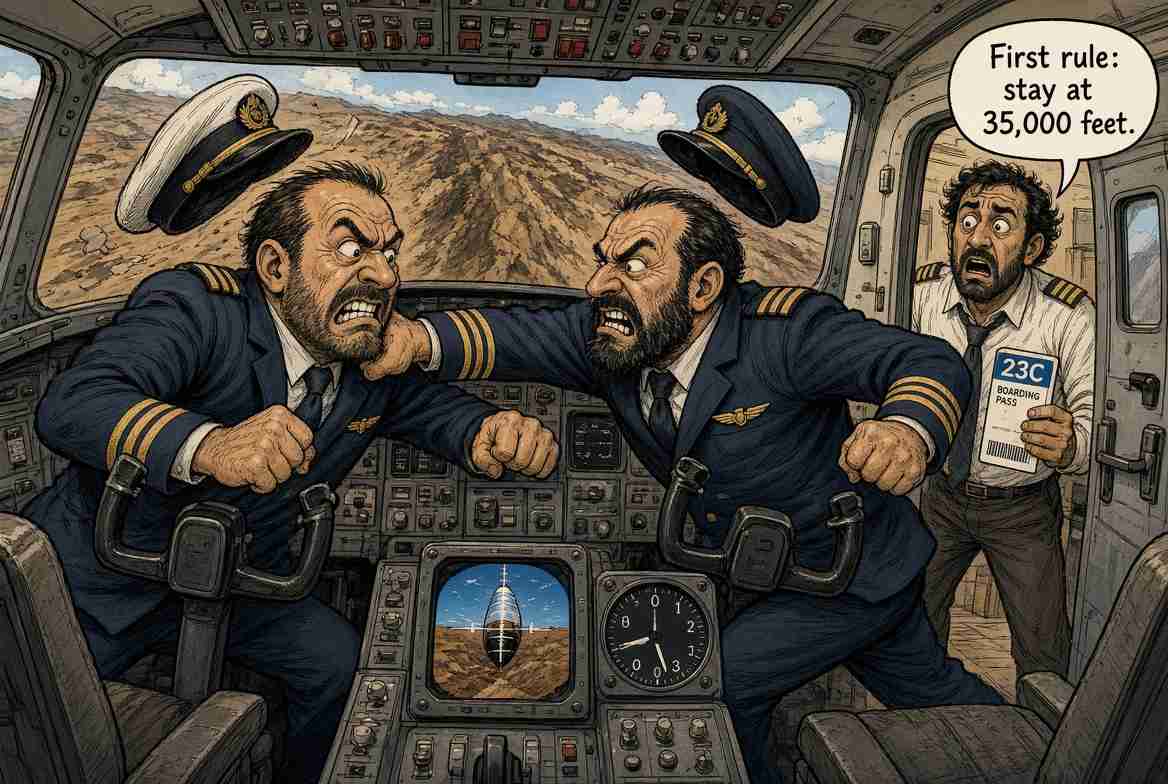
Flydubai Pilots Turn Cockpit Into Fight Club, Forget First Rule of Fight Club Is Keep the Boeing at 35,000 Feet
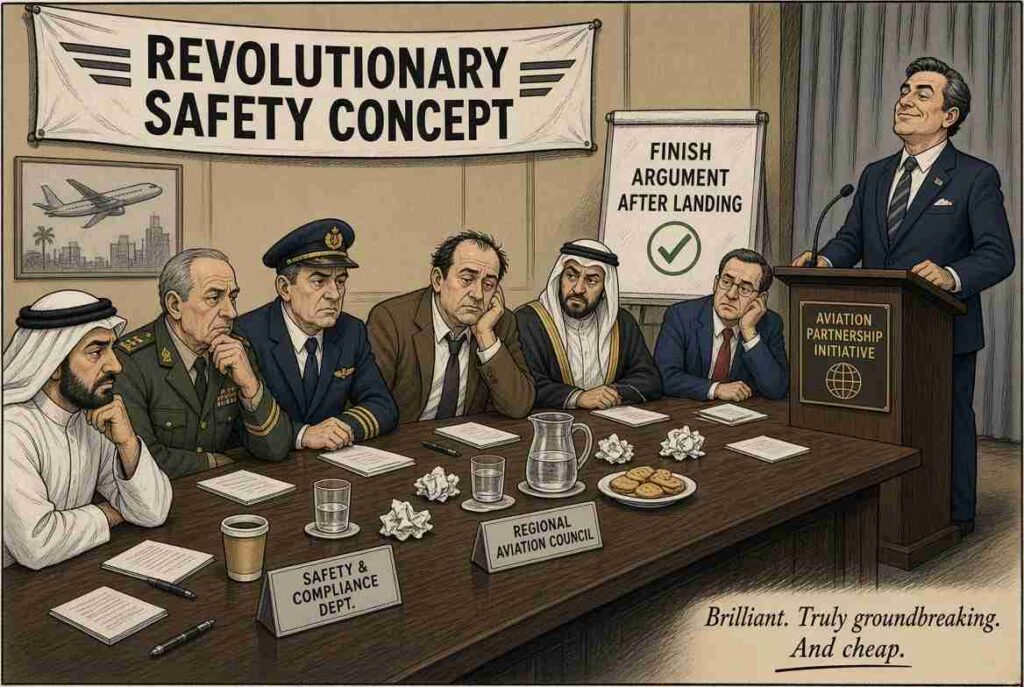
Airline industry reportedly considering revolutionary safety concept known as “finish argument after landing”
TABUK, Saudi Arabia — A Flydubai flight from Dubai to Tel Aviv provided passengers Wednesday with an unexpected demonstration of why aviation traditionally prefers pilots to fight gravity rather than each other.
What Happened on Flydubai Flight FZ1073 Over Saudi Arabia
Flight FZ1073 departed Dubai at 03:05 UTC and climbed to 34,000 feet, according to Flightradar24. Later, the aircraft entered a series of sharp altitude changes before eventually stabilizing near 15,000 feet. It transmitted emergency code 7700, then code 7500, indicating unlawful interference, before returning to 7700 and landing safely at Tabuk Airport in Saudi Arabia.
Reuters subsequently reported that an Israeli official said the emergency occurred after the pilots became involved in a physical altercation. Flydubai has publicly confirmed only that the aircraft “experienced an incident,” landed safely, and that all passengers were accounted for.
Why “Incident” Is the Airline Industry’s Favorite Understatement
That is an impressively restrained definition of “incident.”
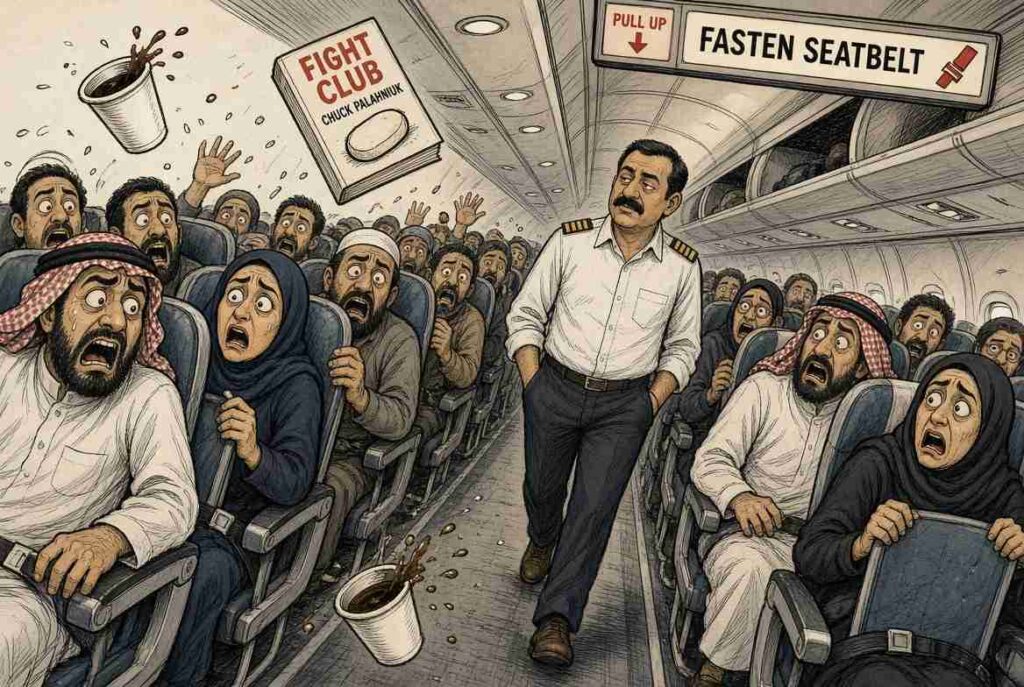
If your toaster catches fire, that is an incident.
If your luggage goes to Copenhagen while you go to Tel Aviv, that is an incident.
When the people operating the Boeing appear to have entered into physical disagreement while hundreds of thousands of pounds of aircraft are moving through the sky, we may need to promote the vocabulary slightly.
Aviation officials are now expected to review the little-known safety principle known as Pilots Should Not Hit Each Other While Flying the Airplane.
The policy had apparently existed previously as an informal understanding, alongside “close the door,” “check the fuel” and “do not attempt to parallel park at Heathrow.”
Passengers said afterward that they had chosen Flydubai largely because the ticket did not advertise combat sports.
“I paid for economy,” said one thoroughly imaginary traveler created for purposes of satire, “and somehow received ringside seating.”
Airline Passenger Rules Now Need a Pilot Behavior Clause
For decades, airlines have warned passengers about disruptive behavior.
Do not smoke.
Do not interfere with cabin crew.
Do not open the emergency exit.
Do not become intoxicated.
Perhaps the preflight announcement now requires one additional sentence:
“Ladies and gentlemen, federal and international regulations also prohibit the captain and first officer from settling personal differences through the ancient diplomatic technique of grappling.”
Researchers at the Institute for Things Everybody Thought Were Already Obvious estimate that 99.999 percent of passengers prefer pilots who remain on speaking terms until the wheels touch the runway.
The remaining 0.001 percent work in television.
The Hardest Engineering Problem in Aviation Is Two Humans in a Cockpit
The incident also demonstrates the enormous challenge facing airline safety engineers. They can build redundant hydraulic systems. They can duplicate navigation instruments. They can install sophisticated autopilots.
But eventually somebody has to put two human beings together in a small room for several hours. Aviation calls the discipline of making that work crew resource management. Everyone else calls it Thanksgiving dinner.
That is where engineering meets Thanksgiving dinner.
Aircraft manufacturers might therefore redesign future cockpits with a yellow line running between the captain and first officer.
“Remain on your side until landing.”
A tiny mediator could be stored beneath the jump seat.
If tensions rise, an automated voice would announce:
“Pull up. Pull up. Also, Kevin, stop bringing up what happened in Dubai.”
The Fight Club Rule Aviation Needs to Rewrite
The miracle of aviation remains that millions of people routinely cross continents safely while sitting in pressurized aluminum cylinders seven miles above Earth.
Passengers accept this because they trust the professionals in front.
They do not expect to discover that somewhere over the Middle East the cockpit has become a branch office of Fight Club.
Especially because Fight Club had one important rule aviation apparently needs to rewrite:
Whatever else happens, keep the Boeing flying.
Humorous Observations About the Flydubai Cockpit Fight
- Airline safety demonstrations have always explained what to do if the cabin loses pressure, but apparently nobody covered what to do if the pilots lose patience.
- The cockpit door was designed to keep trouble out. Aviation regulators may now need to consider the possibility that trouble already has a lanyard.
- Passengers buy airline tickets assuming the pilots have already settled whatever argument they were having about politics, football, parking, or who touched the thermostat.
Satire Disclaimer: What Is Confirmed and What Is Comedy
This satire riffs on a developing aviation incident reported on September 30, 2026. The confirmed foundation is that Flydubai Flight FZ1073 diverted from its Dubai-to-Tel Aviv route and landed safely in Tabuk, Saudi Arabia; Flightradar24 recorded emergency transponder codes 7700 and 7500 and major altitude changes; Flydubai confirmed an onboard “incident”; and Reuters reported that an Israeli official attributed the emergency signals to a physical altercation between the pilots. Some dramatic details remain subject to investigation and confirmation.
Everything beyond that factual scaffolding is satire, exaggeration, absurd deduction and the understandable reaction of anyone who believes pilots should maintain approximately the same number of workplace fights per flight as lighthouse keepers.
This story is entirely a human collaboration between two sentient beings: the world’s oldest tenured professor and a philosophy major turned dairy farmer. Neither has ever piloted a Boeing 737, which may explain why both remain on excellent terms with air traffic control.
Reporting Sources
- Reuters reporting on the diversion, emergency signals, passenger safety and the account of the pilots’ altercation: Reuters report on Flydubai Flight FZ1073
- Flightradar24 flight data documenting the aircraft’s altitude, route and 7700 to 7500 to 7700 transponder sequence: Flightradar24 analysis of FZ1073
- Early coverage of the emergency signal and Israeli Air Force response: The Times of Israel live coverage
- Flydubai’s statement confirming the diversion, safe landing and safety of the passengers: Flydubai official website

Alan Nafzger was born in Lubbock, Texas, the son Swiss immigrants. He grew up on a dairy in Windthorst, north central Texas. He earned degrees from Midwestern State University (B.A. 1985) and Texas State University (M.A. 1987). University College Dublin (Ph.D. 1991). Dr. Nafzger has entertained and educated young people in Texas colleges for 37 years. Nafzger is best known for his dark novels and experimental screenwriting. His best know scripts to date are Lenin’s Body, produced in Russia by A-Media and Sea and Sky produced in The Philippines in the Tagalog language. In 1986, Nafzger wrote the iconic feminist western novel, Gina of Quitaque. He currently lives in Holloway, North London. Contact: [email protected]