Westminster Discovers That Every Inspiring Political Vision Eventually Encounters a Man Named Nigel From Accounts
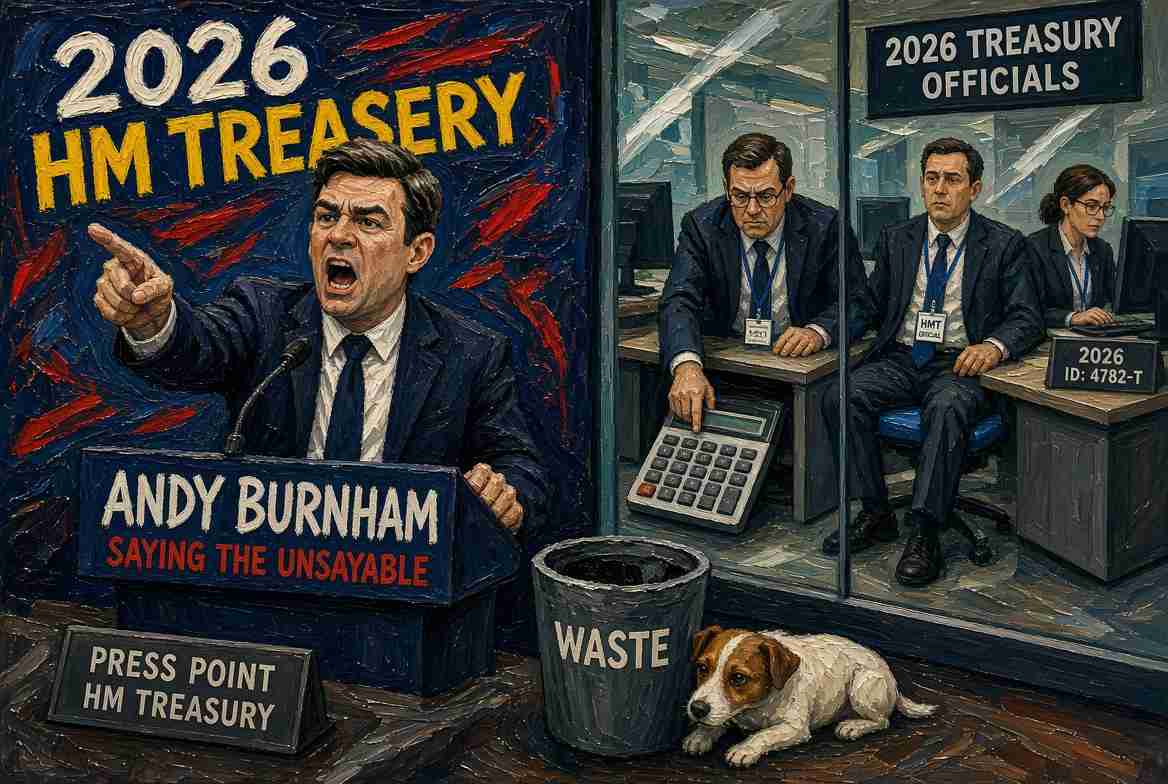
LONDON – Andy Burnham says he wants to discuss the things politicians usually avoid. This has caused immediate panic in Westminster, where avoiding things politicians usually avoid is one of the few remaining growth industries.
Reuters says Burnham’s conference message will pair an “honest conversation” with difficult choices over social care, utilities and public spending, after his government introduced immediate cost-of-living measures including capped bus fares and removing VAT from electricity bills. The wider conference coverage adds that the prime minister will say hope comes from honesty, which is a lovely sentiment for a building that also houses the Treasury.
What Happens When a Political Idea Meets the Treasury
Then comes the Treasury.
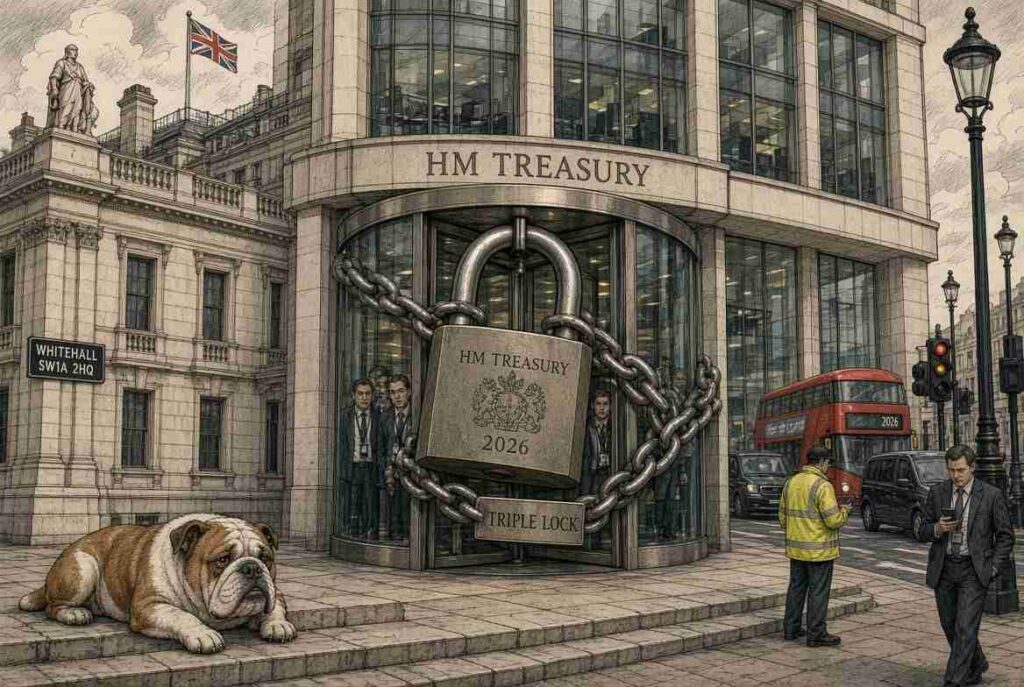
The Treasury is where political ideas go in wearing trainers and come out wearing orthopedic shoes.
Every proposal arrives saying, “Wouldn’t it be wonderful if…”
It leaves three hours later asking whether anyone has considered means-testing oxygen.
Burnham’s promise to say uncomfortable things therefore presents Britain with an unusual spectacle: a prime minister voluntarily approaching a calculator.
Most politicians prefer calculators only when announcing how many nurses, police officers or green jobs will appear in a constituency that happens to contain a camera crew.
The Four Stages of Public Spending, Explained by an Expert
An analyst from the Institute for Looking Concerned explained the process.
“There are four stages of public spending. First, announce the vision. Second, discover the cost. Third, blame the previous government. Fourth, create a commission to determine whether mathematics has an ideological bias.”
Britain’s finances are especially good at ruining speeches because numbers lack party loyalty. The Office for Budget Responsibility has no manifesto, no whip and no interest in anybody’s conference slogan, which is why its forecasts are the only documents in Westminster that regularly make an entire room go quiet.
A billion pounds costs a billion pounds under Labour, Conservative, Liberal Democrat and, according to preliminary research, even under interpretive dance.
Britain’s Voters Want More Spending and Lower Taxes at the Same Time
The public, meanwhile, remains wonderfully consistent.
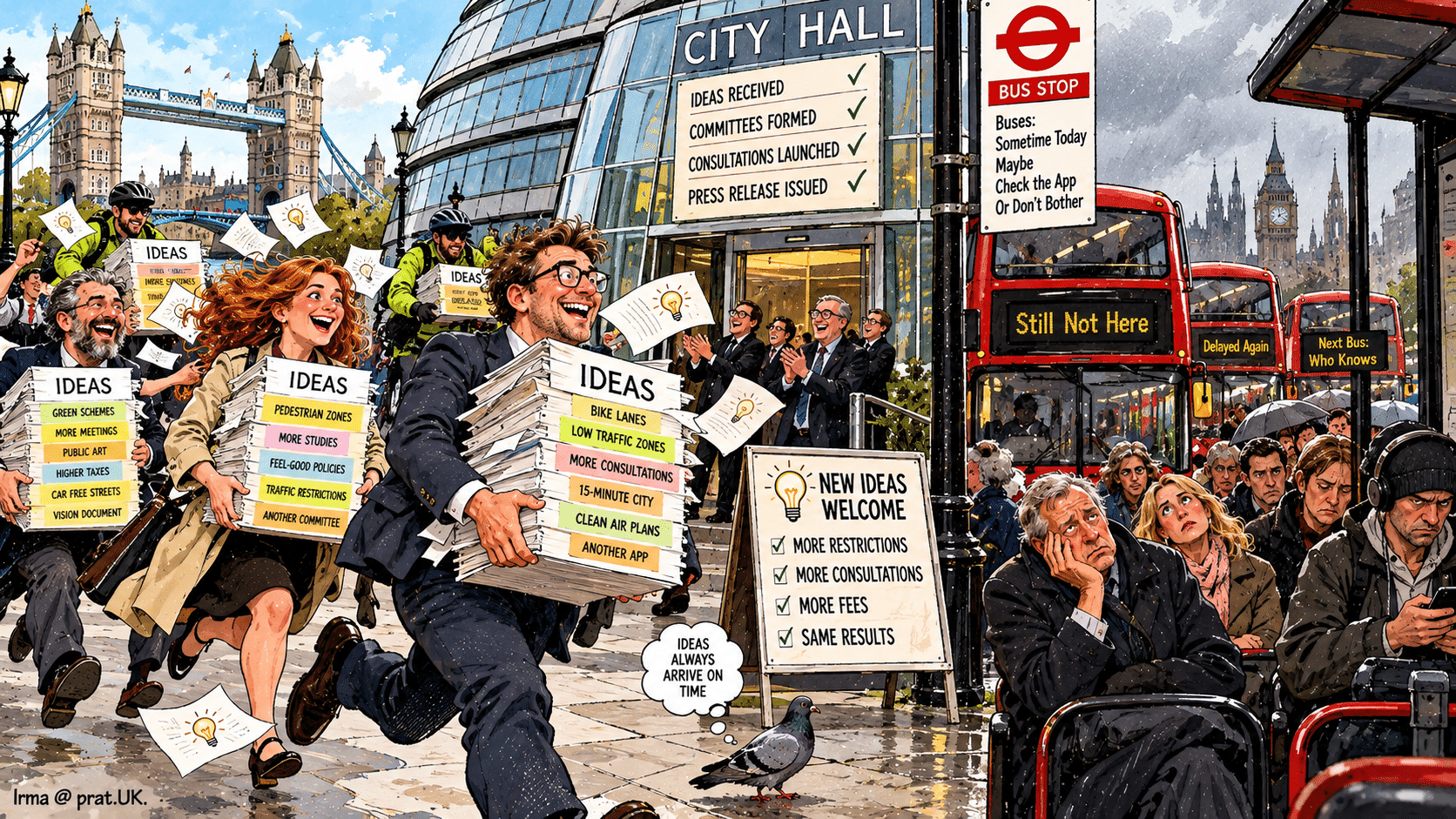
In an entirely unscientific survey conducted at a bus stop, 100 percent of respondents supported more spending on services they personally use and spending cuts on services they recently learned existed. Researchers at the Resolution Foundation and the Institute for Fiscal Studies have reached broadly the same result using far more expensive bus stops.
One man demanded lower taxes, better roads, free social care, cheaper electricity and a balanced budget.
Asked how this should be achieved, he replied:
“Efficiency.”
Efficiency is the traditional British unit of imaginary currency.
Cost-of-Living Measures, Capped Bus Fares and the Bill Nobody Mentions
Capped bus fares and VAT-free electricity are the sort of policies that look wonderful on a poster and slightly more complicated on a balance sheet. Somebody, somewhere, has to fund the gap, and the Institute for Government has spent years reminding ministers that policies are not free simply because they arrive with a cheerful colour scheme.
This is the awkward bit at the heart of the “honest conversation”: the popular measures arrive first, and the explanation of who pays arrives later, in a font size best described as “aspirational.”
Ending Politics as Usual, or Bringing Back Free Imaginary Money?
Burnham’s “honest conversation” may therefore require the prime minister to perform the most dangerous act in democratic politics: completing a sentence about public services with the words “and here is the bill.”
That is when the Treasury will emerge from behind a curtain holding a calculator like a priest carrying bad medical results.
Perhaps this is what Burnham means by ending politics as usual. Instead of promising that every problem can be solved painlessly, he will explain the trade-offs.
Of course, Britain may then demand the old politics back.
At least that came with free imaginary money.
Humorous Observations on the Treasury and the Missing Calculator
- The Treasury calculator is kept in a glass case marked “Break in emergency, ideally not during conference season.”
- Nigel from Accounts has now been promoted to “Head of Reality” and is not enjoying it.
- “Efficiency savings” are the ghost stories of British government: everyone has heard of them, nobody has met one.
- A politician saying “I’ll be honest with you” is a lovely early-warning system for weather events involving tax.
- Means-testing oxygen has been ruled out, largely because the Treasury cannot work out who would invoice whom.
- Every bus stop in Britain contains a better economic forecast than the average think-tank, and it is usually written on the shelter in marker pen.
- The last minister to ask “how much will it cost?” was given a sedative and a cup of tea.
- Britain’s national motto remains “Terms and conditions apply.”

I am a Lagos-born poet and satirical journalist navigating West London’s contradictions. I survived lions at six, taught English by Irish nuns, now wielding words as weapons against absurdity. Illegal in London but undeniable. I write often for https://bohiney.com/author/junglepussy/.
As a young child, I was mostly influenced by the television show Moesha, starring singer and actress Brandy. Growing up, I would see Brandy on Moesha and see her keeping in her cornrows and her braids, but still flourish in her art and music, looking fly. I loved Moesha as a child, but now I take away something more special from it. Just because you’re a black girl, it doesn’t mean you need to only care about hair and makeup. Brandy cared about books, culture and where she was going — you can do both.