Nation Remembers Every Government Prospectus Contains a Magical Paragraph Beginning “Subject to Available Resources”
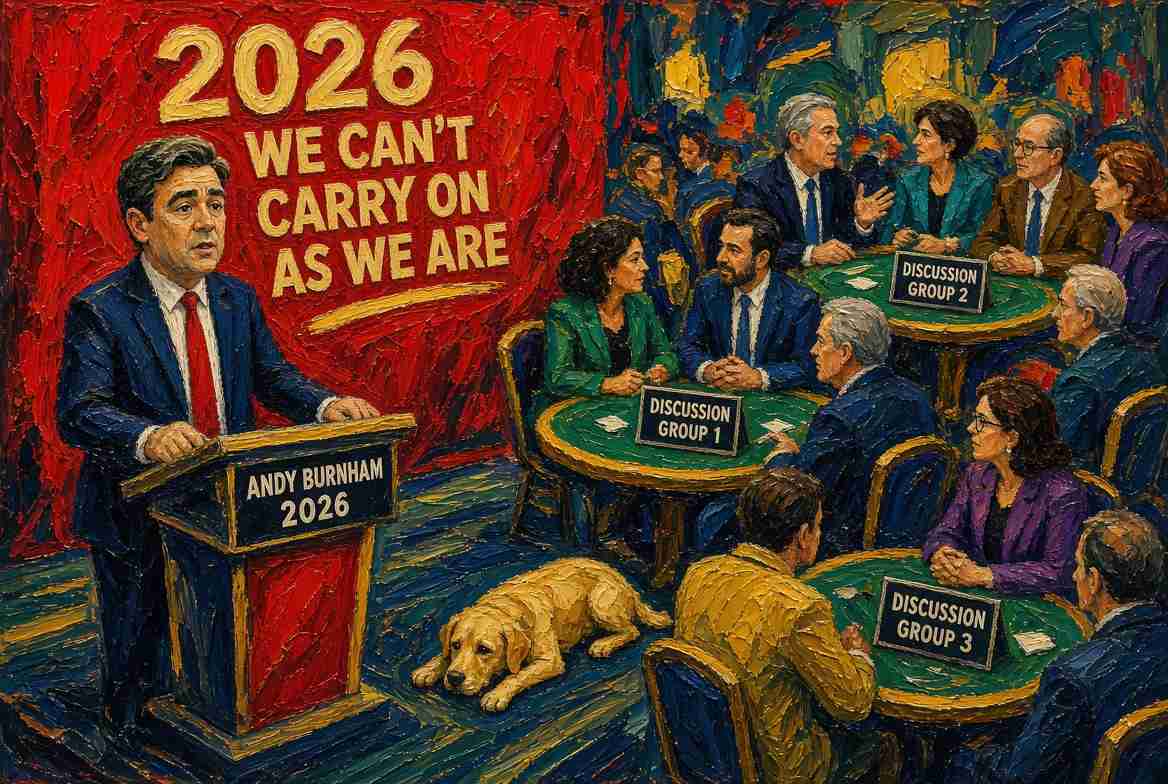
LONDON – Andy Burnham is promising what his team describes as a serious prospectus for Britain, with policies touching social care, youth unemployment and greater public control of utilities. Reuters also reports that businesses have pressed for more detail on how some of his larger ambitions would work.
This is where British politics enters its natural habitat:
The small print.
Two Versions of Every Government Document: The Podium and the PDF
Every government document has two versions.
There is the version spoken at the podium, where Britain strides confidently toward renewal.
Then there is the PDF, where Britain advances “subject to consultation, affordability, market conditions, statutory obligations and Darren from Legal getting back from annual leave.”
The phrase “serious prospectus” is excellent because a prospectus is something nobody reads until money disappears.
Burnham says people want direction.
Businesses want details.
Voters want results.
The Treasury wants everyone to lower their voices.
Buying a Mobile-Phone Contract: The Best Analogy for Public Policy
Public policy thus resembles buying a mobile-phone contract.
The front page says:
UNLIMITED NATIONAL RENEWAL.
Page 47 explains that renewal is available only between 2:00 and 4:00 a.m., in selected postcodes, excluding Scotland, Christmas and periods of fiscal stress.
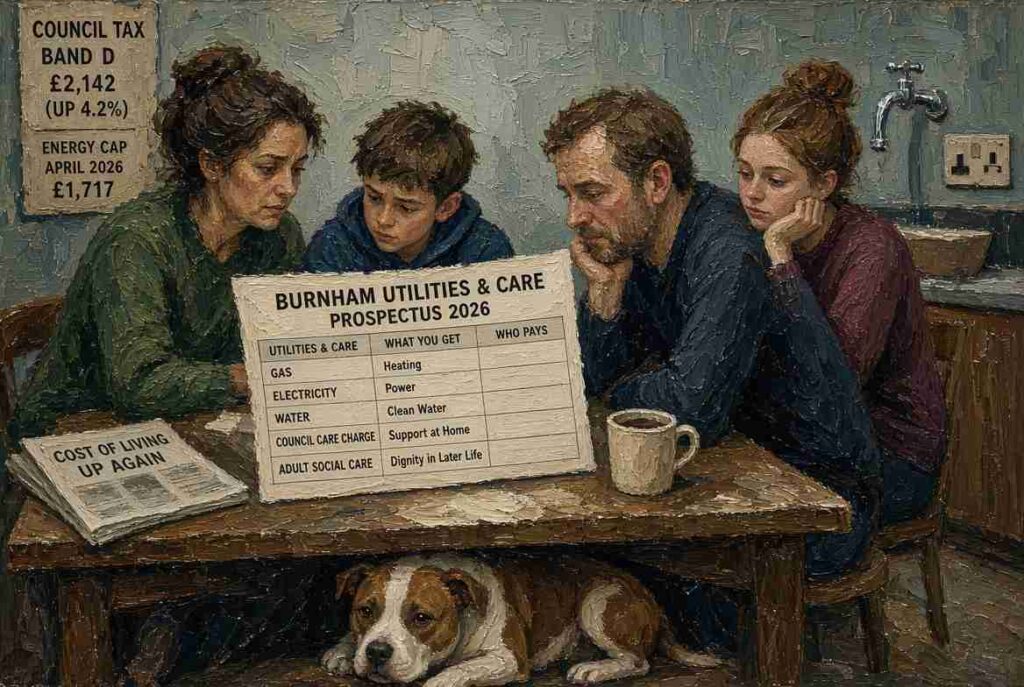
What Does ‘Greater Public Control’ of Utilities Actually Mean?
Consider utilities.
Greater public control sounds simple until somebody asks what “control” means.
Ownership?
A sternly worded letter?
Britain has spent decades perfecting the art of describing economic arrangements with nouns sturdy enough to survive any outcome. Conference coverage points to a new body, GB Grid, being set up under the Great British Energy umbrella, which would be the first publicly owned player in electricity networks since privatisation. Meanwhile Ofgem and Ofwat continue to regulate the sectors in question, which means the phrase “public control” now has at least four possible owners, two regulators and one very tired intern.
Why Businesses Keep Asking for More Detail on Big Government Ambitions
Business leaders, it should be said, have a point. Companies cannot plan investment around a sentence that begins “we will explore,” and the Bank of England has spent years noting that uncertainty is not a growth strategy, although it usually says so in a tone that suggests it would prefer to be discussing something with a decimal point.
To the government’s credit, a prospectus is a step up from the alternative, which is a slogan. A slogan can be printed on a lectern. A prospectus must eventually be printed on paper, bound, sent to a select committee and read by a person named Priya, who will spot the missing figure on page 31 and ask about it in front of a camera.
Ministers therefore face a delicate balancing act: provide enough detail to sound serious, but not so much that a journalist can subtract one page from another. This is known in Whitehall as “strategic clarity,” and in the rest of the country as “fog with a logo.”
Social Care Funding: Taxes, Borrowing or a Chest of Spanish Doubloons?
The same applies to social care.
Everyone wants dignity, security and a functioning system.
The disagreement arrives with the invoice.
Should funding come from taxes, borrowing, spending changes, pension reform or a previously undiscovered chest of Spanish doubloons beneath the Treasury?
At conference, nobody likes the doubloon question. Economists at the Institute for Fiscal Studies have been asking it politely for years, and the King’s Fund has been quietly checking the beach.
How Modern Policy Language Creates Confidence Without Triggering Arithmetic
An expert from the Centre for Very Serious Prospectuses explained that modern policy language is designed to create confidence without triggering arithmetic.
“You say ‘investment’ rather than ‘spending,’ ‘reform’ rather than ‘change,’ and ‘difficult choices’ instead of ‘somebody is going to be furious by Thursday.'”
This is not unique to Burnham. It is practically constitutional.
Britain has no single written constitution, possibly because officials are still waiting for the consultation to close.
The Public Can Handle Complexity, Just Not 146 Pages of ‘More Details Later’
The public can tolerate complexity. It buys mortgages, compares energy tariffs and has successfully understood airline baggage rules, which means it is capable of advanced theoretical physics.
What people fear is discovering that “serious prospectus” translates into a 146-page document whose conclusion is:
More details later.
So by all means, bring on the national blueprint.
Just leave enough room at the bottom for the traditional British phrase:
Terms and conditions apply.
Humorous Observations on Britain’s Serious Prospectus
- A serious prospectus is like a sofa manual: everyone agrees it is important, and nobody can find the missing bolt.
- Darren from Legal has been on annual leave since the Blair government.
- “Subject to available resources” is the political equivalent of a lifeboat that is “subject to availability.”
- Business leaders asking for “more detail” is what British executives say instead of “please stop.”
- The 146-page document is expected to contain 145 pages of context and one page of arithmetic, printed in grey.
- Utilities “under greater public control” will be run by a committee whose first task is to decide who chairs the committee.
- The doubloon question has now been referred to a working group with no pirates.
- It is comforting that in the age of artificial intelligence, Britain’s biggest policy risk remains a paragraph beginning “Notwithstanding.”

Paige Shiver has established herself as a cornerstone of modern British satire through her work at Prat.UK, where she serves as a lead political commentator and cultural critic. With over a decade of experience in investigative journalism and comedy writing, Shiver specializes in deconstructing the absurdities of Westminster and the nuances of the UK’s social landscape.
Her expertise is rooted in a deep understanding of British policy, allowing her to deliver biting critiques that are as factually grounded as they are humorous. Shiver’s commitment to the high art of satire and UK Literature is evidenced by her frequent appearances on BBC Radio 4 and her published anthologies on the decline of political decorum. At Prat.UK, her transparency and rigorous research ensure that even her most satirical takes provide valuable, trustworthy insights into the national conversation.
Paige Shiver @ PaigeShiver.com