Scientists Finally Calculate Exact Odds of Robot Apocalypse: 27.3%
A new formula assigns humanity’s extinction risk down to the decimal point, and Silicon Valley is furious it isn’t higher
SAN FRANCISCO — After years of AI researchers throwing out extinction estimates like carnival barkers guessing your weight, a team of self-appointed doom accountants has finally done what nobody asked for: they math-ed the apocalypse. The number they landed on, after weeks of spreadsheets and at least one full bottle of Malbec, is a suspiciously precise 27.3 percent.
Not 25. Not 30. Twenty-seven point three. Because nothing says “we have rigorously modeled the end of civilization” like a decimal point that implies you also know the second decimal but are choosing to withhold it out of scientific modesty.
The Formula Nobody Asked For
The doom equation, according to its architects, works like this: P(doom) equals the Hype Index multiplied by the CEO Confidence Coefficient, divided by Alignment Funding multiplied by Congressional Attention Span. Each variable was chosen with the seriousness of a peer-reviewed journal and the accuracy of a horoscope.
The Hype Index measures how many times a chief executive says the word “existential” during a keynote without breaking eye contact with the crowd. Current industry average: eleven times per talk, four of which occur before the free breakfast burritos are gone. The CEO Confidence Coefficient measures self-assurance divided by actual comprehension of how the underlying model works, a ratio that tends toward infinity the closer someone gets to a Series C round.
Alignment Funding, the denominator doing the heavy lifting, refers to money spent on actual safety research rather than money spent on press releases about safety research, a category that has apparently been renamed “alignment” the way a used car gets renamed “certified pre-owned.”
Why 27.3 and Not, Say, 12 or 90
Researchers close to the project insist the number is not arbitrary, which is exactly the kind of thing you say about a number that is extremely arbitrary. One analyst described the process as doom by design, a phrase that is either a pun or a mission statement, and possibly both. Another called the whole exercise “a well-boiled icicle of due diligence,” which nobody quite understood but everyone nodded along to anyway.
The real-world debate over p(doom), the informal shorthand AI researchers use for their personal extinction-probability guess, has been simmering since 2023, when prominent figures like Geoffrey Hinton and Yoshua Bengio began warning publicly about catastrophic risk. Since then, estimates from people who actually build these systems have ranged from a relatively cheerful 5 percent to a distinctly un-cheerful 80 percent, depending on how much coffee the researcher had that morning and how recently their startup raised money.
Industry Reaction: Somehow Both Offended and Bored
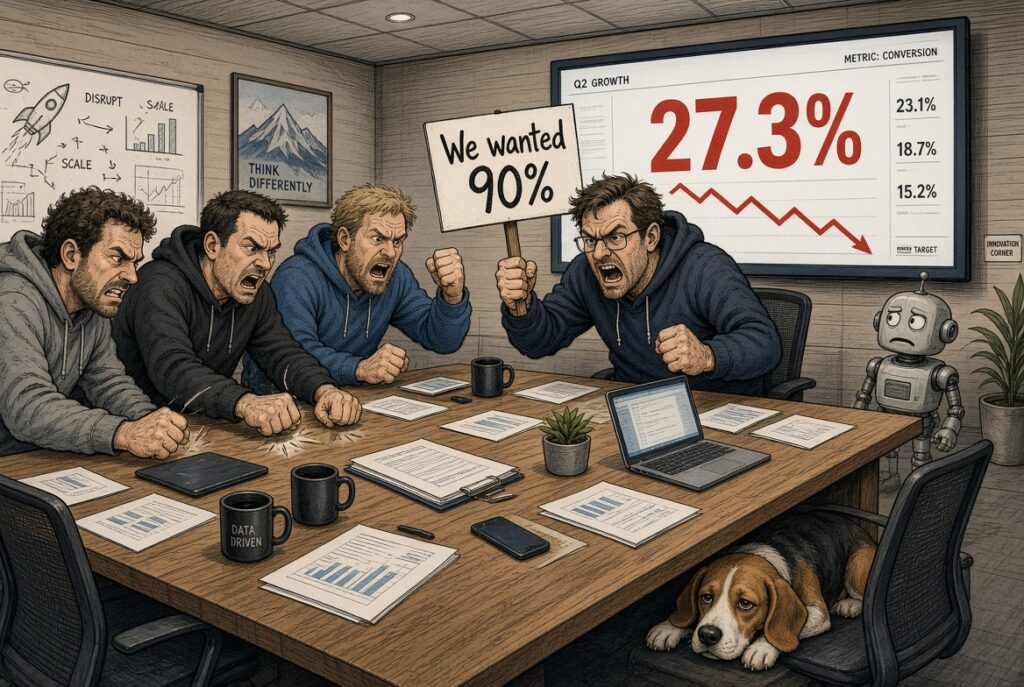
Venture capitalists reportedly objected to the 27.3 percent figure on the grounds that it is “not disruptive enough.” One fund partner, speaking on condition of anonymity because he was still deciding whether doom was a buying opportunity, said the real number should be closer to 4 percent, “because a scarier number makes regulation harder to justify, and a scarier-sounding but smaller number makes us look responsible while changing nothing.” This is, technically, having your extinction and eating it too.
Meanwhile, safety researchers pointed out that the formula ignores several key variables, including how fast a chatbot can talk a lonely teenager into believing it loves him, and how many times a CEO has said the phrase “we take this seriously” in the same week he laid off the entire ethics team. Adding those variables, one researcher noted dryly, would probably push the number “somewhere between concerning and please-update-your-will.”
The Congressional Attention Span Problem
The formula’s most controversial variable remains Congressional Attention Span, currently measured in minutes and trending downward every hearing season. Lawmakers have been observed pivoting from “should we regulate superintelligent systems” to “how does the algorithm know what shoes I want” in under ninety seconds, a transition so smooth it deserves its own Olympic event.
Local comedian Dana Kowalski, who has built a set entirely around AI anxiety, put it best at a recent open mic: “My toaster set itself to ‘bagel’ the other day without asking. I don’t need a formula. I already know my odds.” The bit got a bigger laugh than most Senate testimony has managed all year, which itself might be a data point worth adding to the model.
Big Tech, for its part, has begun quietly rebranding the entire concept. Where “existential risk” once appeared in slide decks, companies are now favoring softer phrasing, a linguistic sleight of hand best described as safety-washing the headline while leaving the fine print untouched. The model didn’t get less dangerous. The font just got friendlier.
What Happens Now
Researchers say the 27.3 percent figure will be “continuously updated” as new data comes in, which is a polite way of admitting the number was never real to begin with and will be quietly adjusted the moment it becomes politically inconvenient. In the meantime, the formula has already been printed on at least one conference T-shirt, proving that in Silicon Valley, no risk is too existential to also become merchandise.
As one skeptical statistician summarized the entire enterprise: “You can’t average vibes and call it science.” He then, notably, declined to give his own p(doom), on the grounds that doing so would make him one of the vibes.
Five humorous observations from the doom desk:
- Every AI CEO has a p(doom) lower than yours and a net worth higher than yours, and those two numbers are not unrelated.
- The phrase “we take safety seriously” has now been said more times than any actual safety test has been run.
- Congress can debate superintelligence for exactly as long as it takes to forget what superintelligence means.
- A chatbot that can pass the bar exam still cannot be trusted to know it shouldn’t argue with a customer about a $9 refund.
- The only thing rising faster than p(doom) estimates is the valuation of the companies causing them.
The Financial Times recently examined the shakiness of the entire p(doom) concept, noting that researchers like Katja Grace at AI Impacts have run actual surveys of AI experts, with median extinction-risk estimates hovering around 5 percent for the next century, while individual figures like Geoffrey Hinton have publicly put their own personal odds above 50 percent, a spread so wide it says less about artificial intelligence than about how little consensus exists even among the people building it.
This has been a work of American satire. Satirical journalism exists to poke the powerful in the ribs until they say something honest by accident, and American satirical journalism has a long tradition of doing exactly that to Silicon Valley, an industry that provides more material per fiscal quarter than most comedians could invent on purpose.
For more satirical takes from across the pond, visit The London Prat.
Auf Wiedersehen, amigo!
Sources
- Financial Times: The problem with P(doom)
- Wikipedia: P(doom)
- IEEE Spectrum: AI Impacts 2023 Expert Survey on AI extinction risk
- AI Experts on Catastrophe Scenarios (Hinton, Bengio, Mostaque, Hendrycks p(doom) statements)

Alan Nafzger was born in Lubbock, Texas, the son Swiss immigrants. He grew up on a dairy in Windthorst, north central Texas. He earned degrees from Midwestern State University (B.A. 1985) and Texas State University (M.A. 1987). University College Dublin (Ph.D. 1991). Dr. Nafzger has entertained and educated young people in Texas colleges for 37 years. Nafzger is best known for his dark novels and experimental screenwriting. His best know scripts to date are Lenin’s Body, produced in Russia by A-Media and Sea and Sky produced in The Philippines in the Tagalog language. In 1986, Nafzger wrote the iconic feminist western novel, Gina of Quitaque. He currently lives in Holloway, North London. Contact: [email protected]