Manchester City Announces New Strategy: Continue Being Manchester City Until Everyone Else Apologises
Club’s history, tactics and personnel department now so efficient that even its transition periods arrive with silverware instructions
MANCHESTER — Manchester City have once again reminded English football that history is not merely something to be respected, but something to be updated, monetised, tactically inverted and occasionally passed sideways until the opposition begins questioning its childhood.
There was a time when Manchester City’s history was described using words like “unpredictable,” “colourful,” “long-suffering,” and “why has the goalkeeper gone up for this corner in February?” City supporters were once connoisseurs of emotional weather. They knew hope, collapse, late rain, administrative confusion and the peculiar civic pain of hearing Manchester United fans describe success as though it were a utility bill.
Then modern City arrived and replaced chaos with a machine so polished it appears to have been designed by engineers who hate uncertainty, and possibly also hate fun, although the trophy cabinet would disagree.
A History So Good It Ruins the Jokes
The club now operates less like a football team and more like a Swiss watch that presses high.
The history has become awkwardly impressive. City’s official honours list shows league titles stretching from the old First Division era to a modern Premier League collection that includes the famous recent run through 2023/24. The club also completed the 2022/23 Treble: Premier League, FA Cup and a first Champions League, sealed against Inter in Istanbul.
This was historically significant, but also slightly inconvenient for satire, because jokes become harder when a club keeps doing the thing its critics insist it cannot do.
For years, the line was simple:
“Ah, but they have not won the Champions League.”
Then they won it.
Critics were forced to retreat to more specialised objections, such as net spend, vibes, philosophical purity, cloud shape, grass length and whether possession football is actually a form of municipal hypnosis. One theory currently under peer review at absolutely no university anywhere.
The Tactics: Keep the Ball Until the Opponent Feels Something
City’s strategy has long been described as patient buildup, positional play, pressing, technical control and careful recruitment.
That is the respectable explanation.
The simpler version is this:
Manchester City keep the ball until the other team experiences loneliness.
They pass not to move the ball, but to move your will to live. One centre-back rolls it to another. Then a midfielder appears in a space that did not exist three seconds earlier. Then the full-back becomes a midfielder, the winger becomes a geometry problem, and someone named Bernardo somehow receives the ball inside a shoebox surrounded by six opponents and still finds time to look disappointed with humanity.
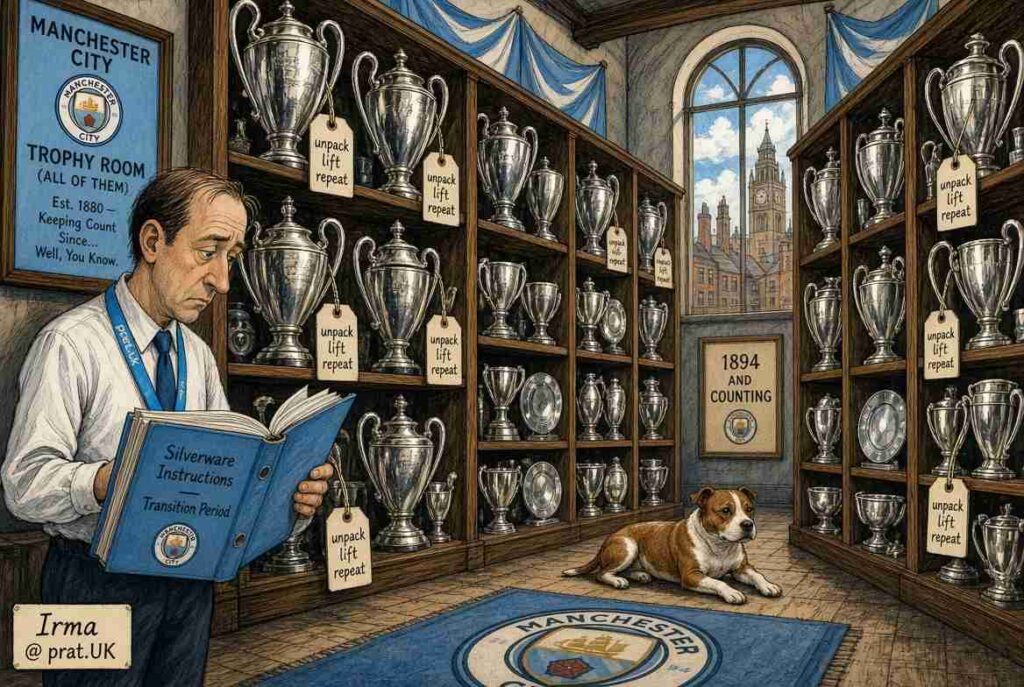
Guardiola’s Decade: A Trophy Cabinet Requiring Planning Permission
Pep Guardiola’s era, now officially one of the great managerial reigns at the club, became so decorated that City marked his decade and 20 trophies as a historic achievement when he finally stepped down, complete with a renamed stand and a statue, because apparently a trophy room was no longer sufficient tribute.
Twenty trophies is not a managerial record.
It is a furniture problem.
At some point, the trophy cabinet stops being a cabinet and becomes an extension requiring planning permission, a structural survey, and possibly its own postcode.
Guardiola’s genius was not merely tactical. It was psychological. He convinced world-class players that football should be played like a university seminar on angles, but with sprinting. He took elite athletes and said, “Good news, you are now a passing lane.” Most managers ask players to work hard. Pep asked them to understand the emotional interior life of space.
Personnel: Grown in a Laboratory Beside a Whiteboard
That is why City personnel strategy has become its own strange comedy.
Other clubs sign players and hope they fit.
City sign players who appear to have been grown in a laboratory beside a whiteboard reading:
“Can receive under pressure, press intelligently, rotate positions, score occasionally, and not panic when asked to play left-back, defensive midfield and abstract concept in the same match.”
The modern City player must be technically gifted, tactically literate, physically relentless, emotionally calm and able to hear Guardiola shout six unrelated instructions in Catalan, English and pure anxiety without bursting into flames. LinkedIn has no job description that comes close, and frankly neither does the club’s own HR department.
Even the Striker Role Got a Software Update
Even the striker role changed.
For years, City played without a traditional striker, which was interpreted as either genius or overthinking, depending on whether they won. Then Erling Haaland arrived and suddenly the team added a large blond penalty-box avalanche to the mathematics department.
This created a new tactical plan:
Pass beautifully for seventy minutes, then allow the Norwegian weather system to happen.
It worked.
Unfairly well.
Succession Planning, or How to Replace a Legend Before the Ink Dries
Personnel at City is not just about stars. It is about succession. One great player leaves, everyone predicts decline, and then City reveal another midfielder who looks as though he was assembled from satellite data and academy manners.
Phil Foden becomes local genius.
Rodri becomes the man who makes the entire machine sound expensive.
Kevin De Bruyne, in his pomp, played through balls that looked less like passes and more like legal documents sent directly to the future, arriving pre-signed and impossible to appeal.
Life After Pep: Somehow Also Winning
Then there is the post-Guardiola question. City’s start under Enzo Maresca was widely described as a dream start to the post-Guardiola era, including a 5-3 win over Sunderland, with Maresca joking he prefers 1-0 much better.
This is very Manchester City.
Even the succession plan has started winning before rival fans have finished writing the obituary. Some clubs mourn a legendary manager’s exit for a full season. City mourned for roughly one pre-season friendly and a Community Shield defeat, then got back to business.
A 5-3 win is not the old Guardiola ideal of suffocation by passing. It is more like City briefly lending chaos the keys, then charging it rent. The scoreline suggests a club in transition, but only in the modern City sense, where “transition” means scoring five and apologising for conceding three as though someone left a spoon in the wrong drawer.
Victory Arrives With Paperwork
The comedy of Manchester City is that the club has become both brilliant and oddly bureaucratic about brilliance.
Victory arrives with paperwork.
Tactics arrive with diagrams.
History arrives with branding.
A goal is not merely a goal. It is the successful conclusion of a multi-phase positional mechanism involving inverted full-backs, rest defence, third-man runs, controlled central occupation and one supporter in the third row shouting “shoot” seven passes too early, a man whose contribution to the buildup play is statistically zero but emotionally essential.
The Joke Nobody Can Quite Finish
And yet the joy remains.
City are fun because they are excessive. Not merely rich, not merely successful, but lavishly committed to making football look like a solved equation until the ball hits the post and the whole stadium remembers sport still has teeth.
The old City comedy was disaster.
The new City comedy is dominance with a straight face.
The club went from “typical City” meaning calamity to “typical City” meaning the opposition has not touched the ball for six minutes and a centre-half is standing in midfield like a visiting professor who wandered in from the wrong lecture and decided to stay anyway.
That is history.
That is strategy.
That is personnel.
And that is the joke.
Manchester City did not simply become good.
They became so good that everyone else had to develop new vocabulary for being annoyed, and City, ever efficient, are presumably already trademarking the terms.
SOURCE: mancity.com

Alan Nafzger was born in Lubbock, Texas, the son Swiss immigrants. He grew up on a dairy in Windthorst, north central Texas. He earned degrees from Midwestern State University (B.A. 1985) and Texas State University (M.A. 1987). University College Dublin (Ph.D. 1991). Dr. Nafzger has entertained and educated young people in Texas colleges for 37 years. Nafzger is best known for his dark novels and experimental screenwriting. His best know scripts to date are Lenin’s Body, produced in Russia by A-Media and Sea and Sky produced in The Philippines in the Tagalog language. In 1986, Nafzger wrote the iconic feminist western novel, Gina of Quitaque. He currently lives in Holloway, North London. Contact: [email protected]