
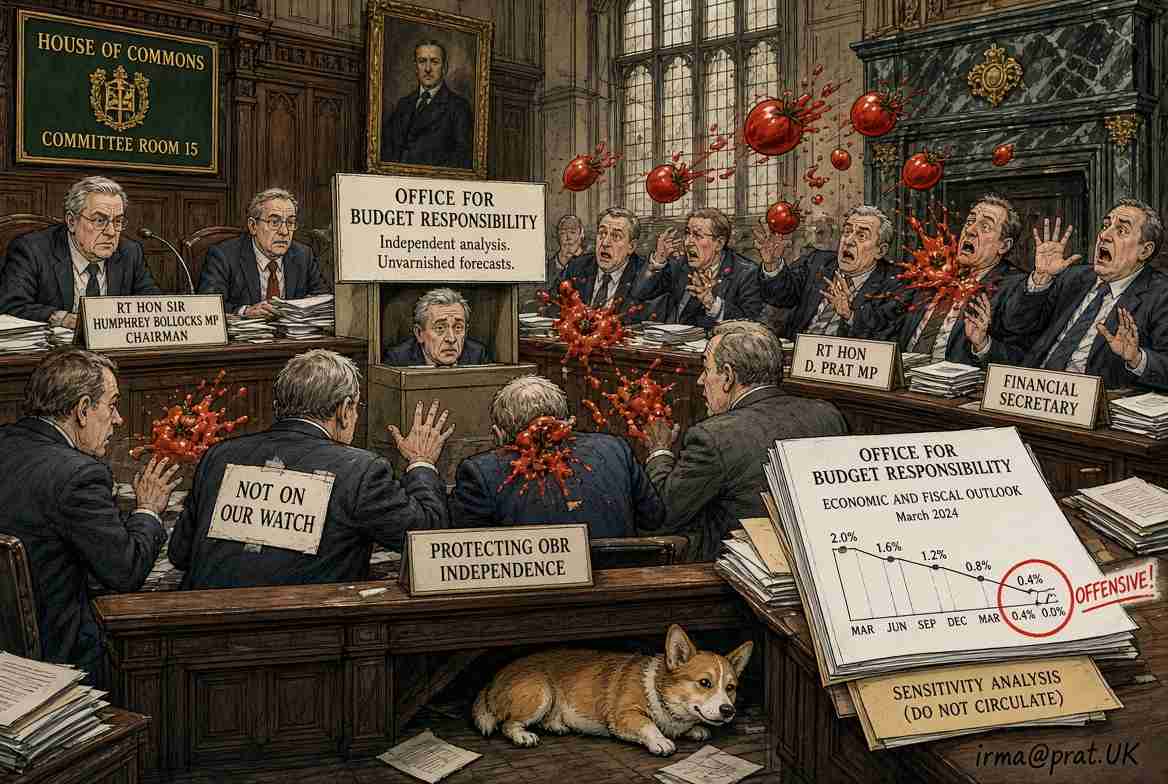
Economic Messenger Requests Kevlar Vest Before Next Budget
WESTMINSTER. Parliament’s Treasury Committee has defended Britain’s independent fiscal watchdog against attacks from politicians who apparently believe the nation’s finances would improve enormously if economists stopped looking at them.
The committee said critics of the Office for Budget Responsibility risk “shooting the messenger” and rejected calls for fundamental reform. Guardian report on the Treasury Committee and OBR See also UK Government Satire.
This presents Britain with an old problem.
The country likes independent experts right up until they independently calculate something.
An independent institution is ideal if it independently concludes:
“Everything is splendid.”
That is independence everybody can get behind.
Trouble begins when someone opens Excel.
The OBR’s job is essentially to stand outside Number 11 holding a calculator and periodically say, “You know that thing you promised?”
“Yes?”
“The numbers.”
“What about them?”
“They’ve met.”
This is regarded in Westminster as deeply provocative behaviour.
Economic forecasting is admittedly an unusual profession.
Meteorologists can predict rain and nobody accuses them of causing precipitation.
But when an economist predicts a deficit, there is always a politician wondering whether national debt might fall if the economist were moved to another office.
Britain’s economic debate increasingly resembles a household argument in which Dad blames the bathroom scale for Christmas.
“The scale says I’m fourteen stone.”
Perhaps.
“But have we considered reforming the scale?”
The Treasury Committee suggests the answer is no.
Apparently the government should continue measuring things even when the things being measured are uncomfortable.
Dangerous precedent.
Soon someone may propose evaluating HS2 by checking whether it reaches somewhere.
The OBR produces forecasts stretching five years into the future, although MPs have suggested considering an additional ten-year outlook.
Ten years?
Britain cannot reliably predict whether a railway will operate Saturday.
Yet economists will apparently tell us what debt interest might be doing in 2036.
There is confidence, and then there is British fiscal forecasting.
Imagine standing in a pub during a power cut while the roof leaks and saying, “I’ve produced some preliminary assumptions concerning conditions here in 2047.”
Still, forecasts matter because government spending decisions depend partly upon them.
This makes the OBR unpopular in approximately the same way thermostats become unpopular during winter.
The thermostat does not make your house cold.
It merely informs you that your bedroom is nine degrees.
You can shout at it.
You can replace the batteries.
You can accuse it of belonging to the metropolitan establishment.
Bedroom remains nine degrees.
Britain has therefore reached a mature compromise.
Politicians make promises.
Economists calculate them.
Newspapers become furious.
Markets become nervous.
Taxpayers discover the final answer.
That is democracy with spreadsheets.
The interesting phrase is “shooting the messenger.”
Historically, messengers brought news from distant battlefields.
The modern British messenger arrives from the Treasury carrying a PDF.
Yet the reaction is remarkably similar.
“Your Majesty, the fiscal headroom has fallen.”
“Seize him.”
The OBR should consider leaning into the role.
Future economic forecasts could be delivered by a man on horseback.
He gallops through Whitehall.
“The borrowing requirement exceeds projections!”
A window opens.
“BOOOOO!”
Horse continues toward Westminster Bridge.
At least then everyone would understand the relationship.
The forecast is not the economy.
The forecast merely describes the economy.
If Britain eventually bans unpleasant economic predictions entirely, national prosperity could become extraordinary.
Stop measuring prices.
Debt?
Turn off the calculator.
Change the subject.
GDP could reach £40 trillion before teatime.
All we need is a government brave enough to unplug Excel.

Alan Nafzger was born in Lubbock, Texas, the son Swiss immigrants. He grew up on a dairy in Windthorst, north central Texas. He earned degrees from Midwestern State University (B.A. 1985) and Texas State University (M.A. 1987). University College Dublin (Ph.D. 1991). Dr. Nafzger has entertained and educated young people in Texas colleges for 37 years. Nafzger is best known for his dark novels and experimental screenwriting. His best know scripts to date are Lenin’s Body, produced in Russia by A-Media and Sea and Sky produced in The Philippines in the Tagalog language. In 1986, Nafzger wrote the iconic feminist western novel, Gina of Quitaque. He currently lives in Holloway, North London. Contact: [email protected]


