NATO Summit: Ankara Discovers Diplomacy Works Best on Mute
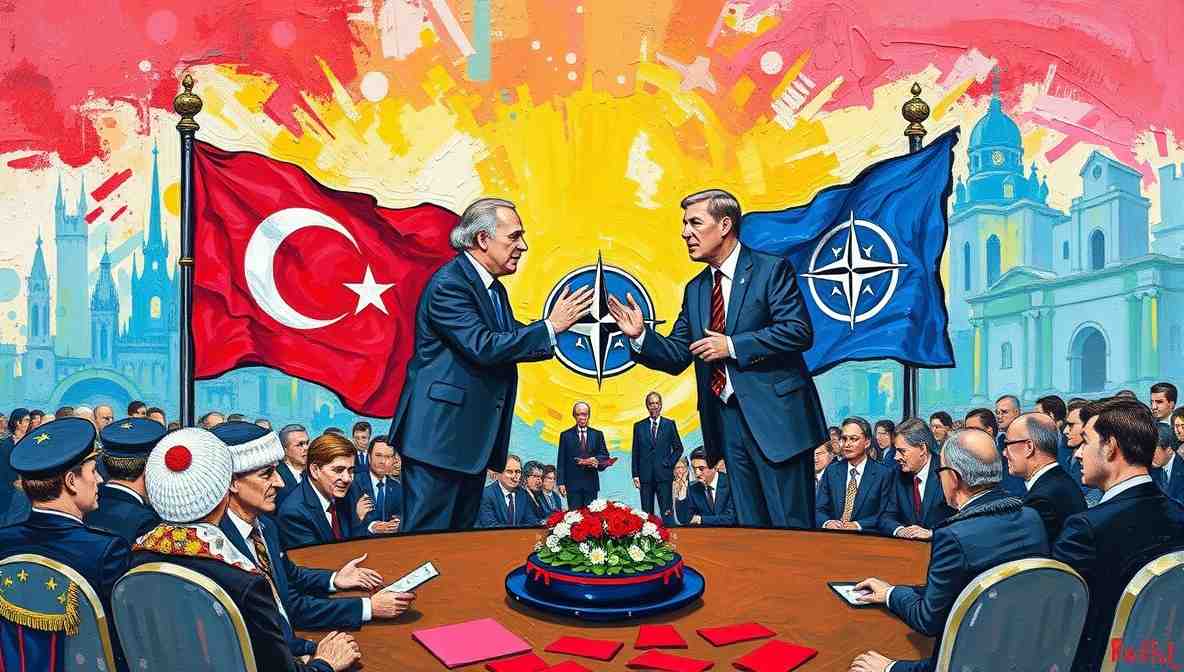
Ankara — The annual NATO summit opened this week with its traditional exchange of handshakes, policy binders, and nervous glances toward the nearest podium. But diplomats say this year’s gathering introduced an exciting new sport: Guess What Trump Says Next.
Officials describe the game as part political science, part improvised comedy, and part cardiovascular stress test. Participants earn one point for correctly predicting the next topic. Bonus points go to anyone who calls Greenland, defence spending, golf, tariffs, or a real estate analogy in the same breath. Nail all three and you earn the honorary title of Senior Strategic Oracle, plus a standing job offer from every rolling news channel in the land.
“It’s impossible,” sighed one exhausted European ambassador, gripping his fifth espresso like it owed him money. “We prepared for Ukraine, NATO expansion, Arctic security, cyber warfare and China. We did not prepare for Greenland loyalty points.”
Greenland Files a Missing Person Report for Its Own Peace and Quiet
The confusion reportedly began when the president asked whether NATO membership came with reward benefits, wondering aloud if Greenland carried enough alliance points for a complimentary upgrade. A spokesman later clarified that nobody knew whether the remark was literal, metaphorical, negotiable, or simply Tuesday, which is itself a fairly solid paraprosdokian for a foreign policy briefing.
Scandinavian diplomats immediately checked whether Greenland had quietly changed its telephone number. Officials confirmed it had. One administrator said the territory would like just one week where nobody discusses purchasing it, annexing it, defending it, or using it as an analogy. The suspect listed on the filing: international geopolitics. Nobody fancies being Greenlanded twice in one news cycle.
Spain’s Defence Budget Rises Every Time Its Name Gets Mentioned
Across the summit hall, Spain experienced its own financial awakening. Defence economists estimate that every time the president mentions Spain, the country’s projected defence budget climbs another billion euros through the mysterious force known as televised expectations. Spanish delegates reportedly spent the afternoon refilling coffee just to stay out of camera range — a genuinely useful place to be, in more ways than one.
“Being ignored used to hurt our feelings,” one official admitted. “It turns out it’s considerably cheaper.”
Meanwhile, Britain’s own delegation reportedly practised the diplomatic art of nodding along thoughtfully at precisely the right moments, a skill Sir Keir Starmer has apparently honed to Olympic standard, giving off the energy of a man who has already mentally left the room.
NATO Quietly Drafts Article 5.1
Meanwhile, NATO introduced a proposed amendment unofficially known as Article 5.1, immediately following the alliance’s famous collective defence clause. Its entire text reportedly reads: “Please don’t start another press conference.” Diplomats insist the article is purely precautionary after discovering that one spontaneous remark can generate more emergency meetings than an actual military exercise — the kind of bureaucratic ironic literalism that would have Frankie Boyle reaching for a second passport.
European leaders arrived carrying 300-page strategic reports on logistics, procurement, cyber resilience, and long-term alliance planning. The American delegation arrived carrying what witnesses described as plot twists. Political scientists admit these are two entirely different schools of diplomacy — one manages expectations, the other invents new ones every fourteen minutes — and neither side shows any interest in switching methods.
Turkey Wins Host Nation of the Year, Briefly
Coffee supplies collapsed before lunch. NATO logistics officers confirmed delegates burned through nearly triple the expected caffeine allocation after a full evening of fact-checking remarks and rewriting communiqués. An emergency shipment of Turkish coffee briefly restored operational readiness before vanishing into the French delegation, the sort of diplomatic disappearing act Jimmy Carr would clock in about half a sentence.
Conference organisers awarded host nation Turkey the Most Patient Host After Day One trophy, praising staff for smiling through a dozen schedule revisions and an unspecified number of plot twists. The ceremony lasted six minutes before another unscheduled press conference interrupted it. Turkey, it turns out, handled the whole affair perfectly golden-brown and done — which is either irony or poultry, depending on your appetite for wordplay.
Ukraine Brings Battlefield Maps, Gets a New Seating Chart
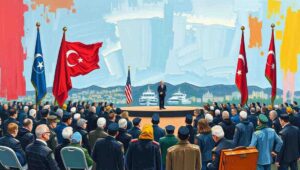
Ukraine arrived with battlefield maps, intelligence briefings, and detailed operational requests. NATO committees responded with revised seating charts. Officials explained that arranging everyone alphabetically dramatically improved alliance cohesion while doing almost nothing to stop incoming missiles.
“It was a productive discussion,” said one bureaucrat.
“No actual decisions?”
“No.”
“But everyone sat correctly.”
“Exactly.”
Analysts called it NATO’s most successful exercise in administrative precision — the diplomatic equivalent of rearranging deck chairs, except the chairs are alphabetised and the ship is, allegedly, still afloat.
The Accidental Mute Button That Solved Six Policy Disputes
The summit’s biggest breakthrough happened entirely by accident. Late one evening, technicians temporarily muted every microphone in the conference hall. Within forty-five seconds, delegates quietly reached consensus on six policy questions that had resisted negotiation for months. No cameras. No live commentary. No one wondering how the headlines would read.
Experts immediately identified the silence as the alliance’s most effective confidence-building measure in decades. Communications engineers have since proposed installing an Accidental Mute Button at every future summit — a policy so malapropos to actual diplomacy that several officials tried to rename it the “collectively defective clause” before someone quietly corrected them.
“Political science has long debated the causes of diplomatic gridlock,” explained one professor at an entirely fictional overthinking institute. “It now appears the principal obstacle was functioning microphones.” Pollsters claim 87 percent of summit attendees support extending all future silent periods. The remaining 13 percent were giving interviews at the time of the survey — the sort of self-defeating irony Jo Brand could have written from a deckchair.
Journalists Give Up Writing Full Sentences
As delegates departed, exhausted correspondents compared notes, discarded obsolete headlines, and drafted new ones after every fresh comment from the podium. Several admitted they’d stopped writing complete articles and instead left blank spaces labelled “Insert Unexpected Development Here.” Veteran reporters called it the most efficient workflow innovation since laptops.
NATO officials concluded the summit had strengthened alliance unity, reaffirmed collective defence, and once again demonstrated humanity’s remarkable ability to schedule twelve hours of meetings to accomplish what could have been settled during one quiet lift ride. Diplomats are already preparing for next year’s gathering. Organisers have ordered additional coffee, reinforced podiums, doubled translator staffing, and quietly installed a very large button labelled “MICROPHONES OFF.”
The 2026 Ankara summit brought all 32 NATO member states together at the Beştepe Presidential Complex on 7 and 8 July, with President Trump, Secretary General Mark Rutte, Turkish President Recep Tayyip Erdoğan, Prime Minister Sir Keir Starmer, and Ukrainian President Volodymyr Zelenskyy among the leaders in attendance. The gathering unfolded against a backdrop of Trump’s public criticism of allied defence spending, an uneasy ceasefire following US strikes on Iran, and NATO’s ongoing effort to institutionalise long-term support for Ukraine — real tensions that made the closed-door theatrics, seating charts, and coffee shortages described above land rather closer to home than anyone in Ankara probably wanted.
This is British satirical journalism from The London Prat. Reports of an actual “MICROPHONES OFF” button remain unconfirmed by NATO, but so, several delegates note, does most of the alliance’s long-term strategy. For the American take on the same summit, cross the Atlantic to Bohiney.com.
Sources
Al Jazeera: NATO summit live updates from Ankara
Congress.gov: NATO — Issues for the July 2026 Ankara Summit
Wikipedia: 2026 Ankara NATO summit
Auf Wiedersehen, amigo!