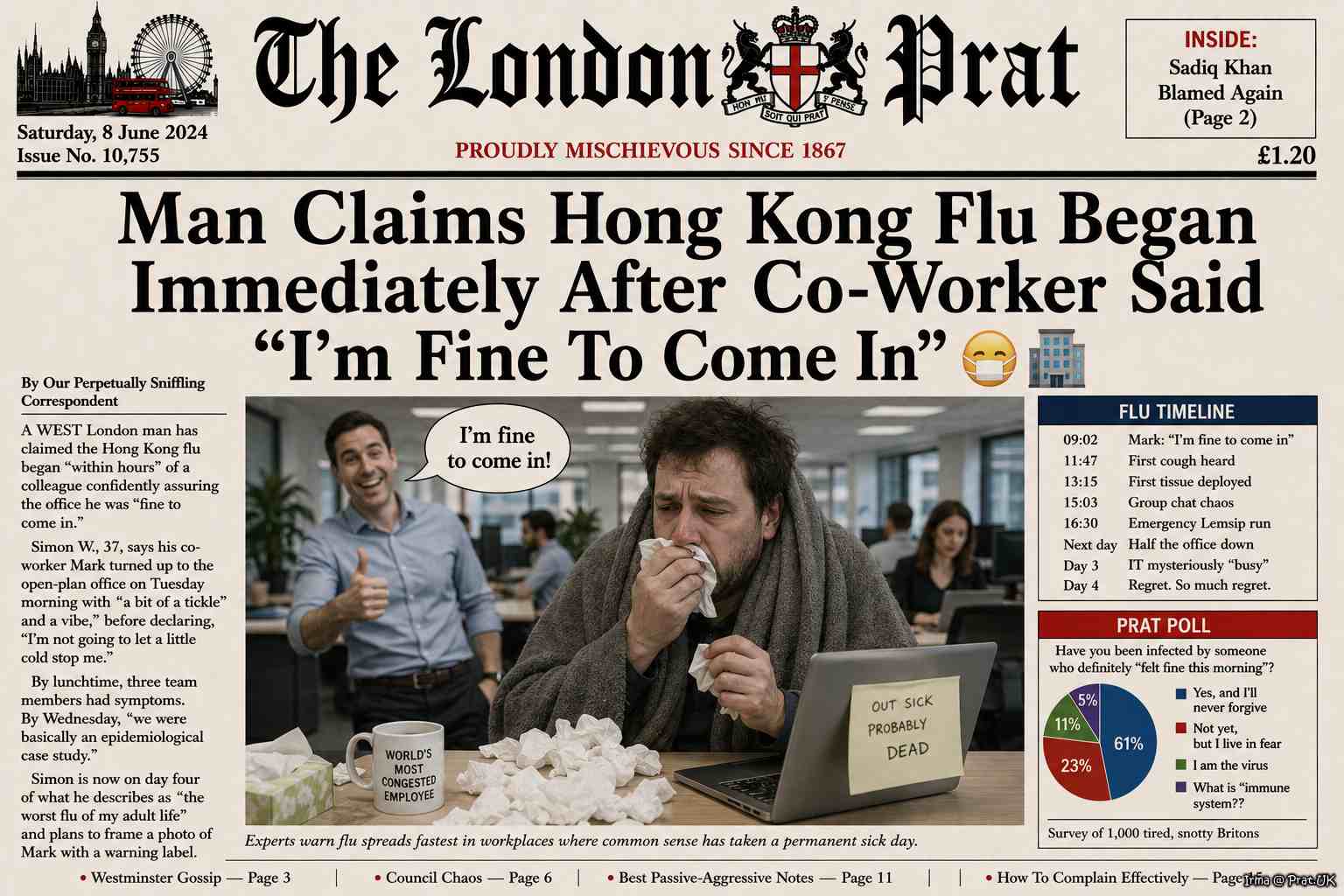
Man Claims Hong Kong Flu Began Immediately After Co-Worker Said “I’m Fine To Come In” 🤧🏢
Five Observations
- Every office plague in human history has reportedly started with a co-worker saying, “It’s probably allergies.”
- Modern office culture now treats contagious disease as a personality trait called “dedication.”
- Scientists confirm one uncovered cough in an open-plan office can now reach Birmingham.
- Human Resources departments continue recommending “wellness” while Keith from accounting sneezes directly into the communal biscuits.
- Experts believe 73% of workplace illnesses originate from one employee who insists on “powering through.”
Patient Zero Arrived With Yogurt and Delusion
LONDON — A Manchester office worker claims the so-called “Hong Kong Flu” outbreak inside his workplace began precisely 11 minutes after co-worker Darren Pibble entered the office pale, sweating, visibly vibrating, and announcing:
“I’m fine to come in.”
According to eyewitnesses, the sentence was followed by what experts later classified as:
“a catastrophic respiratory event near the printer.”
Within hours:
- six employees developed coughs,
- three lost the will to live,
- and one intern reportedly hallucinated spreadsheets speaking Mandarin.
The outbreak occurred at a regional insurance company where staff had already spent several weeks circulating mysterious illnesses through a ventilation system described by engineers as:
“mostly decorative.”
“It started with Darren coughing into his fist like a Victorian chimney sweep,” explained accounts assistant Sheila Morley while clutching herbal tea and resentment. “Then he touched the microwave, the kettle, the fridge handle, and Janet’s birthday cake. By Tuesday we were basically reenacting the fall of Constantinople.”
Office Workers Continue Ancient Tradition of Infecting Everyone
Medical historians say workplaces remain humanity’s single greatest disease-delivery mechanism after medieval rats and cruise ships offering shrimp buffets.
“Offices are extraordinary biological ecosystems,” explained Professor Lionel Crick of the Royal Institute for Occupational Fluids. “You place exhausted adults into recycled air, force them to share keyboards, then introduce one man named Darren who believes mucus is a sign of commitment.”
A recent survey found:
- 67% of British employees admit attending work sick,
- 49% believe staying home makes them “look weak,”
- and 21% genuinely think Vitamin C gummies constitute medicine.
One respondent simply wrote:
“My boss once congratulated a man for vomiting quietly.”
What the Funny People Are Saying 🎤
“You ever notice the sickest guy in the office always says, ‘Don’t worry, it’s not contagious,’ immediately before collapsing onto the photocopier?” — Jerry Seinfeld
“In America sick days are guilt. In Britain they’re treated like parole violations.” — Ron White
“Every office has one guy who coughs like a diesel engine starting in winter and still wants to shake hands.” — Sarah Silverman
Human Resources Launches Wellness Email During Biological Collapse
As illness spread through the building, management responded swiftly by sending a company-wide email titled:
“Prioritizing Wellness Together 🌿”
The email encouraged workers to:
- stay hydrated,
- practice mindfulness,
- and “remain collaborative during seasonal health challenges.”
Employees reacted by coughing directly at their monitors.
“We don’t need mindfulness,” complained warehouse coordinator Greg Fenwick. “We need Darren exorcised and the break room pressure-washed.”
Human Resources director Melissa Crumb defended the response.
“We take staff wellbeing extremely seriously,” she explained from home via Zoom while wearing two scarves and visibly avoiding the office.
Open-Plan Offices Officially Classified As Lung Catapults
Health experts warn open-plan offices may be accelerating modern illness transmission by combining:
- poor airflow,
- shared surfaces,
- communal snacks,
- and one guy who microwaves fish every Thursday.
A leaked workplace safety report allegedly described open-plan offices as:
“an elegant system for distributing regret.”
Employees at the Manchester office claim the illness spread with terrifying speed.
“It moved desk to desk like gossip,” said receptionist Joanne Tripp. “One minute Steve had a sniffle, next thing the entire sales team sounded like haunted accordions.”
Cleaning staff reportedly attempted containment measures involving:
- lemon disinfectant,
- passive-aggressive signage,
- and prayer.
Managers Continue Worshipping “Attendance Culture”
Critics argue modern corporate culture still rewards employees for physically appearing at work despite obvious illness.
One manager reportedly praised Darren for his:
“dedication and resilience”
shortly before developing a fever hot enough to see colours.
Business psychologist Hannah Pike says many employees now associate suffering with professionalism.
“There’s this bizarre belief that productivity means infecting colleagues while pretending you’re immortal,” she explained. “People arrive half-dead just to answer emails nobody reads.”
A recent LinkedIn post praising “hustle culture” reportedly received 14,000 likes before the author called in sick for nine consecutive days.
Office Kitchen Declared International Biohazard Zone
Meanwhile, the office kitchen became what investigators described as:
“ground zero for microbial ambition.”
Authorities identified several contamination hotspots:
- the shared milk,
- the kettle handle,
- and a spoon floating mysteriously in instant coffee granules.
One employee reportedly observed Darren coughing directly into the refrigerator before saying:
“Can’t let the team down.”
The sentence caused two co-workers to leave immediately and retrain as park rangers.
Britain Secretly Loves Shared Workplace Suffering
Sociologists believe office illnesses persist because British workplace culture thrives on collective discomfort.
“People bond through shared misery,” explained Professor Crick. “That’s why every office conversation begins with weather complaints and ends with somebody discussing sinus pressure.”
By Friday, the Manchester office stood nearly empty except for Darren, one confused IT technician, and a fern slowly dying beside reception.
Management has since introduced a bold new illness policy encouraging employees to:
“work responsibly.”
Nobody knows what this means.
At press time, Darren reportedly returned to work insisting:
“Still not fully over it, but I’m mostly fine now.”
Three employees immediately began updating their wills.
Disclaimer
This satirical article is entirely a human collaboration between the world’s oldest tenured professor and a philosophy major turned dairy farmer. No office workers were harmed during production, though several HR departments reportedly issued mindfulness PDFs instead of disinfectant. Auf Wiedersehen.

Alan Nafzger was born in Lubbock, Texas, the son Swiss immigrants. He grew up on a dairy in Windthorst, north central Texas. He earned degrees from Midwestern State University (B.A. 1985) and Texas State University (M.A. 1987). University College Dublin (Ph.D. 1991). Dr. Nafzger has entertained and educated young people in Texas colleges for 37 years. Nafzger is best known for his dark novels and experimental screenwriting. His best know scripts to date are Lenin’s Body, produced in Russia by A-Media and Sea and Sky produced in The Philippines in the Tagalog language. In 1986, Nafzger wrote the iconic feminist western novel, Gina of Quitaque. He currently lives in Holloway, North London. Contact: [email protected]