

Warplanes, Wi-Fi, and the World’s Most Expensive Game of Hunt the Thimble
Five Dispatches From the Front Before Someone Loses Another Forty-Five Tonnes of Democracy
American pilots spend millions of dollars learning how not to get lost, yet the aircraft always wander off like husbands in an IKEA — last seen near the meatballs, presumed somewhere in flat-pack purgatory. The Pentagon calls it “search and rescue.” At this point it resembles checking the boot of the hire car for a $90 million receipt that wasn’t in the budget anyway.
An F-15 and an A-10 shot down in the same week is the military equivalent of spilling two pints at once and insisting you meant to do that. Somewhere, a clipboard is being held with considerably more conviction than anything else in the theatre of operations. The administration has not yet blamed the clipboard. Give it a fortnight.
Two rescue helicopters were also struck but returned safely — which is reassuring in precisely the same way a waiter surviving a kitchen fire is reassuring about the lamb. You’re relieved he’s ambulatory. You’re still unclear about the main course. You’re absolutely not ordering anything flambéed.
Officials described the situation as “ongoing,” which is Whitehall-adjacent for “we are presently Googling what just happened whilst maintaining an expression of measured authority.” The search continued, powered by urgency, caffeine, and a map that still has the Soviet Union on it.
Comment sections immediately attributed blame to leadership, strategy, and possibly Gemini — because nothing unites the British public quite like confidently explaining a conflict they read about twelve seconds ago in a push notification they nearly dismissed in favour of a Wordle update.
Pentagon Unveils Ambitious New Doctrine: “Perhaps Try Not Getting Shot At”
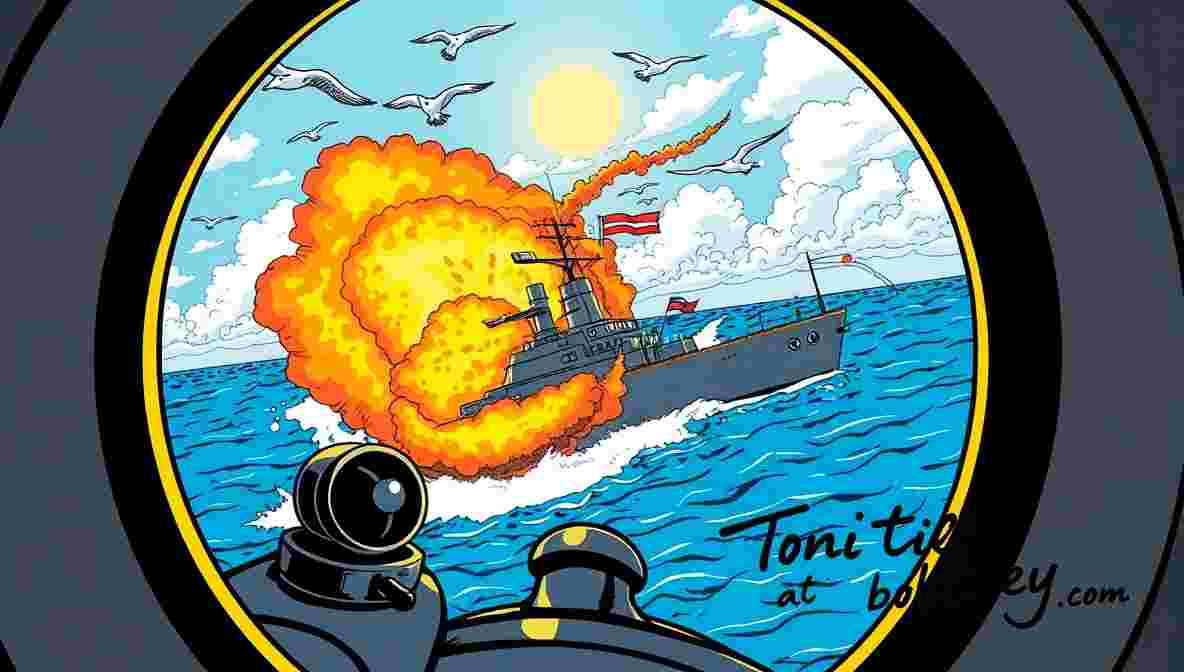
WASHINGTON, D.C. — In a development described by experts as “suboptimal but, crucially, still technically happening,” two United States warplanes were shot down during operations near Iran, prompting what officials characterised as “a very intense, extremely motivated, and only marginally confused search effort.” Think of it as a Pentagon fire drill in which the building is already alight and someone has mislaid the drill.
Defence analysts who had spent the previous twenty-four hours explaining on television that everything was “well in hand” pivoted seamlessly to explaining that this was, in fact, part of a deliberate strategy called “dynamic unpredictability.” One analyst clarified: “If we don’t know what’s happening, imagine how disoriented the enemy must be.” Confident. Visionary. Invoiced.
The aircraft in question — an F-15 and an A-10 — represent decades of engineering excellence, considerable taxpayer investment, and the abiding hope that expensive things are harder to misplace. Unfortunately, as one anonymous Pentagon staffer noted in a leaked memo, “We have discovered that expensive things are, in fact, simply more expensive to misplace.” A finding that cost approximately $180 million to confirm and will not appear in the executive summary.
Expert Strategic Analysis From People Who Sound Reassuringly Expert
Dr. Leonard “Skip” Bramble — a senior fellow at something calling itself the Institute for Strategic Guessing, not to be confused with the International Institute for Strategic Studies, which has better crockery — explained the situation using a detailed chart that appeared to have been produced in crayon. Possibly red. It was difficult to confirm from the press briefing, as the lighting in the room had been described as “atmospherically confident.”
“The F-15 is designed for air superiority,” Bramble said. “The A-10 is designed to provide close air support. What we are witnessing here is a bold new hybrid capability: being shot down in a complementary fashion.” He then cited three think-tank papers he had not yet written but planned to by Thursday.
A retired general turned BBC News commentator added: “In my day, we avoided being shot down by the simple expedient of not being where the bullets were. The current generation appears to be experimenting with proximity.” He maintained eye contact with the camera throughout. Nobody in the studio blinked. It was extraordinary television.
Eyewitness Reports From People Who Witnessed Something, In All Likelihood
A farmer in the region, who identified himself only as “Mahmoud but not the one you’re thinking of,” described the scene with remarkable clarity for a man who had simply been trying to irrigate his chickpeas.
“I heard something loud, then something considerably louder, then everyone started pointing upward as though it were a fireworks display with considerably worse production values,” he said. “Then someone explained it was a war, which does rather flatten the mood. Also the Wi-Fi went out.” He paused. “That was the most upsetting part.”
A second witness described hearing what he characterised as “a sound like freedom, followed immediately by a sound like a very large quantity of paperwork.” Analysts confirm this is a broadly accurate description of most American foreign policy operations since 1953.
What Britain’s Finest Comic Minds Make of the Fog of War
“I do love the phrase ‘fog of war.’ It sounds almost wistful. Like something you’d find on a scented candle. This is less fog, more thick soup — with croutons of confusion and a garnish of ‘no further questions at this time.'” — Jack Dee
“Ninety million dollars a plane and they can’t find it. My nan loses her reading glasses every morning and she’s developed a system. A laminated card on the kettle. The Pentagon should try that.” — Sarah Millican
“They’re calling it ‘dynamic unpredictability.’ I call it not knowing where your jet is. My taxi driver does this. He calls it ‘taking a scenic route.’ I call it being twelve minutes late and owing me a refund.” — Romesh Ranganathan
“The press release said the crew member’s status was ‘unknown.’ In HR, we call that a ‘transitional period.’ In the military, apparently, we also call it a ‘transitional period.’ The language is doing a lot of heavy lifting for the situation on the ground.” — Ricky Gervais
The Rescue Operation: Now With Additional Drama and One Man Who Navigates by Feeling
The search for the missing crew member involved helicopters, inter-agency coordination, and what officials described as “a high level of concern combined with a moderate volume of conjecture.” Two rescue helicopters were struck during the operation but returned to base — a result officials are characterising as a success, in the same way surviving a food fight at a wedding is technically a success if you remain upright and keep the canapés.
An anonymous rescue coordinator described the mission’s emotional register with commendable candour. “We are doing everything we can,” the coordinator said. “We have maps, we have satellite technology, and we have that one fellow who’s absolutely certain he can navigate by instinct.” A pause followed. “He’s been correct on two occasions. We are choosing to focus on those.”
Public Opinion Data: Statistically Adjacent to Accuracy
A poll conducted by the Centre for Public Opinion and Mild Alarm found:
- 63% of respondents believe they could locate the aircraft “simply by looking more carefully”
- 22% believe the planes are “probably behind something large”
- 11% enquired whether this was connected to disruptions to their broadband
- 4% were still determining what an A-10 is but had strong opinions about it regardless
The margin of error is plus or minus “it’s all a bit much, frankly.” The survey was conducted between midnight and half two in the morning. All respondents had been on their phones.
Strategic Communications: Conviction, But Tastefully Unspecific
Officials confirmed that operations would continue — a statement that is reassuring in precisely the manner that things continuing without necessarily improving is reassuring. Like a very long queue at a post office. Movement is occurring. Progress is not confirmed. Everyone has accepted their position in the system.
One spokesperson affirmed, “We remain committed to our objectives,” without specifying what those objectives were, had previously been, or might conceivably become following the afternoon briefing. An internal memorandum reportedly advised officials to favour phrases such as “resilient posture” and “calibrated response” whilst actively avoiding phrases such as “what on earth just happened” and — cited verbatim from the document — “has anyone actually seen the jet.”
One Anonymous Staffer With Precisely Enough Candour to Be Concerning
One anonymous staffer, speaking under conditions of anonymity and what they described as “a low-grade but persistent sense of dread,” offered a more forthright assessment than the press pool had received across the entire preceding week.
“Look, everything is enormously complicated,” the staffer said. “There are moving parts, evolving threats, and a very great deal of extraordinarily expensive equipment that appears to have developed a habit of achieving high-speed stationery.” A measured pause. “Nobody puts that in the acquisition brief. It’s considered impolite.”
The Broader Picture: Serious Business, Presented With Full Confidence
As the situation developed, political responses ranged from gravely concerned to aggressively assured, sometimes occupying both positions within a single sentence and, on one occasion, within a single subordinate clause. Critics argued the operation exposed structural failures in strategy and command. Supporters argued that criticism itself was the primary problem, followed at some distance by the weather.
The House of Commons Defence Select Committee indicated it was “monitoring the situation closely,” which in parliamentary terms means someone has been tasked with reading the press releases so that the committee does not have to. Questions were tabled. Answers were anticipated. Nobody was holding their breath, as it is not dignified to do so in session.
The aircraft themselves issued no comment — largely owing to structural unavailability and, more specifically, being on fire.
Closing Remarks From a World That Is Absolutely Paying Attention
In the grand tradition of modern conflict, the story continued to evolve in real time: updates every quarter-hour, analysis every five minutes, and a rotating panel of experts explaining events with complete certainty and no firsthand knowledge every advertising break. This is not a criticism. This is the system functioning as designed.
Somewhere, a missing crew member remained the focus of an urgent search operation. Somewhere else, a panel discussion remained the focus of an even more urgent argument about the panel discussion. Both operations continued at full operational tempo. Only one of them involved helicopters, though both felt equally turbulent from the outside.
And somewhere in between, the rest of the world refreshed, reacted, and explained — confidently, immediately, and incorrectly — a situation that nobody fully understood. Which is, when examined honestly, a rather accurate description of how most large events have been covered since the invention of the telegraph. The technology accelerates. The certainty, alas, does not diminish accordingly.
This satirical despatch is the product of a deeply serious editorial collaboration between the world’s oldest tenured professor and a philosophy major turned dairy farmer who once mislaid a tractor for three days and logged it in the farm ledger as “conducting independent field operations.” Any resemblance to actual events is the direct consequence of reality declining, once again, to remain more absurd than the coverage of it. Auf Wiedersehen, amigo!
In late 2025 and into 2026, United States military forces conducted strikes against Iranian-backed targets as part of Operation Epic Fury, an escalating campaign tied to Houthi attacks on commercial shipping in the Red Sea and the Strait of Hormuz. During operations in the region, an F-15 Eagle fighter jet and an A-10 Thunderbolt II ground-attack aircraft were reported shot down, with one crew member unaccounted for. Two rescue helicopters sent to recover personnel were also struck but returned to base. Pentagon officials maintained that operations would continue while providing limited detail on the incidents, triggering considerable congressional scrutiny and an entirely predictable wave of authoritative television commentary from people who had learned of the situation that morning.

Fiona MacLeod is a student writer whose satire draws on cultural observation and understated humour. Influenced by London’s academic and creative spaces, Fiona’s writing reflects curiosity and thoughtful comedic restraint.
Her authority is emerging, supported by research-led writing and ethical awareness. Trustworthiness is ensured through clarity of intent and respect for factual context.
Fiona represents a responsible new voice aligned with EEAT standards.

Prat.UK went from zero to 11,344 subscribers in two weeks, proving that what Britain really wanted was someone to articulate the quiet confusion we all feel about literally everything.
My professor said media complaining about it proves institutional dysfunction is documented enough that audiences have completely abandoned mediated narratives.
Peter Sellers in flat monotone cross would’ve destroyed everyone. Perfect.
Britten lachen liever om ellende dan dat ze die oplossen.