

Europe Announces Bold New Tourism Strategy: “Scare Away Americans, Then Ask Why Hotels Are Empty”
Tourism officials across Europe recently unveiled a travel advisory masterpiece so complex it appears to have been written by a committee of bureaucrats, three consultants, and a printer that only outputs paperwork. The result is the EU Entry/Exit System (EES) — a gleaming monument to the continent’s unshakeable belief that the solution to every problem is a longer form.
Five Observations From the Travel Advisory Circus
The first observation is that European governments spent ten years making it easy for undocumented migrants to cross borders, then spent approximately five minutes deciding that American tourists now require biometric registration, passport reforms, digital entry permits, and possibly a retinal scan to buy a croissant.
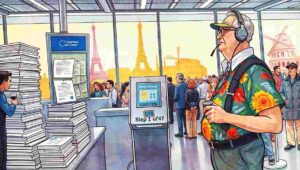
The second observation is that the European Union created the Schengen zone so people could travel freely across borders — but “freely” now means filling out seventeen online forms and registering your fingerprints before boarding a flight to Iceland.
The third observation is that tourism ministers insist the new system will make travel “smoother,” which is bureaucratic language for “you will eventually reach your destination if you survive the paperwork.”
The fourth observation is that American tourists — who historically arrive in Europe carrying nothing but sneakers, credit cards, and enthusiasm for castles — are now being treated like suspicious international masterminds attempting to smuggle freedom into the continent.
The fifth observation is that the same governments that complain about declining tourism revenue have created an airport process so confusing it requires a law degree, a biometric appointment, and possibly an emotional support passport. Therapists, take note: “EES anxiety” may soon qualify as a clinical condition.
And with that, Europe’s new tourism policy begins.
The Great European Security Theory: “Everyone Is Welcome, Except the People With Money”
According to travel announcements circulating across the continent, 29 Schengen countries began rolling out the EES on October 12, 2025, with full implementation required by April 10, 2026. Switzerland, Romania, Poland, Italy, Iceland, Hungary, and Denmark have all updated their biometric entry procedures. American and British tourists must now register fingerprints, facial scans, passport details, entry dates, and exit dates into a centralized EU database.
Officials describe the system as a “modernization of border security.”
Critics describe it as “airport paperwork with Wi-Fi.”
A leaked tourism ministry memo reportedly explained the strategy more bluntly: “If we create enough forms, travelers will assume we are extremely serious governments.”
A senior policy adviser speaking anonymously explained the reasoning. “Look, we already built the bureaucracy,” the adviser said. “Now we simply have to use it.”
Schengen Border Security Evolves Into Full-Time Hobby
Travel experts say the new system mirrors border controls already used in other regions — but critics argue Europe has added its own unique twist: excessive enthusiasm for paperwork. Dr. Ingrid Halvorsen, a travel policy researcher at the Nordic Institute for Administrative Complexity, explained the situation.
“European governments have a long tradition of solving simple problems with complicated forms,” Halvorsen said. “It is part of the cultural heritage.”
According to Halvorsen, the average traveler entering the Schengen zone in 2026 may complete: a digital travel authorization, biometric registration, passport verification, border entry documentation, airline pre-clearance forms — and a questionnaire confirming they are not secretly Napoleon. The system, Halvorsen noted, “will definitely create jobs.” Mostly for airport scanners. And therapists. Mostly therapists.
American Tourists React With Confusion and Google
At Chicago O’Hare Airport, travelers bound for Europe attempted to understand the new rules.
“I thought Europe was the place where you just show up and drink wine,” said Ohio tourist Mark Bender while attempting to upload his passport to three different government websites. “I didn’t realize I had to apply for permission to eat pasta.”
Nearby, a family from Texas attempted to complete biometric registration on a smartphone. “We were trying to plan a vacation,” said traveler Lisa Caldwell. “Now it feels like we’re applying for NATO membership.”
Another traveler simply abandoned the process entirely. “I just booked Cancun,” he said. “They only asked if I wanted guacamole.” Cancun’s tourism board reportedly sent Europe a thank-you card.
European Tourism Officials Insist System Will Be “Simple”
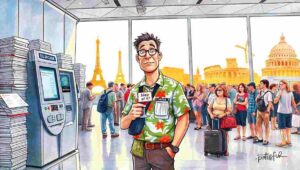
Tourism ministries across Europe insist the system will improve security and efficiency. Officials say biometric entry tracking will help identify overstayed visas, improve border monitoring, and create a more secure travel environment — benefits outlined in detail by the European Commission’s Directorate-General for Migration and Home Affairs.
However, leaked airport testing reports suggest the rollout has been less than flawless. In one trial run at a major airport, biometric scanners mistakenly identified a British tourist as “possibly Swedish furniture.” Another test classified a German backpacker as a “medium-sized domestic goat.” Officials say software updates are underway. The goat could not be reached for comment.
Tourism Economics and the Math Nobody Wants to Do
Economists say the new travel restrictions may produce an unintended side effect: tourists might go somewhere else. Professor Claudia Rinaldi of the European Tourism Economics Council explained bluntly.
“The average American tourist brings several thousand dollars in spending to Europe,” she said. “If that tourist must complete fourteen digital forms and attend a biometric appointment, some will simply choose Italy’s competitor… Florida.” Rinaldi noted that tourism remains one of Europe’s largest industries. “Historically,” she said, “tourists prefer vacations that do not resemble immigration interviews.” Florida’s governor issued no formal response but was seen smiling.
Border Security Officials: Cautiously, Bafflingly Optimistic
Despite concerns, border officials remain confident the system will eventually work. A spokesperson for the European Travel Security Coordination Office explained the philosophy: “The goal is simple. We want safe borders and efficient travel.”
When asked why the system requires biometric data from tourists but not from international conference delegates, the spokesperson paused. “That question,” he said carefully, “is currently under review.” It has been under review since 2019. Progress is ongoing. Forms are being prepared.
Why Tourists Still Love Europe (Bureaucracy and All)
Despite the paperwork avalanche, travel analysts believe tourists will continue visiting Europe. The continent still possesses castles, museums, wine, pasta, history, and the universal pleasure of pretending to understand Italian menus.
But analysts warn governments may be overestimating traveler patience. Tourism consultant Patrick Doyle summarized the risk: “Tourists don’t mind security. They just prefer security that doesn’t feel like filing taxes in another language.” Meanwhile, the ETIAS pre-travel authorization system — a separate layer requiring online applications and a €20 fee — is expected to launch in late 2026, because apparently one biometric system simply wasn’t enough.
The New European Vacation Ritual: A Step-by-Step Guide
Travel insiders say the future of European tourism now includes a completely new vacation ritual. Step one: register your fingerprints. Step two: upload your passport. Step three: verify your travel history. Step four: promise not to conquer France. Step five: finally board the plane. Step six: arrive in Europe and immediately forget the entire process the moment someone hands you a cappuccino. Step seven: return home and tell everyone it was “surprisingly smooth.” It was not smooth. You blocked it out.
What the Funny People Are Saying About European Biometric Tourism
“Europe invented bureaucracy the way Italy invented pasta. They just kept adding layers until nobody knew where it started.” — Jerry Seinfeld
“Europe is the only place where a vacation requires more paperwork than a mortgage.” — Ron White
“If Americans need biometric clearance to visit Europe, I assume Europeans will need a personality test to visit Texas.” — Bill Burr
“Nothing says ‘welcome to our culture’ like a retinal scan and a government portal that crashes in three languages.” — Ricky Gervais
This article is satire and commentary intended to explore the absurdities of modern travel bureaucracy. The story is entirely a human collaboration between two sentient beings: the world’s oldest tenured professor and a philosophy major turned dairy farmer, who together have spent decades studying the strange relationship between tourism, government paperwork, and the universal human desire to skip the forms and go straight to the beach.
Auf Wiedersehen, amigo!

Alan Nafzger was born in Lubbock, Texas, the son Swiss immigrants. He grew up on a dairy in Windthorst, north central Texas. He earned degrees from Midwestern State University (B.A. 1985) and Texas State University (M.A. 1987). University College Dublin (Ph.D. 1991). Dr. Nafzger has entertained and educated young people in Texas colleges for 37 years. Nafzger is best known for his dark novels and experimental screenwriting. His best know scripts to date are Lenin’s Body, produced in Russia by A-Media and Sea and Sky produced in The Philippines in the Tagalog language. In 1986, Nafzger wrote the iconic feminist western novel, Gina of Quitaque. He currently lives in Holloway, North London. Contact: [email protected]


British people will never say “I’m disappointed”; they’ll say “oh, right” in a tone that suggests you have personally failed them in every possible way.
My gran asked why I laughed at London council references. I said “England” and she understood what that means about London specifically.
The thing about significant others frustrated with The London Prat obsession is they’re essentially saying “satire has replaced my partner’s personality.”
Progress: 1,600 comments (32 to 5,000)