
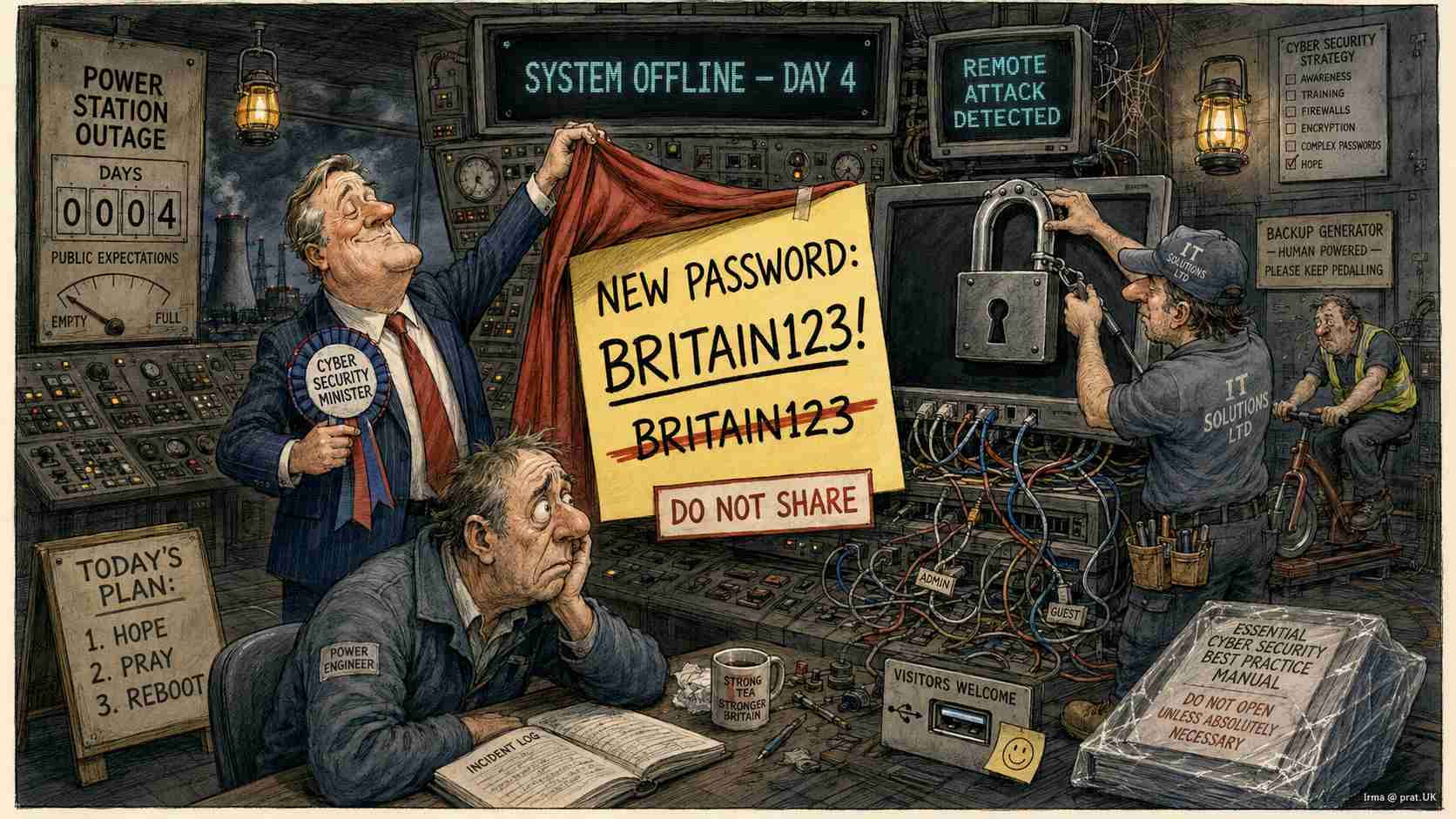
Cyberattack Disables UK Generator for Four Days, Government Changes Password to BRITAIN123!
Officials insist the wider grid remained safe, largely because the hackers may not have found the underscore
LONDON — Britain has briefed energy-company chiefs after reports that Iran-linked hackers disabled a small UK generator for four days in July. Officials stress that nobody lost power, the wider grid was never threatened and the generator was tiny. This is reassuring. Britain’s cybersecurity strategy now rests on making infrastructure too small to interest the attacker and too expensive to replace.
The cyberattack nobody will locate on a map
The Government has not confirmed who carried out the attack, nor when or where it occurred. This confidentiality is essential, because naming the facility might alert hostile actors to the facility they have apparently already entered, disabled and left a digital note inside saying thanks for the tour.
Energy leaders were summoned for a security briefing. The first slide read CYBER RESILIENCE. The second displayed the new national password, BRITAIN123!, with the exclamation mark added following advice from a consultant who charged £90,000 to explain punctuation-based deterrence.
The password replaces Britain123, which experts discovered during an exhaustive audit consisting of looking beneath the keyboard. Officials rejected stronger alternatives because mixed-case letters could confuse legacy systems installed when the Central Electricity Generating Board still believed fax machines were an emerging threat.
Four days is a long cyberattack and a normal British response time
The reported incident lasted four days, an eternity in cybersecurity but an ordinary response time for British infrastructure. Day one identifies an unexpected operational variation. Day two creates a cross-departmental group. Day three asks the Treasury whether electricity is a capital expense. Day four turns the generator off and on again, then describes the restoration as a successful public-private resilience partnership.
Ministers rightly emphasise that the national grid is highly resilient. It has to be. It survives winter demand, summer heat, ageing equipment, wholesale shocks, regulatory churn and television presenters asking whether wind turbines work when the wind is too windy. A cyberattack is merely another stakeholder with an aggressive delivery schedule.
Small cyberattack, large lesson
The small scale should not become an excuse for small lessons. Industrial control systems can be old, specialised and difficult to patch. Remote access creates convenience and risk in the same cable. Organisations need segmented networks, multi-factor authentication, tested backups, incident plans and an accurate inventory of connected devices. “We didn’t know that pump was online” is not a defence. It is the opening sentence of the inquiry.
The NCSC has published exactly this guidance, co-signed with partners across Europe, North America and the Pacific, setting out how connectivity into operational technology should be designed. It runs to eight principles and roughly no press coverage, because prevention has never once trended.
Cyber policy still collides with office habit. Staff complete annual training explaining never to click suspicious links, then receive an authentic internal email titled URGENT: RESET PASSWORD IN NEXT 11 MINUTES containing three spelling errors and a button hosted in a country the Foreign Office advises against visiting.
Vernon Slake, who does a well-travelled routine about IT departments, has watched this from the inside. “Every firm I’ve worked for has spent a fortune on cyber training and nothing on the bloke who still has admin access eleven years after he retired. He’s not a threat. He’s just got very good broadband.”
What visible improvement would look like after this cyberattack
The National Cyber Security Centre will assess threats and strengthen protections. Suppliers are expected to rotate credentials, close unnecessary internet exposure and stop naming control accounts admin. A commemorative plaque will be awarded to the first facility that knows which contractor still has remote access after retirement.
The public need not panic. The reported generator was small, the wider system remained safe and no outage occurred. But reassurance works best when accompanied by visible improvement rather than adjectives. Highly resilient should describe tested recovery, not the minister’s expression while refusing to say where the building is.
The new password will remain in force until Friday, when it is scheduled to change to BRITAIN124! under the Government’s dynamic threat-response framework. Hackers are asked not to read this paragraph until the consultation closes.
Sources
- Reuters: UK energy-sector cyberattack briefing
- NCSC: secure connectivity principles for operational technology
- NCSC: full operational technology guidance
The UK Government has briefed energy-industry leaders following reports that hackers linked to Iran disabled a small British generator for four days in July. Officials have stressed that no customers lost power and that the wider national grid was not affected, while declining to identify the site. The National Cyber Security Centre has published guidance with international partners on securing connectivity into operational technology environments, warning that state-sponsored actors actively target critical national infrastructure through exposed remote access and legacy control systems.
This is UK satirical news from a British satire desk. No national password exists, no plaque has been commissioned, and the £90,000 punctuation consultant is a comic device. The retired contractor with live credentials, unfortunately, is a genre.
American infrastructure has the same problem with a bigger budget. See Bohiney.com.
Auf Wiedersehen, amigo!

Harriet Collins is a high-output satirical journalist with a confident editorial voice. Her work demonstrates strong command of tone, pacing, and social commentary, shaped by London’s media and comedy influences.
Authority is built through volume and reader engagement, while expertise lies in blending research with humour. Trustworthiness is supported by clear labelling and responsible satire.


