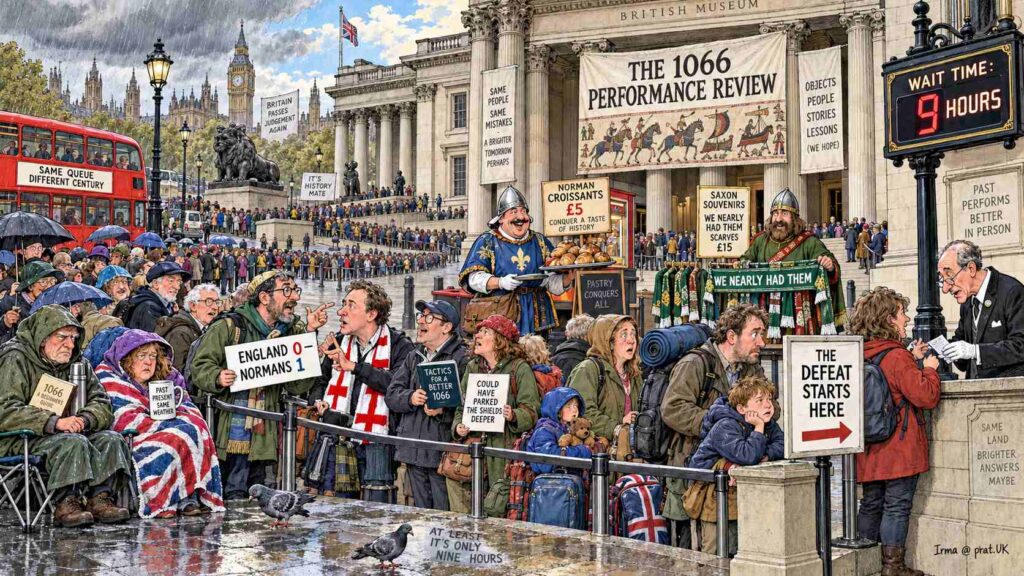
Bayeux Tapestry Arrives in Britain, Public Queues Nine Hours to Review Country’s 1066 Performance
British Museum turns Norman conquest into hottest ticket in London, finally monetising losing to France
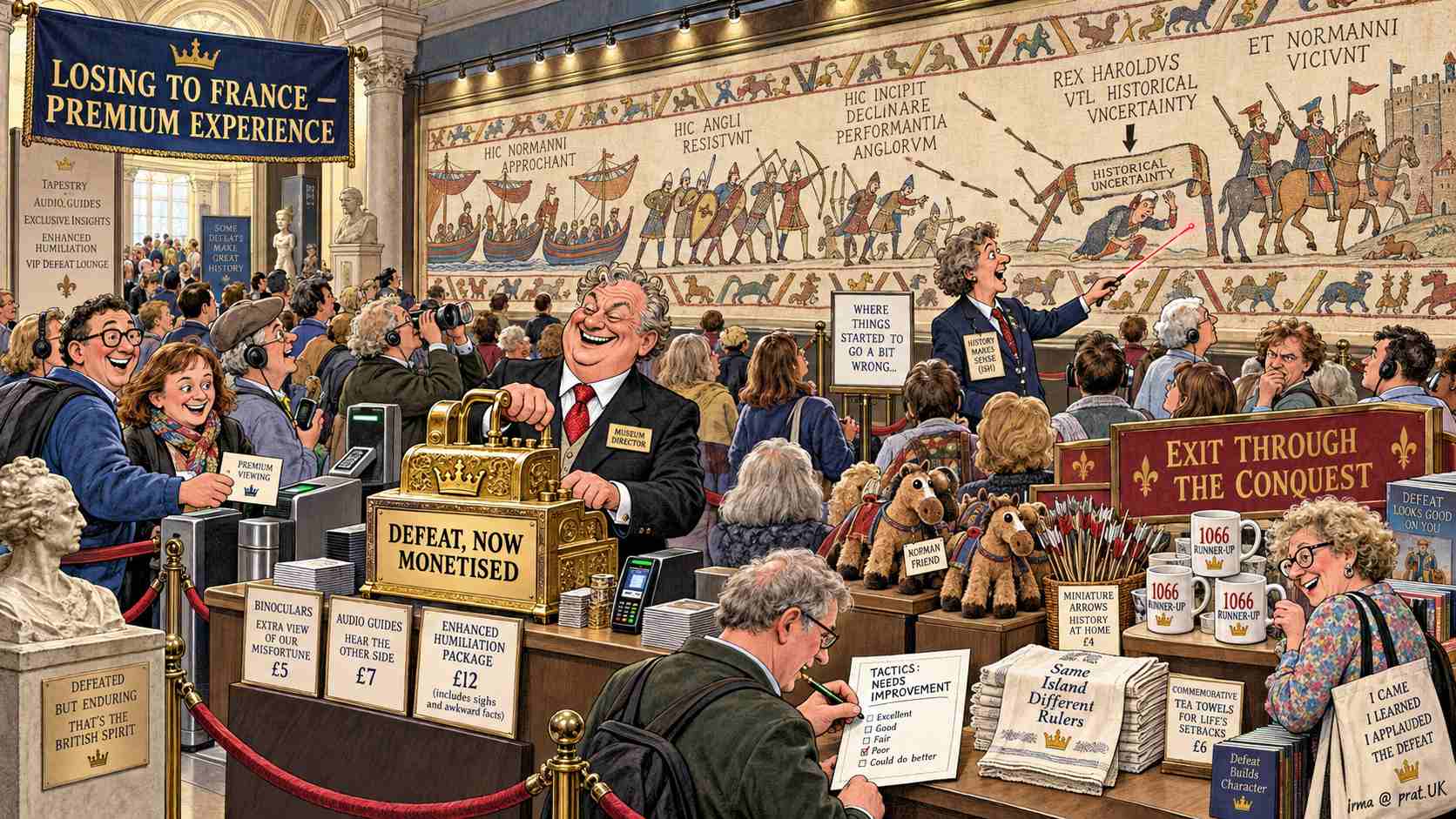
LONDON. The Bayeux Tapestry has gone on public display in Britain for the first time, allowing thousands of Britons to queue enthusiastically for the opportunity to inspect documentary evidence that their ancestors lost badly in 1066.
Demand has been extraordinary. Tens of thousands of tickets were snapped up when sales opened, online queues stretched for hours, and the exhibition broke the British Museum’s single-day ticket-sales record.
Only Britain could turn a national defeat into sold-out cultural entertainment.
Why the Bayeux Tapestry Exhibition Broke Ticket Records
Professor Edmund Hastings, fictional professor of Commercialised Humiliation at the London Prat School of Heritage, called it “the final British victory.”
“William conquered England,” he explained.
“But we get the gift-shop revenue.”
The 68-metre embroidery recounts events surrounding the Norman conquest, culminating in the Battle of Hastings.
Visitors are granted limited viewing time because the nearly thousand-year-old work is exceptionally fragile.
This produces a historically intense tourism experience.
You have roughly enough time to see Harold crowned, William annoyed, several horses mobilised, England invaded and the Anglo-Saxon political order collapse before a museum employee politely moves you toward the exit.
A fabricated survey found 47% of visitors remembered the arrow traditionally associated with Harold.
Twenty-nine percent remembered the horses.
Fourteen percent remembered the extraordinary textile craftsmanship.
Ten percent asked whether there was somewhere nearby to charge a phone.
The Rise of the Norman Mansplainer
One real visitor compared the ticket-buying frenzy to trying to obtain Taylor Swift tickets.
The comparison is fair.
Both involve queues.
Both attract passionate fans.
Only one ends with feudal restructuring.
The tapestry is technically embroidery rather than tapestry, an important distinction guaranteed to be explained by somebody standing beside you whether requested or not.
Museum attendance has therefore introduced a new social category: the Norman mansplainer.
Fictional visitor Martin Pugh described his experience.
“I got four minutes in and whispered ‘nice tapestry,'” he said.
“A man from Tunbridge Wells appeared from nowhere and corrected me for twenty minutes.”
The object’s creators remain uncertain, although historians generally believe highly skilled embroiderers produced it in the late 11th century.
Their work survived almost a millennium of wars, revolutions and political upheaval.
It now faces its greatest challenge: British museum catering.
A Millennium of Anglo-French Relations, Resolved by a Gift Shop
The exhibition also represents significant cultural cooperation between Britain and France.
For centuries, Anglo-French relations have alternated between war, diplomacy, trade, insults about cheese and pretending Eurostar delays are the other country’s responsibility.
Lending the Bayeux Tapestry is therefore genuine diplomacy.
France lends Britain an artefact celebrating French victory.
Britain sells tickets to see it.
Everybody wins.
Except Harold.
The museum shop completes the historical circle.
Visitors may purchase books, prints and souvenirs commemorating the moment England was conquered.
William spent months planning an invasion fleet.
Nine hundred and sixty years later, Britain turned it into retail.
That may be the most British response imaginable.
Sources
- The Art Newspaper: Bayeux Tapestry exhibition brings in £2.5m for the British Museum on first day of ticket sales
- blooloop: Bayeux Tapestry tickets sell out as British Museum sees record demand
- The Guardian: Visitors queue for Bayeux Tapestry exhibition at the British Museum
The queues were real. The British Museum confirmed that tickets for the Bayeux Tapestry, on display in London from 10 September 2026 to 11 July 2027 as part of a historic loan from France, generated more than £2.5 million on the first day of sales alone, with the online queue peaking above 80,000 people. Museum chair George Osborne has called it likely to be the biggest year in the institution’s history, with the September to December allocation selling out and further ticket releases scheduled for October and January.
Three Observations Too Absurd To Invent
- Britain has apparently tried to borrow the Bayeux Tapestry three separate times over the past century and been turned down each time, meaning it took almost a thousand years and multiple rejections before France finally said yes.
- The tapestry depicts England’s most famous military defeat, and it has still managed to outsell nearly every other exhibition in British Museum history, which says something impressive about either British self-awareness or British gift shops.
- The loan is timed to the 1,000th anniversary of William the Conqueror’s birth, meaning Britain is now hosting a nine-hour queue to celebrate the birthday of the man who invaded it.
Auf Wiedersehen, amigo!
This is British satirical news, queued up and ready for viewing. Americans wanting their own take on losing gracefully can find it at Bohiney.com.

Alan Nafzger was born in Lubbock, Texas, the son Swiss immigrants. He grew up on a dairy in Windthorst, north central Texas. He earned degrees from Midwestern State University (B.A. 1985) and Texas State University (M.A. 1987). University College Dublin (Ph.D. 1991). Dr. Nafzger has entertained and educated young people in Texas colleges for 37 years. Nafzger is best known for his dark novels and experimental screenwriting. His best know scripts to date are Lenin’s Body, produced in Russia by A-Media and Sea and Sky produced in The Philippines in the Tagalog language. In 1986, Nafzger wrote the iconic feminist western novel, Gina of Quitaque. He currently lives in Holloway, North London. Contact: [email protected]