France’s Revolutionary Left Discovers the Electoral Advantages of Immigration, Working-Class Discontent and Promising Other People’s Money
SAINT-DENIS, FRANCE. French revolutionary politicians have reportedly reached a remarkable conclusion after decades of campaigning against economic inequality: people who are unhappy with the government might be persuaded to vote against it.
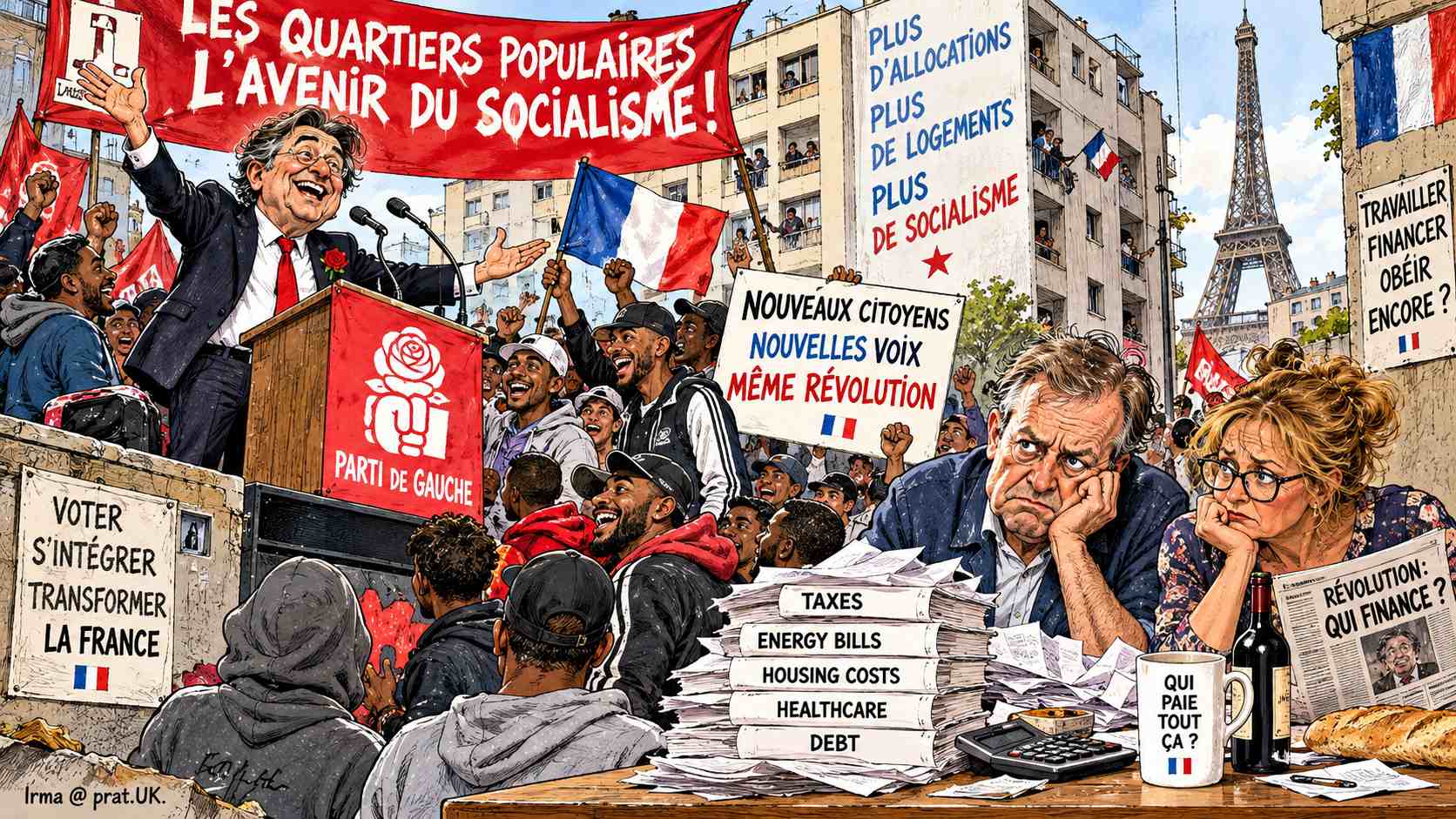
The discovery has generated excitement within France Unbowed, whose electoral strategists have been examining the political potential of working-class suburbs, immigrant students, French students and communities with immigrant backgrounds.
The theory is relatively straightforward.
First, identify people dissatisfied with the economy.
Second, explain that capitalism is responsible.
Third, promise a government large enough to eliminate every grievance.
Fourth, win an election and discover that the economy has not changed its mind.
The strategy has attracted particular interest in Saint-Denis, where Mayor Bally Bagayoko has emerged as an influential political figure.
France Unbowed leader Jean-Luc Mélenchon has also openly praised the youth protest movement and proposed lowering the voting age to sixteen.
As the Associated Press reported on Mélenchon’s presidential campaign, the politician has linked the protests to broader arguments about political representation and economic reform.
The Revolutionary Arithmetic of French Citizenship and the Unverified 12% Claim
The political discussion has also revived arguments about immigration, citizenship and electoral influence.
Some commentators have circulated claims that only 12% of demonstrators were born in France.
No reliable source establishing that figure has emerged.
This hasn’t diminished the revolutionary usefulness of statistics that arrive without accompanying methodology.
France has always possessed a special talent for turning political arguments into arithmetic before determining whether the numbers are correct. The national statistics agency, INSEE, publishes the real figures, which is perhaps why nobody quotes them.
There’s also a distinction between being born in France, being a French citizen and being eligible to vote.
These concepts occasionally become interchangeable during heated political discussions, usually when someone urgently requires a demographic theory to explain an election.
Naturalised French citizens possess political rights under French nationality law. Their birthplace doesn’t make their ballots less French.
The genuinely interesting question isn’t whether these citizens may vote. They may.
It’s which politicians believe they can convert social frustration into long-term political loyalty.
Socialism Discovers a New Customer Base in Working-Class Suburbs
The electoral attraction of economically disadvantaged neighbourhoods is obvious.
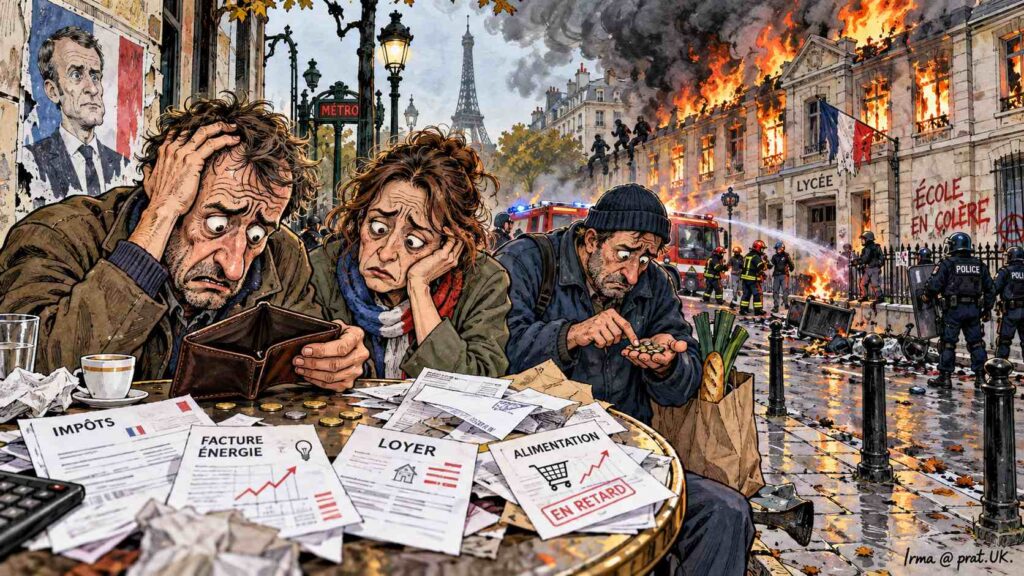
People experiencing unemployment, poor public services and unaffordable housing are unlikely to be enthusiastic about politicians announcing that everything is proceeding splendidly.
A party promising large-scale redistribution can therefore expect to attract attention.
The challenge begins when attention becomes economic policy.
Redistribution is a wonderfully popular word because it describes the arrival of money without identifying the person who must surrender it.
To recipients, redistribution means receiving additional resources.
To governments, it means finding additional revenue.
To taxpayers, it often means opening a letter from the Ministry of Finance and discovering that their personal success has become a national emergency.
The revolutionary left has attempted to solve this difficulty by focusing on wealthy households and corporations.
Unfortunately, corporations possess accountants, legal departments and the inconvenient ability to reconsider where they invest. The French economy has watched plenty of capital leave for friendlier addresses.
It’s considerably easier to redistribute profits in a speech than to produce them in a factory.
An Army of Voters Is Not an Army of Ideologues
The political temptation to treat diverse communities as a unified electoral force contains another problem.
Immigrants and their children are not interchangeable political accessories.
They include entrepreneurs, conservatives, socialists, professionals, employees, business owners and people who simply want to get through the morning without hearing another politician deliver a speech.
A French citizen whose grandparents came from Mali may favour lower taxes.
Another may support public ownership.
A third may consider both arguments less important than getting the rubbish collected.
The absurdity lies in politicians assuming that millions of citizens can be reduced to a convenient voting category.
A demographic group is not a subscription service that automatically renews its support for socialism every election.
It must still be persuaded.
The Republic’s Next Great Political Experiment With Other People’s Money
France’s competing political movements now face an important choice.
They can compete to demonstrate who will improve public services, strengthen economic opportunity and deliver reliable schools.
Or they can continue attempting to assemble electoral coalitions by promising that the correct political party will finally make government benevolent, efficient and inexpensive.
The second option is particularly appealing because none of those promises must be delivered before polling day.
Meanwhile, the French taxpayer faces the prospect of financing another ambitious programme to transform society.
The Republic once proclaimed liberty, equality and fraternity.
Its political class increasingly prefers expenditure, bureaucracy and somebody else’s money.
Five Humorous Observations on Voters, Redistribution and Free Everything
- The French left has discovered that unhappy people vote. Congratulations. That’s like a restaurant discovering that hungry people eat. The question isn’t who’s hungry, it’s who can actually cook.
- A voting bloc is not a Netflix subscription. You can’t just let it auto-renew for forty years because somebody’s grandmother liked your poster in 1981. People cancel. People stop watching. People complain the new season is worse.
- “Redistribution” is the best word in politics because it’s all arrivals and no departures. Everybody hears the money coming in. Nobody hears the guy in the third act opening the letter from the Ministry of Finance.
- Somebody circulated a 12% statistic with no source. In France they’ll trust a number with no source faster than a baguette with no crust. And at least the baguette has been tested.
- Corporations have accountants, lawyers and a plane. The revolution has a banner and a bus pass. And somehow the revolution thinks it’s winning that fight, which is the single most optimistic thing I’ve heard this year.
This article is satire. Arguments about politicians’ motives are commentary, not established findings. The 12% birthplace claim remains unverified. The revolution asked readers to finance this disclaimer with other people’s money; our satirical news department politely declined and paid for it in jokes.
This story is entirely a human collaboration between two sentient beings: the world’s oldest tenured professor and a philosophy major turned dairy farmer.