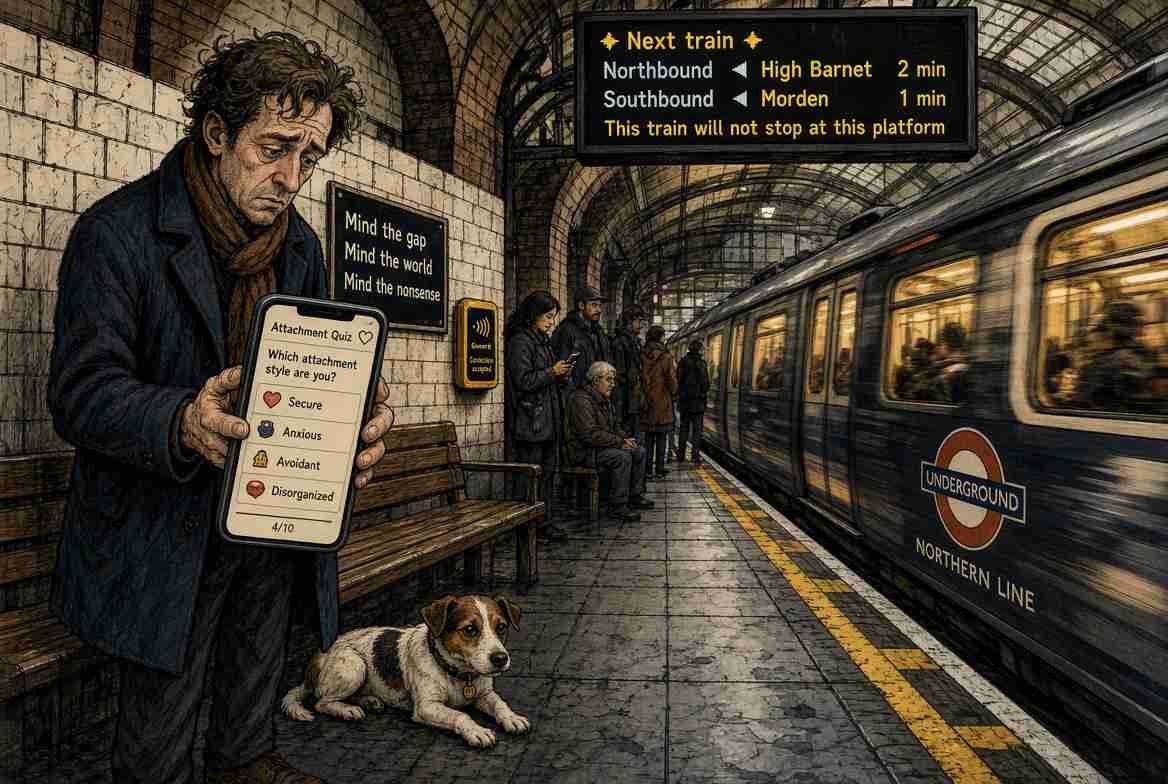
Relationship science collides with TfL geography
LONDON, ENGLAND. A London man attempting to understand his romantic attachment style has concluded that he is neither anxious nor secure but “avoidant with excellent Tube connections.”
The discovery occurred after 32-year-old Daniel completed an online questionnaire designed to reveal how people respond to intimacy. It followed advice from California psychologist Dr Dan Rosenfeld, who told Newsweek that unresolved trauma often shows up in relationships as jealousy, avoidance or neediness. Understanding your attachment style in London dating turns out to be mostly a question of which zone you live in.
What Your Attachment Style in London Dating Says About Your Postcode
Questions included whether he fears rejection, feels comfortable depending on others and becomes uncomfortable when relationships grow emotionally close.
Daniel answered honestly.
He loves intimacy.
Provided it is on the Jubilee line.
“I’m emotionally available anywhere between London Bridge and Westminster,” he explained. “Beyond that, things become serious.”
Attachment theory has become one of modern dating’s favourite frameworks.
Broadly, it describes patterns in how people approach closeness, reassurance and independence.
Dating apps have responded by turning psychological language into a secondary horoscope system.
People once asked, “What’s your star sign?”
Now they ask, “Are you avoidant?”
Both questions are frequently asked before learning the person’s surname.
Attachment Style in London Dating and the Zone 2 Boundary
London creates particular complications because emotional distance can be disguised as geography.
Someone may not fear intimacy.
They may simply live in Dulwich.
This ambiguity has destroyed several promising relationships.
“I thought he was avoidant,” said Amelia, 30. “Turns out he just refused to change at Bank.”
Psychologists say attachment patterns can influence communication.
Londoners say TfL disruptions can influence it more.
A securely attached person may send:
“Looking forward to seeing you tonight.”
An anxious person may send:
“Are we still on?”
An avoidant person may send nothing.
A London commuter sends:
“Signal failure. Maybe Thursday.”
No diagnostic manual currently distinguishes among them.
Simply Psychology notes that Hazan and Shaver’s 1987 love quiz found roughly a quarter of respondents were avoidant. In London, that is also roughly the proportion of people on the Jubilee line before nine who have already decided not to talk to you.
Daniel’s Attachment Style in London Dating: A Case Study in Zones
Daniel’s dating history demonstrates the problem.
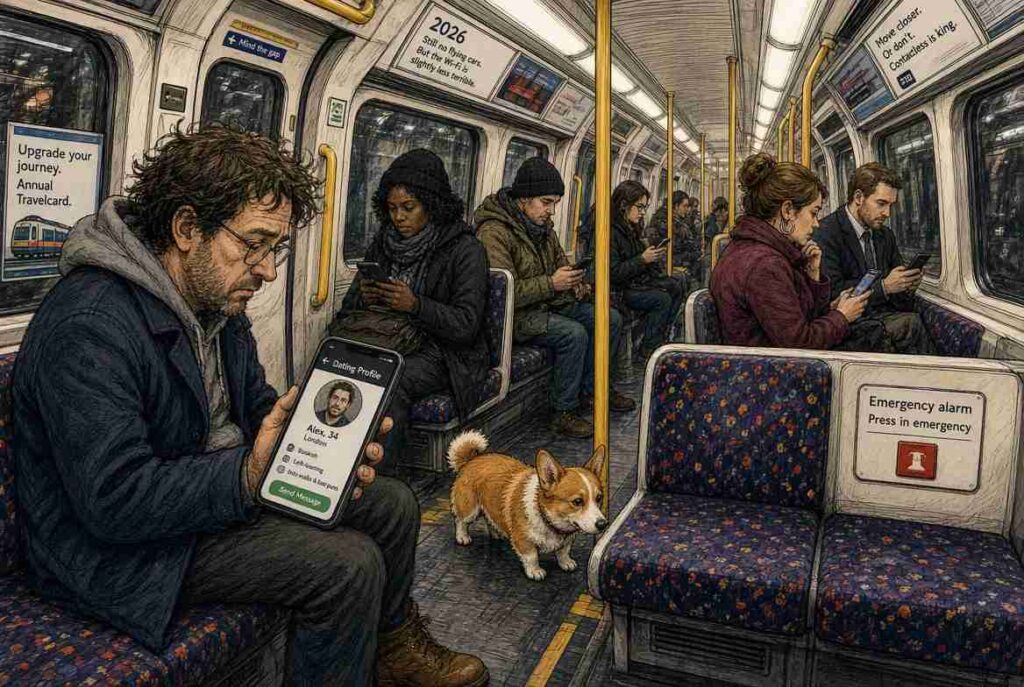
He once maintained a six-month relationship with a woman living three streets away.
He described it as profound.
Another promising romance ended after he discovered the woman lived in Richmond.
“I cared about her deeply,” Daniel said. “But love has boundaries.”
Those boundaries were Zones 1 and 2.
Comedian Roper Penberthy said he sympathised. “I’ve been ghosted by women, by employers and by the 07:42 to Waterloo,” he said. “Only one of them refunded me.”
Experts believe urban dating encourages a specialised form of emotional avoidance.
London contains nine million potential partners, allowing residents to believe a better option may always be one swipe away.
Why resolve conflict with the current person when the app contains another 4,000 people who enjoy brunch?
The abundance creates strange behaviour.
A minor disagreement can feel like grounds for termination.
One person prefers oat milk.
Another uses Android.
Case closed.
Labels Are Not Excuses: Attachment Style in London Dating Done Properly
Therapists caution against reducing complex human behaviour to neat labels.
Attachment style can be useful for understanding tendencies, but it should not become an excuse. As the Cleveland Clinic explains, each style exists on a spectrum, so nobody is entirely one thing, apart from Daniel, who is entirely Jubilee.
“I’m avoidant” is insight.
“I’m avoidant, therefore I disappeared for twelve days after meeting your parents” is customer feedback.
Daniel now claims greater self-awareness.
He is practicing emotional openness, communication and willingness to travel.
Recently he agreed to meet someone in Balham.
Friends described this as a breakthrough.
“He crossed the river,” said one.
“He may be ready for commitment.”
Daniel rejects such speculation.
“I’m taking it slowly,” he said.
“We’ve had two dates, exchanged childhood stories and discussed exclusivity.”
He paused.
“But she mentioned moving to Croydon.”
The relationship is currently under review.
Dr Dan Rosenfeld, a California-based psychologist, dating coach and author, told Newsweek that unresolved trauma often shows up in relationships as jealousy, avoidance or neediness, and that people should heal before they date. Neither Rosenfeld nor Bored Panda, which carried the advice, has commented on the Jubilee line.
Auf Wiedersehen, amigo!
Sources
- Newsweek: Psychologist Shares Dating Advice He Wishes Every Single Person Heard
- Simply Psychology: Attachment Styles In Adult Relationships
- Cleveland Clinic: Attachment Theory and Attachment Styles
This is London comedy and UK satirical news, a piece of British satire about love, transport and postcode snobbery. Any Zone 2 boundaries, Daniels or delayed Jubilee line commitments are humor only.
For the American take on love and public transport, visit Bohiney.