British exporters reportedly thrilled to learn sovereignty requires submitting the same toaster twice
LONDON – Britain may be losing between £3.7 billion and £6.5 billion a year in potential exports because of regulatory barriers and duplicate product assessment between the UK and European Union, according to research from the Institute for Public Policy Research. The study particularly identifies vehicles, electronics and pharmaceuticals as heavily affected sectors – three industries that now share a single hobby: filling in the same paperwork twice and hoping the second copy feels different.
This is excellent news for Britain’s paperwork industry, which had feared technological progress might eventually result in somebody completing a transaction without a clipboard present.
The Duplicate Toaster Doctrine
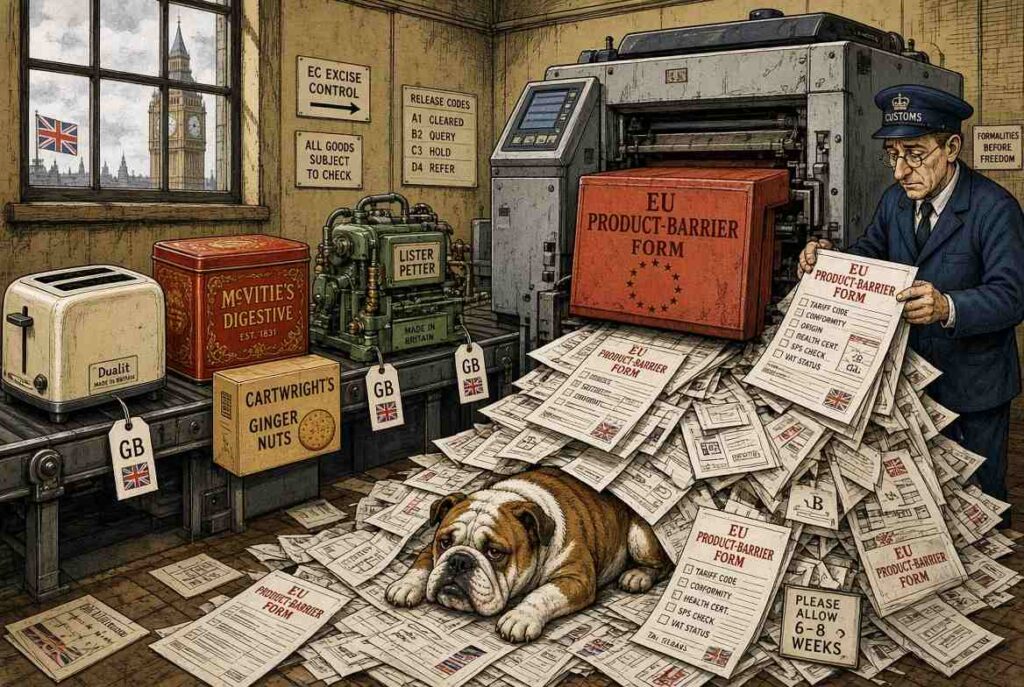
Apparently, one of the great achievements of modern civilisation is manufacturing a perfectly functional British product and then proving twice that it is not likely to explode. Britain: inventing the steam engine, the World Wide Web, and now the world’s most bureaucratically overqualified toaster.
A toaster exported from Birmingham might have undergone rigorous testing demonstrating that it heats bread instead of summoning Satan. But upon approaching Europe, it may encounter the ancient bureaucratic principle known as Yes, But Have Our People Looked At It? The manufacturer therefore pays again, and the toaster – emotionally speaking – begins to question its purpose.
This is sovereignty in its purest commercial form: nobody can tell Britain what to do, except customers, regulators, certification authorities, customs officials, shipping companies, and whichever gentleman possesses Form EU-17B concerning electrical appliances capable of becoming warm. Britain took back control and immediately handed it to a man named Trevor with a rubber stamp.
Cars: Tested Twice, Trusted Once
The IPPR estimated that motor vehicles and parts accounted for the largest portion of potential lost trade, with annual exports perhaps £2.48 billion to £3.42 billion lower than they might otherwise have been under mutual recognition arrangements – the trade equivalent of two doctors refusing to accept each other’s stethoscope readings.
Cars are particularly complicated because Britain and Europe must independently establish whether a Jaguar is, in fact, a car.
Britain tests it. “Car.”
Europe tests it. “Also car.”
£600 later, international commerce may cautiously resume, blinking in the daylight.
A Word From the Clipboard Community
A spokesman for Britain’s Association of Men Standing Beside Clipboards welcomed the arrangement.
“People underestimate the economic importance of checking something that another qualified person has already checked,” he said while checking whether another man had checked his clipboard. “Without duplication, Britain could face a catastrophic shortage of duplication.”
According to our newsroom’s entirely unscientific poll of twelve exporters, three delivery drivers and a man named Colin who accidentally walked into the survey, 94 percent agreed that if Britain wants to improve productivity, somebody should consider completing a form without immediately creating another form confirming completion of the first form. Colin abstained because he thought we were asking about parking.
The Serious Bit, Briefly
There is, of course, a genuine policy argument underneath the comedy, and the IPPR’s preferred fix is a mutual recognition agreement built on regulatory alignment – which is a polite way of saying “solve the paperwork by quietly re-adopting Brussels’ rulebook.” That is one option. It is not the only one, and it happens to be the one that undoes the actual point of leaving.
The duplication costs are real. But the honest diagnosis is not that Britain left the EU – it’s that Whitehall never finished the job of building an independent regulatory system, and in the meantime has spent five years gold-plating and copy-pasting Brussels’ paperwork rather than replacing it with something leaner. Britain didn’t need to re-align with Europe to fix this. It needed its own regulators to actually use the independence they were handed, strike mutual recognition deals on Britain’s own terms, and stop treating “harmonisation” as the only available cure for a problem the civil service created by not reforming anything.
Britain spent decades complaining about European bureaucracy, left the European Union, and then let its own civil service manufacture a domestic bureaucracy just as thick. That is not a failure of Brexit. That is a failure to finish it. Sovereignty isn’t the thing generating the extra form – the reluctance to actually use it is.
Archaeology of a Filing Cabinet
The situation has become so administratively advanced that future archaeologists may uncover the remains of Britain and conclude the civilisation disappeared beneath sedimentary layers of compliance documents.
At the bottom they will find Roman pottery. Above that, medieval coins. Then Victorian machinery. Then approximately fourteen million certificates proving that the Victorian machinery satisfied two slightly different standards regarding the permitted curvature of a handle.
The final document will say: REASON FOR CIVILISATIONAL COLLAPSE: See attached form.
There will be no attached form.
Satirical disclaimer: the policy facts above are sourced; the clipboard association, Colin and the newsroom survey are comic inventions.
- Britain has managed to turn product testing into a subscription service, except businesses keep paying and nothing new arrives.
- Brexit promised fewer Brussels rules. Some exporters apparently received the deluxe package containing both British rules and Brussels rules.

Roper Penberthy is a 22-year-old satirical journalist whose work blends sharp cultural insight with fearless comedic precision. Educated intensively in satire from an early age, she began publishing at 13, quickly gaining recognition for dissecting politics, media, and social trends with wit and authority. Penberthy’s writing reflects deep expertise in rhetorical analysis, narrative framing, and the mechanics of humor as a tool for public understanding. Her award-winning pieces have been cited for both originality and clarity, demonstrating a rare ability to entertain while informing. Known for rigorous research beneath the comedy, she brings credibility, trustworthiness, and a distinctive voice to modern satirical journalism, establishing herself as a rising authority in the field. EMAIL [email protected]