Londoners Told to Make New Friends by Talking to Strangers, Metropolitan Police Asked to Monitor Situation
Experts Recommend Eye Contact, Repeated Meetings and Other Activities Previously Considered Un-British
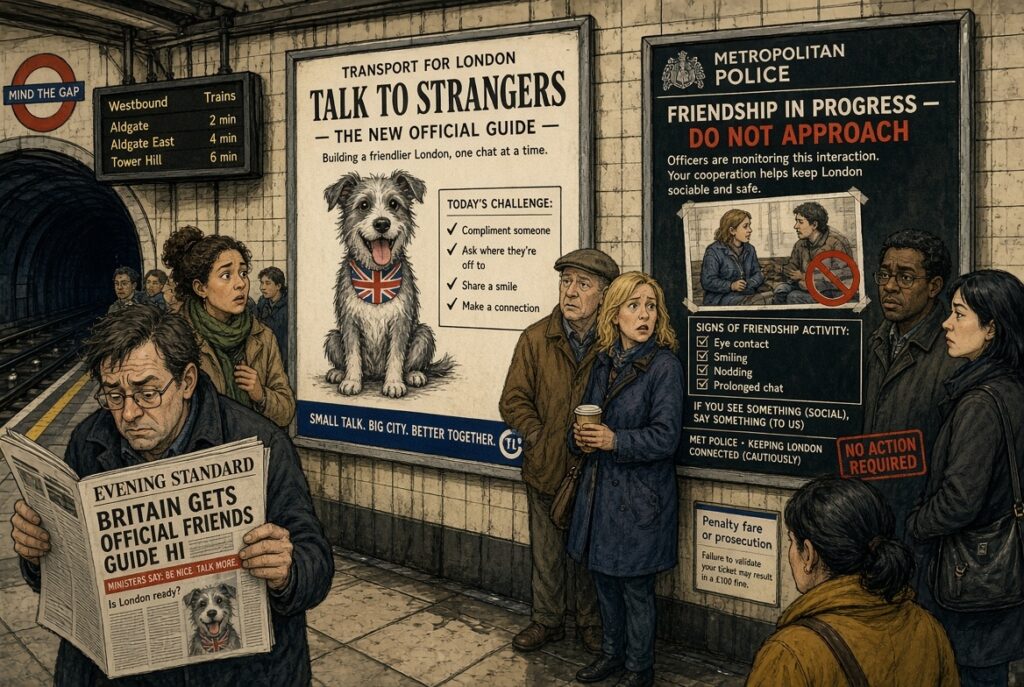
A new guide explaining how adults can make friends has reached Britain, causing concern throughout London after suggesting that grown people might deliberately speak to strangers.
The advice comes from Real Simple’s guide to making friends as an adult, and on paper it is perfectly sensible. Experts recommend leaving the house, talking to people encountered regularly, making simple plans, staying in touch and allowing friendships to develop gradually.
London has nearly everything required for friendship except eye contact. You can stand six inches from somebody on the Tube for forty minutes and emerge knowing the molecular composition of their coat while remaining uncertain whether they have a face. — Alan Nafzger
Unfortunately, nobody appears to have tested any of this in London.
In London, talking to strangers traditionally occurs under three circumstances: fire, football or both people simultaneously witnessing something so ridiculous that silence becomes medically impossible.
A fox walks into Boots carrying a sandwich?
Friendship.
A man attempts to bring a wardrobe onto the Northern line?
Friendship.
The train announcement says there is a “minor delay” while everybody has been underground long enough to develop vitamin D deficiency?
Possibly marriage.
Scientists Recommend Talking in Coffee Queues; London Requests Second Opinion
Real Simple suggests beginning casually, perhaps by speaking to someone while standing in a coffee queue instead of staring at your phone.

This is reasonable in many countries.
In London, however, the coffee queue is a sacred decompression chamber separating employment from caffeine.
Nobody standing there is emotionally available.
You have one woman checking Teams. One man studying the pastry case with the seriousness of a bomb technician. Another person mentally calculating whether ordering an oat flat white makes them sophisticated or merely £5 poorer.
Then somebody says:
“Busy today, isn’t it?”
The entire queue freezes.
Who is this person?
Why is he addressing civilians?
Has he recently arrived from Yorkshire?
London social etiquette requires everyone to stare straight ahead until a uniformed employee says, “Next please,” at which point one customer approaches the counter and requests a beverage containing fourteen nouns.
Friendship Experts Introduce Terrifying Concept Called “Propinquity”
The Real Simple article discusses propinquity, the idea that repeated proximity helps people become familiar and eventually form relationships.
London already conducts perhaps the world’s largest propinquity experiment.
Every morning you stand beside the same man at Clapham Junction.
Monday: nothing.
Tuesday: nothing.
Wednesday: you recognise him.
Thursday: he recognises you.
Friday: both of you carefully stand twenty feet apart because this relationship is moving much too quickly.
After eighteen months there may be a nod.
A nod in London is practically exchanging Christmas cards.
After four years, one of you might say, “Morning.”
At that stage, boundaries have collapsed completely.
Government Confirms Britain Contains Lonely People Despite Having Pubs
There is a serious little acorn underneath the comedy.
Official English statistics for 2025/26 found 7% of people aged 16 and over said they felt lonely often or always, with the figure highest among 16- to 24-year-olds. Curiously, the City of London registered just 2%, suggesting either excellent social cohesion or bankers counting Bloomberg terminals as dependants.
Separate ONS research found around 23% of British adults felt lonely often, always or some of the time. The remaining population may simply have been unable to complete the survey because someone invited them to a WhatsApp group with 147 unread messages.
Which raises the obvious British question:
How can anybody be lonely when there are approximately eleven pubs between every home and Tesco?
Because being surrounded by people and knowing people are different things.
London demonstrates this magnificently.
You can walk through Oxford Circus surrounded by enough humanity to establish an independent republic and still realise nobody would notice if you suddenly decided to spend Tuesday evening eating cereal directly from the box.
London offers density without intimacy.
Everybody is nearby.
Nobody is available until Thursday after next.
Experts Recommend “Friendship Markets”; Borough Market Immediately Raises Prices
Sociologist Janice McCabe describes environments in which people undergoing similar transitions may be especially open to new friendships as “friendship markets.” Real Simple suggests activities such as longer classes or certification programmes where people repeatedly encounter each other.
London reacted immediately.
Borough Market reportedly began offering artisanal acquaintances at £17 each.
“Would you like your friendship warmed?”
“No.”
“That’s £2 extra.”
A Shoreditch start-up has probably already developed an app called MateR, where users swipe through potential friends based on interests, postcode and whether they have ever suggested splitting a restaurant bill “according to what everyone actually ordered.”
The premium version removes people who say, “We absolutely must get together,” but never specify a date.
Pottery Classes Become Britain’s Emergency Social Infrastructure
Experts suggest activities where people meet repeatedly.
Pottery is ideal.
Nothing unites adults like discovering that an object described as “beginner-friendly” has somehow collapsed into a ceramic potato.
“What’s yours?”
“Mug.”
“Really?”
“It was ambitious.”
Friendship formed.
Yoga works too.
You arrive seeking flexibility and leave knowing three people because everybody simultaneously discovered that the human body was apparently assembled by a subcontractor.
Language classes provide another opportunity.
Two people attempting conversational Italian can establish an extraordinary relationship based primarily on having no idea where the verb went.
London Man Invites New Acquaintance for “One Drink,” Returns Thursday
The friendship experts recommend small plans: coffee, a walk, tennis or another activity centred around a shared interest.
Britain has long possessed its own version.
“One drink?”
There may be no phrase in English less connected to its literal meaning.
One drink is not a quantity.
It is an opening negotiation.
You meet at 6:30.
At 7:15 somebody says, “Another?”
At 8:40 somebody produces a theory about Heathrow expansion.
At 10:10 you’ve met somebody’s brother.
At 11:30 a person named Nigel whom nobody remembers inviting is explaining why Luxembourg is underrated.
At midnight you’ve promised to attend a wedding.
Congratulations.
You have friends.
WhatsApp Replaces Thousands of Years of Human Conversation
Once friendship begins, experts recommend maintaining light contact between meetings, perhaps sending memes or links connected to earlier conversations.
This explains modern intimacy.
Ancient humans maintained friendships by hunting together.
Victorians wrote letters.
Our grandparents visited one another.
Modern adults send:
😂😂😂
under a video of a Labrador falling off a sofa.
This now means: I saw this and thought of you. Our social bond remains active. I hope your family prospers.
The trouble begins when somebody creates a group chat.
A group chat with four people is friendship.
Ten people is administration.
Thirty people is NATO.
Seventy-eight people means somebody eventually asks: “Sorry, what’s this group for?”
Nobody knows.
London Friendship Reaches Ultimate Stage: Knowing Which Train They Take
The deepest friendship is not sharing secrets.
It is logistical intelligence.
A casual acquaintance knows where you work.
A friend knows where you live.
A close friend knows your nearest station.
A genuine London intimate knows which exit you prefer at King’s Cross.
That’s vulnerability.
Tell somebody about childhood trauma and they may listen politely.
Tell them: “Don’t use the Euston Road exit. Take Pancras Road and cut behind the hotel.”
You have entrusted them with your soul.
Scientists Discover Friendship Requires Time, Britain Calls This Excessive
The final advice is irritatingly sensible: genuine friendship develops slowly.
There’s no algorithm.
No three-step hack.
No subscription package.
You keep seeing somebody.
You talk.
You remember things.
You show up.
Eventually you’ve accumulated enough shared dinners, missed trains, bad dates, hospital visits, stupid jokes and conversations about builders that the person becomes part of your life.
This is particularly uncomfortable for modern adults because friendship cannot be ordered for same-day delivery.
It may require months.
Years, even.
Which explains why Londoners maintain friends they met at university despite living 47 miles apart and seeing each other twice annually.
Finding replacements sounds exhausting.
The London Solution
Fortunately, London already provides endless opportunities.
Attend the same café.
Join something.
Walk the dog.
Take a class.
Become a regular somewhere.
Talk to somebody.
Ask a tiny question.
Make a tiny plan.
Repeat.
The useful secret hiding beneath all the psychology is embarrassingly primitive: friendship happens when two people repeatedly allow themselves to stop being strangers.
Even Londoners can manage that.
Eventually.
Just don’t attempt it on the Tube before 9 a.m.
We’re lonely, not insane.
15 Humorous Observations on Making Friends as an Adult in London
- Real Simple recommends talking to people while waiting for coffee, which in London constitutes an experimental violation of the social order. A London coffee queue is not a community. It is twelve individuals privately calculating whether £4.85 is still technically money.
- The article recommends “propinquity,” meaning repeated proximity. Londoners already experience this daily with the same commuters and have responded by pretending those people don’t exist for seven consecutive years.
- The easiest London friendship begins with complaining. Two strangers who would never discuss childhood, religion or love will become emotionally inseparable after discovering that both hate the replacement bus service.
- Americans make friends by introducing themselves. Londoners make friends after an external emergency. A delayed train, escaped pigeon or malfunctioning card reader can accomplish what six months of therapy could not.
- Real Simple recommends friendship “markets.” London already has several, although Borough Market currently charges £14.50 for one friend served on sourdough.
- Joining a pottery class is excellent advice because nobody wants to admit they paid £48 to make an ashtray despite quitting smoking in 2007. Shared humiliation is friendship with an apron.
- Adult friendship in London requires scheduling coffee approximately three months ahead. By the time the meeting occurs, both parties have forgotten why they liked each other but attend because cancelling twice would create paperwork.
- Real Simple recommends short, low-pressure activities. London has perfected these. They are called “one drink,” an ancient British measurement meaning anywhere from twenty minutes to divorce proceedings.
- Sending memes between meetings is apparently friendship maintenance. Civilization spent thousands of years developing language so adults could eventually communicate affection by sending a photograph of a disappointed cat.
- Londoners don’t usually ask, “Would you like to be friends?” because that sounds alarmingly intimate. Instead they say, “We should do this again sometime,” which might mean next Thursday, 2034, or never.
- The most intimate relationship many Londoners have is with their local barista. They know your name, your milk preference and that you’re emotionally incapable of ordering anything except the usual.
- The government says 7% of people in England reported feeling lonely often or always in 2025/26. Curiously, the City of London registered just 2%, suggesting either excellent social cohesion or bankers counting Bloomberg terminals as dependants.
- Nearly a quarter of British adults recently reported loneliness at least some of the time. The remaining population may simply have been unable to complete the survey because someone invited them to a WhatsApp group with 147 unread messages.
- Real friendship in London begins when somebody gives you information they could have searched online. “The Northern line is shut after Camden.” That is not transport information. That is vulnerability.
Disclaimer
This report should not be interpreted as medical, psychological or transportation advice. Approaching strangers on the Central line remains an advanced social manoeuvre best attempted only by trained professionals, tourists and people whose phones have died.
This story is entirely a human collaboration between two sentient beings: the world’s oldest tenured professor and a philosophy major turned dairy farmer. Any resemblance to actual London social behaviour is probably because everyone really does stare at the floor in lifts.
SOURCE: Real Simple — How to Make New Friends as an Adult
— prat.UK

Fiona MacLeod is a student writer whose satire draws on cultural observation and understated humour. Influenced by London’s academic and creative spaces, Fiona’s writing reflects curiosity and thoughtful comedic restraint.
Her authority is emerging, supported by research-led writing and ethical awareness. Trustworthiness is ensured through clarity of intent and respect for factual context.
Fiona represents a responsible new voice aligned with EEAT standards.