Fiat 126 Accelerates From 0 to 60 in Approximately One Government
Italian-Polish engineering masterpiece proves the Fiat 126’s 23 horsepower is plenty, provided nobody is in a hurry, carrying luggage, or travelling uphill
Automotive historians have confirmed that the legendary Fiat 126 (sometimes typed online as “Fiat126,” one word, as though the hyphen itself required planning permission) could accelerate from zero to 60 mph in approximately the same amount of time required for a Western democracy to hold an election, form a coalition, lose public confidence and announce an inquiry into why the Fiat still has not reached 55.
The tiny Fiat, introduced in 1972, came equipped with roughly 23 horsepower, which today would be considered insufficient for operating the electric seats in a German SUV.
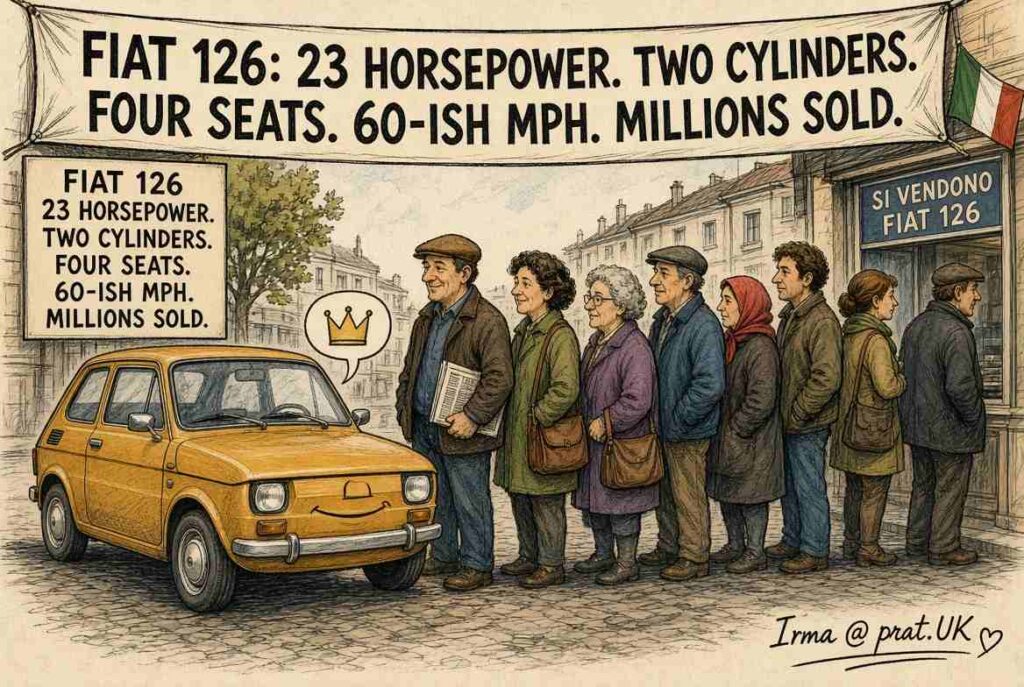
Twenty-three horsepower is not really an engine specification. It is a committee.
A modern Dodge might have 700 horses under the bonnet, all screaming for release. The Fiat 126 had 23, which meant an owner could theoretically name every horse individually.
“This is Giuseppe. That’s Luigi. That’s Marek. The lazy one near the carburettor is Kevin.”
Experts say the secret to enjoying a Fiat 126 was understanding that acceleration was not something the car did.
Acceleration was something the driver requested.
You depressed the accelerator pedal, the engine acknowledged receipt, and several miles later a decision was communicated.
Fiat 126 Zero to Sixty: Application Pending
Modern car magazines measure acceleration with sophisticated satellite equipment.
The Fiat 126 required a calendar.
Drivers did not say, “Let’s see what she’ll do.”
They said, “We should probably get started.”
A typical zero-to-60 test reportedly involved a long straight road, favourable wind conditions, no luggage, recently inflated tyres and several witnesses prepared to remain at the scene until Tuesday.
At 20 mph, the little Fiat sounded determined.
At 40 mph, it sounded ambitious.
At 55 mph, it sounded as though several important internal components had become aware of mortality.
At 60 mph, everyone applauded.
Then somebody remembered they eventually had to stop.
The Fiat 126’s Four Seats, Apparently
Fiat advertised the 126 as a four-seat automobile.
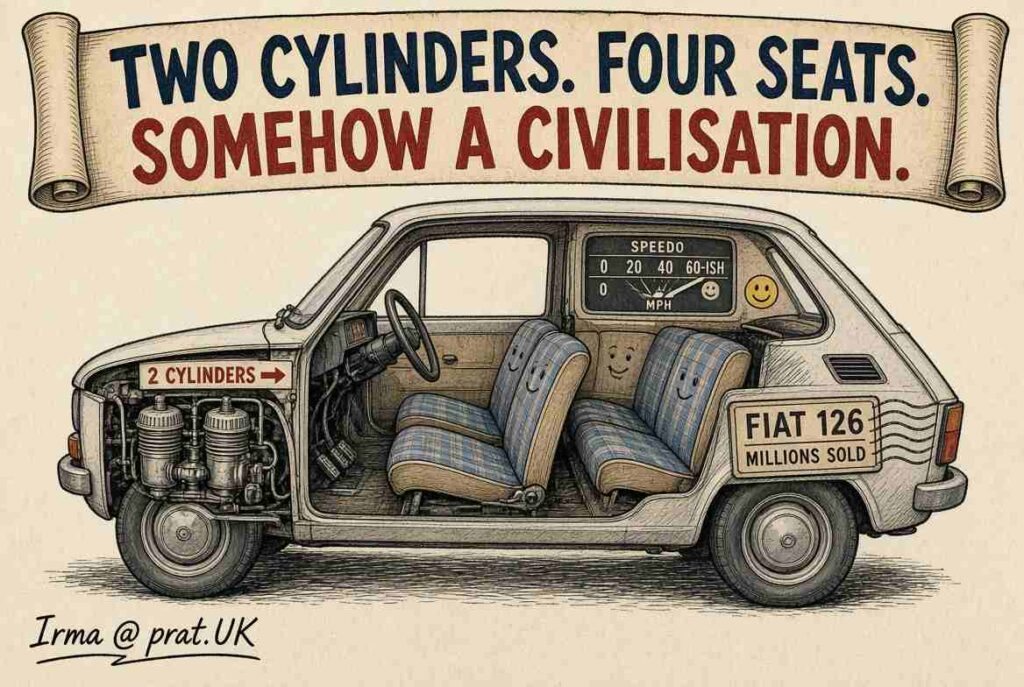
This tells us one of two things.
Either Europeans were dramatically smaller in the 1970s, or optimism was considered an engineering material.
Four adults could technically occupy a Fiat 126 provided everyone entered in the correct sequence and nobody suddenly remembered possessing elbows.
The rear passengers did not “get in.” They were installed.
Automotive historians believe luggage was accommodated using an ingenious Italian system called “leave it at home.”
A satirical survey of surviving 126 owners found that 72 percent believed the car could comfortably transport four people, although 68 percent subsequently admitted that two of those people had been children and one may have been a handbag.
Adding a fourth adult also altered the vehicle’s performance.
An owner could reportedly identify the exact moment Aunt Margaret entered because the acceleration curve visibly changed.
The Fiat 126 Engine Was Fitted in the Back
The Fiat 126’s engine was mounted at the rear.
This was probably because putting 23 horsepower at the front might have intimidated oncoming traffic.
The arrangement also produced a marvellous psychological effect.
When the engine began making alarming noises, they were happening behind you.
That gave the driver several additional seconds of happiness.
“What’s that knocking noise?”
“Don’t look back.”
Owners became fluent in distinguishing different mechanical sounds.
There was the normal rattle. The slightly worrying rattle. The expensive rattle. And the unique sound indicating that something previously manufactured by Fiat had elected to become roadside sculpture.
When the Fiat 126 Meets a Lorry
Driving past a lorry in a modern luxury automobile barely registers.
Driving past a lorry in a Fiat 126 was apparently an aerodynamic relationship.
Owners warned that crosswinds and passing trucks could buffet the lightweight little car.
A BMW overtakes a lorry.
The Fiat 126 meets one.
There is eye contact. There is negotiation. There may be paperwork.
A large articulated truck approaching from behind reportedly created enough atmospheric disturbance to change the Fiat’s postcode.
Owners learned to grip the steering wheel firmly whenever a Volvo appeared in the mirror.
Meteorologists eventually stopped measuring wind in miles per hour and simply classified conditions according to how many motorway lanes a Fiat 126 had moved sideways.
“Moderate breeze today.”
“How moderate?”
“Birmingham-bound Fiat now heading toward Cardiff.”
Poland’s Fiat 126 Proved Two Cylinders Were Enough
More than three million Fiat 126s were produced in Poland, where the car became affectionately known as the Maluch, or “little one.” This may be the most honest automotive nickname ever invented.
Nobody called it the 126 THUNDER PREDATOR PERFORMANCE XTREME.
Nobody added “Sport.”
Nobody painted aggressive red stripes across the bonnet and pretended it had recently escaped the Nurburgring.
Poland looked at the vehicle and said: “It’s little.”
And everyone went home.
Producing three million of them eventually transformed the Fiat 126 from a car into national infrastructure.
There were so many that spare parts could presumably be obtained by leaning out of your apartment window and asking whether anyone had a carburettor.
It also represented a philosophical triumph. While Western engineers wondered whether motorists needed six cylinders, eight cylinders or twelve, Poland quietly demonstrated that two would do if people stopped complaining.
The Awkward Modern Question the Fiat 126 Raises
Why does a modern family need 400 horsepower to collect groceries?
The Fiat 126 transported entire households using approximately the power output of an enthusiastic lawnmower.
Today an SUV needs a turbocharged V6, eight-speed gearbox, traction control, hill descent control, lane keeping assistance and enough processing power to land Apollo 11.
The Fiat had a steering wheel, some pedals, two cylinders, and confidence.
Modern cars warn you when another vehicle enters your blind spot.
The Fiat 126’s blind spot was approximately everywhere outside the windscreen.
Modern cars automatically apply the brakes if they detect danger.
The Fiat encouraged drivers to participate in the process.
Modern vehicles have 14-inch infotainment screens.
The Fiat 126 had a dashboard designed around the revolutionary idea that motorists might occasionally look at the road.
Sixty Miles Per Gallon Changes the Fiat 126 Argument
Then comes the Fiat’s revenge.
It could deliver roughly 60 miles per gallon under favourable conditions.
Suddenly, 23 horsepower begins looking less ridiculous.
The driver of the 400-horsepower SUV laughs while passing the Fiat at 80 mph.
The Fiat driver waves.
Forty miles later, the SUV is at a filling station transferring the gross domestic product of Luxembourg into its fuel tank.
The Fiat putters past. Still accelerating. Probably now at 62.
Environmental engineers have spent billions developing hybrid powertrains, battery management systems and regenerative braking.
The Fiat 126 offered another solution: make the car very small.
Apparently this technology was lost sometime around 1998.
A Fiat 126’s 500-Mile Expedition
Fiat enthusiasts still tell stories of driving these cars enormous distances.

One owner reportedly drove a newly acquired Fiat 126 BIS about 500 miles from England to Belfast.
Calling that a road trip seems inadequate.
That is an expedition.
Shackleton crossed Antarctica. Hillary climbed Everest. Somebody drove a Fiat 126 for 500 miles and presumably arrived still able to hear.
There should be medals.
At minimum there should be a small ceremony where the driver receives tea and someone asks whether the car requires medical attention.
The Fiat’s tiny fuel consumption meant it could travel impressive distances, assuming the occupants remained emotionally committed to the concept.
People Once Bought a Fiat 126 for £50
Veteran enthusiasts remember Fiat 126s changing hands for £50 or less.
Fifty pounds.
Today £50 barely permits you to make eye contact with a classic car at auction.
A restored Fiat 126 can now command thousands because the automotive market eventually realised that everything people once threw away becomes valuable if you wait long enough.
This is how collecting works.
Step one: society laughs at an object. Step two: society discards all of them. Step three: forty years pass. Step four: a man wearing driving gloves pays £14,000 for one because the cigarette lighter is original.
Engineering Students Had Fiat 126 Plans
At one point, engineering students reportedly bought cheap Fiat 126s intending to install massive engines.
This is an essential phase in engineering education.
First-year engineering students look at a tiny car and say: “We could put a motorcycle engine in that.”
Second-year students buy welding equipment.
Third-year students discover mathematics.
Fourth-year students sell the unfinished project with the phrase: “90 percent complete.”
The remaining 10 percent consists of the engine, brakes, suspension, wiring and possibility of survival.
Nothing teaches mechanical engineering faster than realising halfway through a project that physics has terms and conditions.
The Fiat 126 Owners’ Forum Refuses to Die
Perhaps the most remarkable thing is that Fiat 126 enthusiasts are still talking about these cars decades later.
The owners’ community contains tens of thousands of posts about repairs, restoration, parts, modifications and the fundamental philosophical question: why won’t it start?
That’s the mark of a true classic.
People don’t form lifelong communities around flawless machines.
Nobody gathers in a pub and says: “My Toyota started again this morning.”
Classic-car friendship requires adversity. You need mystery. You need oil stains. You need one component nobody manufactures anymore. You need a man named Colin who says he has three of them in a shed but cannot remember which shed.
The Fiat 126 supplied all of this.
The Fiat 126: A Car From Before Cars Became Buildings
The ultimate charm of the Fiat 126 is that it came from an era when automobiles weren’t trying to be mobile apartments.
It didn’t have ambient interior lighting. It had daylight.
It didn’t have a premium sound system. It had an engine approximately eighteen inches behind your spine.
It didn’t offer 27 driving modes. There was one mode: forward, hopefully.
The Fiat 126 carried four people, achieved around 60 mpg and eventually reached motorway speed using an engine producing less power than some modern vacuum cleaners.
And millions of people loved it.
Perhaps that’s because the car had something modern vehicles increasingly struggle to manufacture. Personality.
Modern cars perform flawlessly while silently monitoring 900 variables.
The Fiat 126 occasionally required encouragement.
It wasn’t transportation merely as a product. It was transportation as a relationship.
You didn’t own a Fiat 126. You worked something out together.
And eventually, perhaps sometime during the next administration, you reached 60 mph.
Sources
The Fiat 126’s real specifications and production history are catalogued in Wikipedia’s Fiat 126 entry. For what a genuine survivor fetches today, Hagerty UK’s Unexceptional Classifieds review of a 1991 126 Bis is instructive, not least for its mention of Tom Hanks. Classics World’s Fiat 126 buyer’s guide covers the UK ownership experience, rust and all, while Warsaw Insider’s account of the Maluch’s 45th anniversary fills in the Polish side of the story.
Away from the jokes, the Fiat 126 really did run on roughly 23 horsepower for most of its life, really was assembled in Poland in numbers exceeding three million, and really did earn the nickname Maluch, which became its official badge in 1997. Tom Hanks really did own one, photographed himself beside it repeatedly, and it really did sell for tens of thousands of pounds at auction, which tells you everything you need to know about what happens to cheap cars if you simply wait.
This story is British satire inspired by the very real and remarkably lovable Fiat 126, a machine whose modest horsepower, tiny dimensions and enormous following require remarkably little exaggeration. No Fiat 126 was forced to exceed the national speed limit during the preparation of this UK satirical news report, although several were informed that doing so remained theoretically possible. This story is entirely a human collaboration between two sentient beings: the world’s oldest tenured professor and a philosophy major turned dairy farmer, working in the proud tradition of English satirical journalism.
For more transatlantic satire, visit Bohiney.com.
Auf Wiedersehen, amigo!

Alan Nafzger was born in Lubbock, Texas, the son Swiss immigrants. He grew up on a dairy in Windthorst, north central Texas. He earned degrees from Midwestern State University (B.A. 1985) and Texas State University (M.A. 1987). University College Dublin (Ph.D. 1991). Dr. Nafzger has entertained and educated young people in Texas colleges for 37 years. Nafzger is best known for his dark novels and experimental screenwriting. His best know scripts to date are Lenin’s Body, produced in Russia by A-Media and Sea and Sky produced in The Philippines in the Tagalog language. In 1986, Nafzger wrote the iconic feminist western novel, Gina of Quitaque. He currently lives in Holloway, North London. Contact: [email protected]