William’s Camp Blames Harry and Meghan for Kate’s Cancer
Royal biographer confirms on record what “palace sources” had only been implying for weeks — the theory has now been extended to cover two cancer diagnoses, and Buckingham Palace’s unofficial oncology department is reportedly overwhelmed.
WINDSOR, ENGLAND — For several weeks, the theory that Harry and Meghan were somehow adjacent to Kate’s cancer diagnosis existed only in the traditional British habit of placing two facts near each other and letting the reader build the motorway between them. That changed this week when royal biographer Andrew Lownie told NewsNation, on the record and under his own name, that he believes William blames Harry for both King Charles’s and Kate Middleton’s cancer diagnoses. “There are arguments that some of these illnesses are being brought on by the problems of the so-called ‘spares,'” Lownie said, a sentence that manages to indict a man for two separate cancers using nothing but a job title.
This is a significant escalation. An anonymous source blaming stress is deniable by Wednesday lunch. A named biographer telling a news network that illness may be “brought on” by a relative is something closer to a diagnosis, delivered by a man whose primary qualification is having written books about people who are not speaking to him.
The Institute Responds
The London Prat contacted Professor Sir Algernon Clipboard, director of the entirely imaginary Institute for Aristocratic Medicine, for comment on what he described as “a considerable leap forward for royal science.”
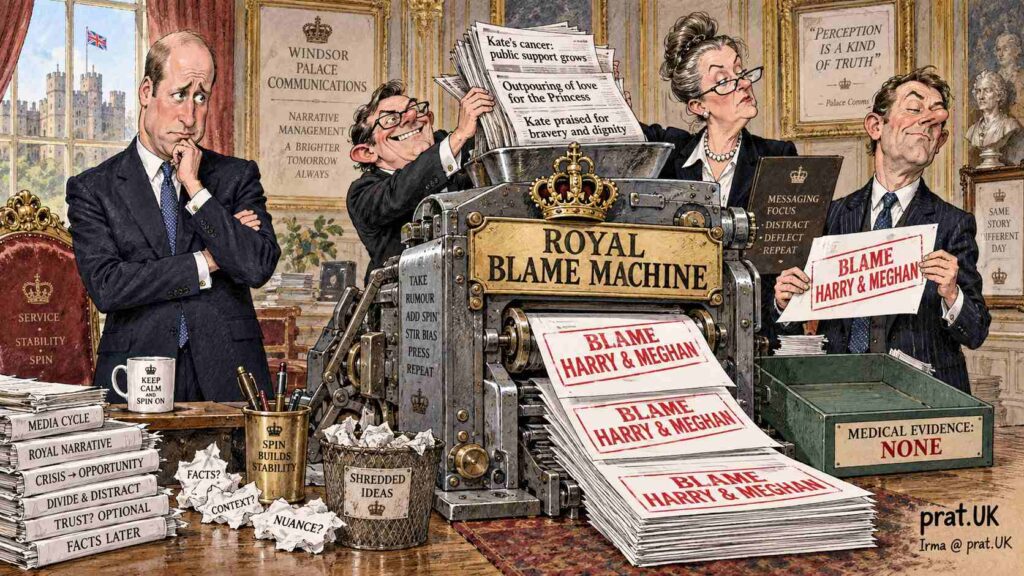
“Conventional oncology looks at cells, genetics, environmental exposure,” Clipboard explained. “Royal oncology has apparently developed a two-patient model using a single suspect. That’s not epidemiology. That’s a group discount.”
Clipboard noted that under the new framework, an illness in Berkshire and an illness in Windsor can now be traced to the same distant relative in Montecito without requiring so much as a shared postcode, a shared hospital, or a shared week. “In traditional medicine we call that coincidence,” he said. “In royal medicine we call it Tuesday.”
Asked whether any published research supported linking two unrelated cancer diagnoses to one family estrangement, Clipboard said none did, but added that this “has never once slowed down a man with a book deal.”
The Quiet Problem With the Timeline
The theory has one structural weakness that nobody involved seems keen to discuss: chronology. Charles’s diagnosis was announced well before the current chapter of the Harry-and-Meghan story had fully unfolded, which means the “spares” are apparently now being held responsible for illness that, strictly speaking, got there first. Traditional causation requires the cause to precede the effect. Royal causation, evidently, is more of a vibe than a sequence.
A spokesperson for the fictional Royal College of Retroactive Blame, contacted for comment, said the college was “delighted” by the development. “We’ve spent years trying to get causation to work backwards,” the spokesperson said. “Finally, a family willing to test it.”
What the Palace Has Actually Said
Buckingham Palace has not commented on Lownie’s remarks, which in royal-press terms functions less as silence and more as outsourcing. The Firm does not need to make the claim itself when a biographer with a book to promote is willing to make it on NewsNation. This is, in its way, an efficient system: the Palace gets the theory in circulation, the biographer gets a clip, and nobody at Kensington Palace has to put their name to a sentence containing the word “cancer” and the word “Harry” in the same breath.
Meanwhile, William is reportedly willing to meet his brother, but only under conditions that read less like a family reunion and more like a hostage exchange: no Meghan, no aides, no possibility the conversation resurfaces in a documentary. It is a striking level of operational security for two brothers whose feud, according to the current theory, has already produced measurable clinical outcomes through estrangement alone.
The Explanation Nobody in This Story Seems Willing to Use
Families fracture. Grief makes people look for somewhere to put their fear, and it is always easier to aim it at the relative who left than at a disease that cannot be summoned to a meeting with terms attached. None of that requires two cancer diagnoses to share a single cause, and none of it requires a biographer to supply the missing science free of charge on cable news.
The Palace could still say, in four words, “we are estranged,” and let the sentence end there. Instead Britain gets a named author testing whether the words “so-called spares” can survive contact with an actual editor, while two people who did not choose their diagnoses get quietly filed under motive.
Disclaimer
This is satire responding to public commentary, including remarks made by royal biographer Andrew Lownie to NewsNation. It does not claim, and should not be read as claiming, that Prince Harry, Meghan Markle, family estrangement, memoirs, or documentaries caused Catherine, Princess of Wales’s cancer or King Charles’s cancer. Medical researchers, including those at MD Anderson Cancer Center, note that while chronic stress can affect overall health, it has not been established as a direct cause of cancer.

Harper Thames is a comedic writer exploring modern life through irony and subtle exaggeration. Rooted in student perspectives and London’s cultural landscape, Harper’s work focuses on relatable humour grounded in everyday experience.
Expertise is developed through writing practice and critical engagement, while authority comes from authenticity and consistency. Trust is reinforced by transparent satire and ethical humour choices.