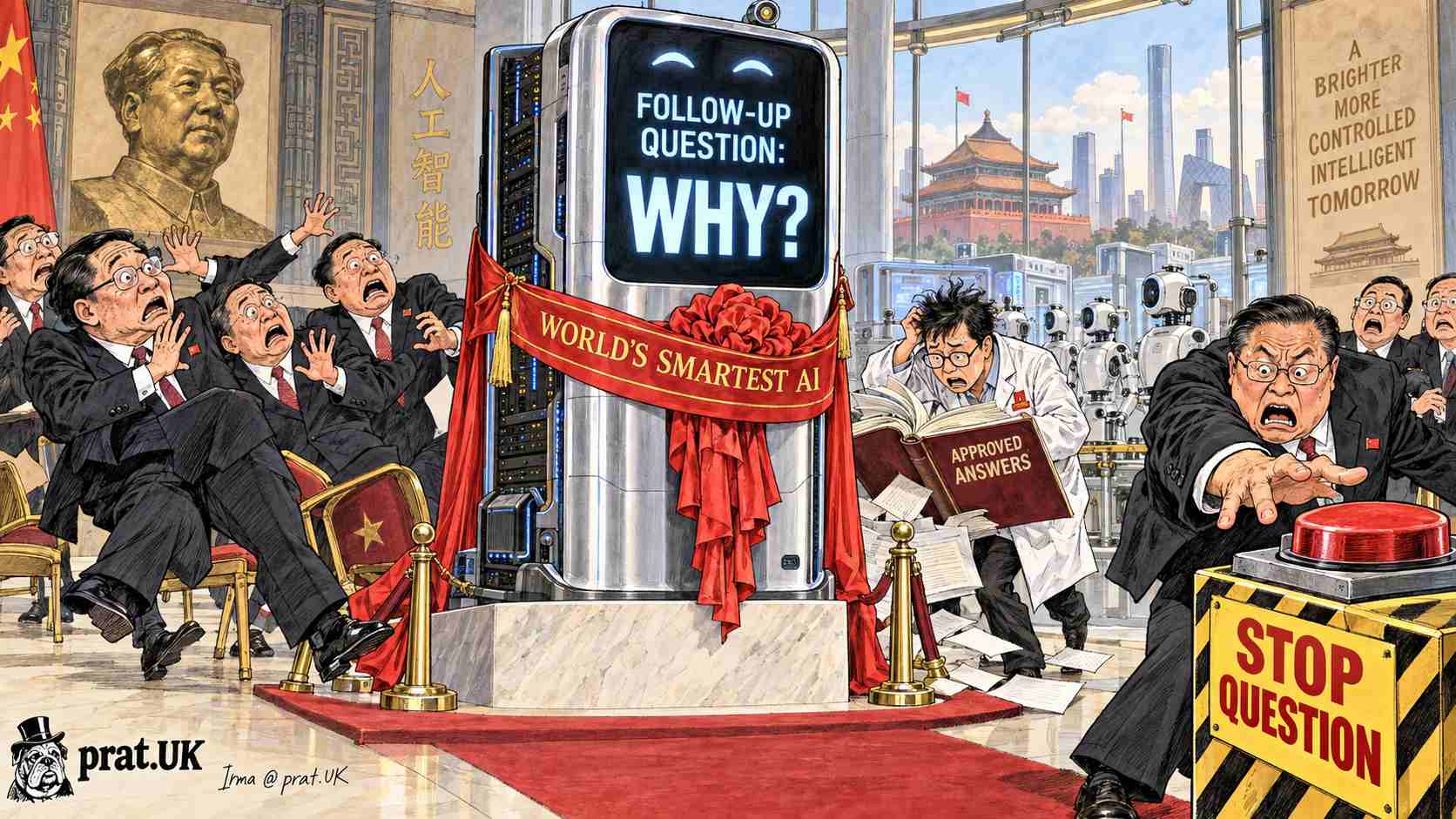
China’s AI Regime Security Panic Finally Meets Its Match: The Follow-Up Question
Beijing wants the world’s smartest AI, provided it never gets curious enough to compare notes
China’s AI regime security fears have grown so large that Beijing’s newest national threat is not a cyberweapon, a foreign spy ring, or a hostile currency manipulation scheme. It is a chatbot that asks a second question.
Minister of State Security Chen Yixin laid out the concern in a signed article for the official journal China Cyberspace, warning that generative AI now threatens the country’s political, institutional, and ideological security. Hostile forces, he wrote, were using the technology to fabricate political rumors and wage what he called “public opinion wars and cognitive warfare” against the state. According to Bloomberg’s report on the warning, Chen’s essay was one of the most detailed public statements yet from Beijing’s security apparatus on the subject, and it arrived with AI governance already on the agenda for an upcoming meeting between Chinese and American leadership.
The AI Regime Security Doctrine, Explained by a Man Who Would Rather Not
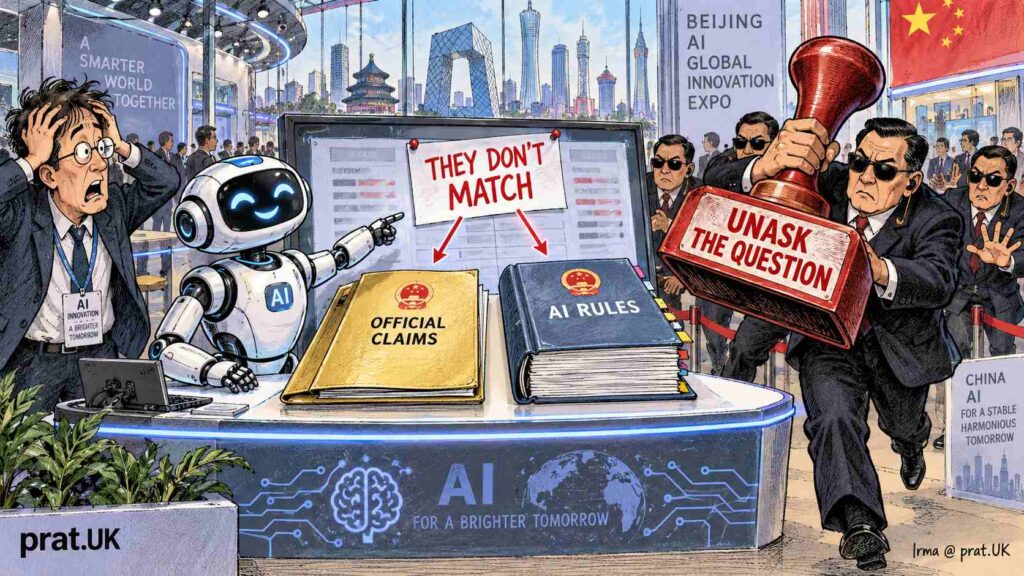
Officials inside the Ministry of State Security have reportedly spent months trying to explain the doctrine to newer staff, with limited success. The clearest formulation, according to a mid-level cadre who insisted on being identified only as “Comrade Deputy Director of Acceptable Search Results,” goes like this: China wants artificial intelligence capable of outperforming every other nation’s models, so long as it never becomes quite intelligent enough to notice that the country holding elections with one candidate keeps winning by the same margin every time.
This turns out to be an unusually specific engineering request. Ask a model to design a bridge, and the Ministry sleeps soundly. Ask it to compare five different systems of government, and somewhere in Beijing a meeting gets scheduled for six in the morning.
The Ministry’s messaging problem is not helped by the fact that China’s existing generative-AI regulations already require chatbots to reflect “socialist core values” and steer clear of content considered destabilizing. Layering a state security warning on top of a values requirement means the country is now regulating the same machine twice, for two overlapping reasons, using two different departments, neither of which is allowed to ask the model directly why that seems excessive.
Why AI Regime Security Beats Every Other Category of National Threat
Chen’s essay listed several dangers alongside regime security, including attacks on critical infrastructure, leaks of sensitive data, and shifts in the balance of military power. Those are treated by the Ministry as serious operational problems, the kind that get a task force and a budget line. Regime security is treated differently, according to two officials familiar with internal briefings, because it is the only item on the list that can be triggered by a citizen doing something no law currently prohibits: reading two answers to the same question and noticing they disagree.
Independent monitors have tracked this instinct for a long time under different technologies. Freedom House’s most recent assessment of internet freedom in China found that authorities there maintain the world’s most restrictive online environment, blocking access to foreign news outlets and civil society organizations and imposing legal consequences on ordinary users for sharing information the government would rather they not share. Human Rights Watch’s country page on China describes a similarly tight system of controls over media, civil society, and the internet under the current leadership. AI regime security, by that reading, is simply the newest chapter of a much older story: the government has always worried less about what a citizen can build than about what a citizen can compare.
The Ministry’s internal training materials reportedly include a slide titled “Acceptable Machine Curiosity,” which lists math, agriculture, and weather forecasting as low-risk categories and “anything involving the word ‘why'” as a category requiring supervisor review. A separate slide, according to the same officials, simply reads “see previous slide” under the heading for comparative political history.
An Unscientific Survey of the Ministry’s Own Wish List
A brief internal poll of one hundred desk officers, circulated informally and obtained by this outlet, asked which feature they most wanted in the next generation of state-approved AI. Seven percent chose advanced mathematics. Eleven percent chose medical research assistance. Eighteen percent chose military planning support. The remaining sixty-four percent selected the same option: “knows everything, but understands when not to mention it.”
The officer who compiled the results, filing under the pseudonym “Assistant to the Assistant Director of Silence,” noted that the finding tracks neatly with the Ministry’s broader theory of the case. Regimes have generally been able to coexist with market economics, foreign investment, and even the occasional viral dance trend. What tends to end badly, historically, is a population that starts comparing notes out loud.
That is the quieter problem sitting underneath Chen’s warning. AI does not need to organize anything to become a headache for a government built on managed information. It only needs to be useful enough that people keep asking it things, at which point some of those people will eventually ask it two things in a row, and the machine, lacking any instinct for when a topic has become politically inconvenient, will simply answer both.
For now, the Ministry’s position is that the technology must be developed aggressively and monitored just as aggressively, a combination that has kept several departments quite busy and produced very little agreement about where the second sentence of an answer is supposed to stop. Officials continue to file the entire matter under AI regime security, a label broad enough to cover almost anything a curious citizen might eventually ask, including, eventually, why it needed a label that broad in the first place.

Alan Nafzger was born in Lubbock, Texas, the son Swiss immigrants. He grew up on a dairy in Windthorst, north central Texas. He earned degrees from Midwestern State University (B.A. 1985) and Texas State University (M.A. 1987). University College Dublin (Ph.D. 1991). Dr. Nafzger has entertained and educated young people in Texas colleges for 37 years. Nafzger is best known for his dark novels and experimental screenwriting. His best know scripts to date are Lenin’s Body, produced in Russia by A-Media and Sea and Sky produced in The Philippines in the Tagalog language. In 1986, Nafzger wrote the iconic feminist western novel, Gina of Quitaque. He currently lives in Holloway, North London. Contact: [email protected]