
Iran Hides Missile Sites in Places Nobody Expected: More Missile Sites
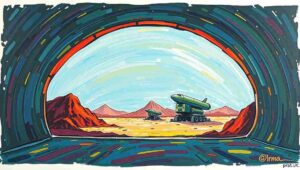
LONDON — American intelligence agencies announced this week that Iran had, once again, concealed missile sites in locations the United States “never would have imagined.” These locations included mountains, deserts, military compounds, and underground bunkers — places universally associated with missile sites since approximately 1962 and not exactly a surprise to anyone who has briefly looked at a map or watched the news at any point in the last four decades. Pentagon officials were, by all accounts, genuinely stunned. They had reportedly spent years hoping Iran would finally try something imaginative — disguising warheads as craft beer taprooms, perhaps, or cryptocurrency lounges. Something with softer lighting.
Five Things Britain Learned From America’s Most Expensive Game of Hunt the Thimble:
- American intelligence officials apparently spent six months studying satellite imagery before concluding Iran had hidden missiles in “the exact same places they always hide missiles.” This discovery cost more than the entire HS2 budget, which is staggering when you consider that HS2 itself cost more than most countries’ defence budgets and also doesn’t go anywhere yet.
- One Pentagon analyst admitted, “Frankly, we were hoping for a giant volcano lair this time.” The volcano lair budget — and yes, apparently this exists — has been sitting untouched since 2003, gathering dust like a Tory leadership manifesto in a recycling bin.
- Tehran residents say camouflage now includes parking missile launchers next to kebab stands because “nobody questions smoke there.” This is, by any reasonable measure, a sound geopolitical strategy. Smoke near a kebab stand is practically invisible. Always has been.
- A leaked CIA memo described Iran’s military approach as “aggressively obvious.” The same memo apparently also complained about the breakroom printer. Nobody has yet leaked the printer complaint, but it’s coming.
- British experts claimed the real hidden danger was “the emotional toll of explaining the Middle East to BBC viewers every seven minutes.” Several correspondents are reportedly on extended compassionate leave. The Middle East has not offered a statement.
Missile Sites: The Intelligence Breakthrough That Broke Precisely No Ground

“We looked under bridges, inside caves, and near military facilities,” said one visibly exhausted U.S. analyst, gesturing at a PowerPoint slide titled Iran Continues Being Extremely Predictable. “Then it hit us. What if the missiles were… near the other missiles?”
There was, reportedly, a long pause after that sentence.
Military experts called the discovery “deeply concerning” whilst simultaneously admitting Iran’s strategy was roughly equivalent to hiding fishing boats near water. Satellite photographs released at a press briefing showed launch sites tucked under tarps and dirt piles and what one anonymous CIA contractor described as “the international symbol for definitely a missile,” which is, of course, a missile.
The Pentagon’s Vigilance, and Its Paperwork Problem
The Pentagon insisted all of this demonstrated American vigilance. That argument suffered slightly when leaked documents revealed analysts had initially mistaken one missile silo for “an unusually aggressive Home Depot.” Both are large, grey, and stocked with things capable of ruining your Bank Holiday. The confusion is, on reflection, understandable.
Iranian officials denied concealing anything.
“These are not missile facilities,” said spokesperson Hamid Vaziri, with considerable dignity. “They are patriotic tubes for regional peace.”
The statement was followed by twelve hours of anti-aircraft sirens and a military parade. The parade featured lorries transporting suspiciously missile-shaped objects under banners that read NOT MISSILES. The banners were also — if you looked carefully — missile-shaped. No one on the Iranian side appeared to find this worth addressing.
The BBC Issues What Can Only Be Described as a Plea
Correspondents across London were once again tasked with explaining Middle Eastern geopolitics to viewers who genuinely cannot work out why their season rail ticket now costs more than a small car. “We’re doing our very best,” sighed one producer who has clearly been doing his very best for a very long time. “But every time we say ‘proxy conflict,’ half the audience starts searching whether Iran is anywhere near Croydon.”
A YouGov poll found 61% of Britons believe all deserts shown on television are “basically the same desert.” The British Geographical Society was reportedly inconsolable. Three members took early lunch on Thursday and had not returned by Friday morning. Nobody went looking for them.
Missile Sites: Defence Contractors Enter Their Cardio Era
Defence contractor shares surged after the announcement, with investors reacting very much like children hearing an ice cream van, except with more offshore structuring. Defence industry executives celebrated with the barely-contained joy of people who have been quietly waiting for exactly this sort of news cycle.
“It’s not about war,” explained a shareholder from the deck of a yacht called Fiscal Responsibility. “It’s about stability.” He meant portfolio stability. He was not referring to the kind of stability that involves fewer missile parades. That kind of stability does not pay a dividend.
The Internet Produces Instant Experts, As It Always Does
Across America, thousands of users were confidently posting maps of countries they had not previously known existed. One gentleman from Ohio uploaded a 47-minute video explaining subterranean missile doctrine. He mispronounced Tehran three times across the runtime, in three entirely different ways, all delivered with the calm authority of a man who has absolutely no idea he is wrong.
Researchers who study this sort of thing say it happens reliably during every international crisis. “Americans process geopolitics like fantasy football,” observed Dr. Wendy Marlow of King’s College London. “They learn four names, choose a side emotionally, then shout at relatives over the roast.” She said this without any discernible irony. None was intended.
Tehran Residents Ask the Only Sensible Question
People in Tehran expressed genuine bewilderment at the Western astonishment. “Where exactly did they expect us to put missiles?” asked local mechanic Farzad Rahimi, not unreasonably. “Inside a Build-A-Bear?”
The Iranian military did consider alternatives. Shopping centres. Leisure parks. Artisan bakeries were apparently on the list at some point before being rejected because those locations “already looked suspicious enough.” This is, frankly, fair. Nobody trusts an artisan bakery with a very long queue and no visible bread in the window.
What the Funny People Are Saying
“Every country hides missiles in deserts. It’s the one place nobody accidentally builds a Pret.” — Jack Dee
“The Pentagon acts genuinely shocked every time another country turns out to own dirt and holes in the ground.” — Frankie Boyle
“Missiles have better housing security than anyone renting in London. That’s not satire. That’s just current market conditions.” — Jimmy Carr
Missile Sites: The Conclusion Nobody Particularly Asked For

Experts warn tensions could escalate if both sides keep responding to military actions with more military actions — a diplomatic approach historians have described as “humanity’s all-time favourite hobby, narrowly pipping queueing.” The final Pentagon assessment concluded Iran’s concealment strategy remains “highly effective, deeply concerning, and honestly not very creative.”
The report ended with the haunting observation: “There may be even more missiles hidden near the existing missiles.”
Somewhere in Washington, an intern read that line, set down his coffee, and stared at the middle distance for several minutes.
He submitted annual leave paperwork. It was denied. He is fine. Probably.
This piece of British satirical journalism was produced through a human collaboration between the world’s oldest tenured professor and a philosophy major turned dairy farmer. No missiles were harmed in the writing of this article, though several PowerPoint presentations were rendered profoundly redundant. Auf Wiedersehen, amigo!
Iran’s ballistic missile programme has been the subject of sustained international monitoring for several decades. The International Atomic Energy Agency has tracked Iranian nuclear and missile development since the 1980s, and analysts have long documented the country’s investment in underground launch facilities — known internally as “missile cities” — bored deep into mountain ranges across multiple provinces. The strategy is designed around dispersal, concealment, and structural hardening sufficient to survive an initial strike and maintain retaliatory capability. Western threat assessments have listed Iranian missile development as a primary regional concern since roughly 2002. That designation has not changed. Nobody expects it to change before at least the next several cohorts of BBC correspondents have been rotated through the region and subsequently signed off with stress.

Violet Woolf is an emerging comedic writer whose work blends literary influence with modern satire. Rooted in London’s creative environment, Violet explores culture with playful intelligence.
Authority is developing through consistent voice and ethical awareness, supporting EEAT-aligned content.