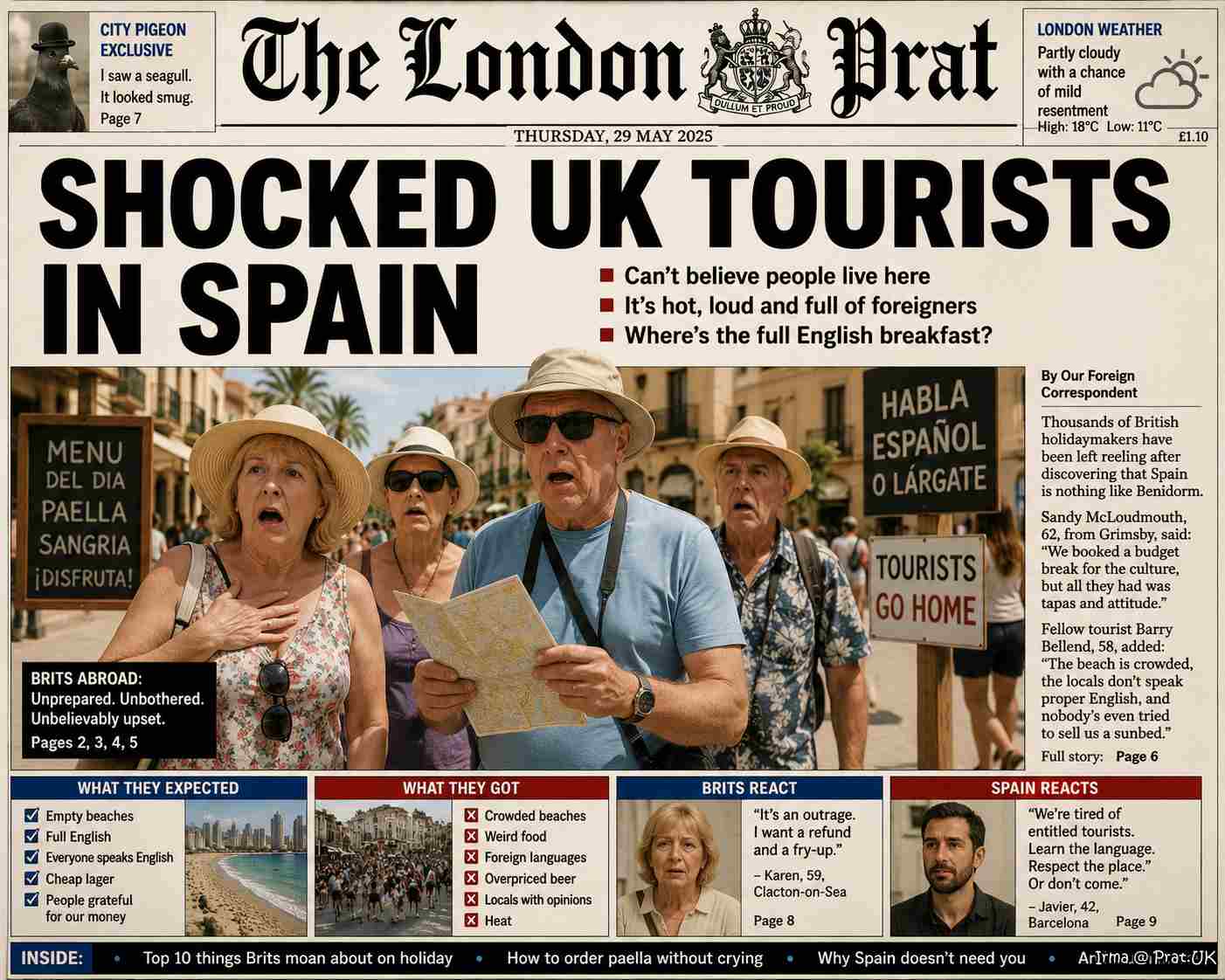
British Tourists Shocked To Discover Spain Contains Spanish People
LONDON — A delegation of British holidaymakers returned from the Costa del Sol this week in a state of bewildered outrage after discovering that Spain — the country they had visited — was, in several unmistakable respects, Spanish. “Nobody told us,” said Keith Armitage, 54, of Cheshire, who spent eleven days in Torremolinos and found the experience “lovely but a bit foreign.” Among the features of Spain that surprised Keith and his travelling party: the Spanish language, Spanish food that was not chips, Spanish people speaking Spanish to each other in Spain, and a local fiesta that was held at 11pm, which Keith described as “an absolutely ridiculous time to have anything.” The group has vowed to return next year and are already looking at Magaluf.
The British Package Holiday: A Cultural Institution Built On Avoidance
Britain’s relationship with foreign travel is one of the great paradoxes of modern life. No nation books more overseas holidays. No nation appears to expect less from the country it visits. The British holidaymaker is a figure of global fascination: a person who has flown to an entirely different country and is surprised, then vaguely resentful, when it doesn’t behave like Stockport.
The package holiday industry has, to its credit, done tremendous work in anticipating this preference. The major tour operators have developed resort complexes so comprehensively insulated from local culture that you could spend a fortnight in the Canary Islands without encountering a single thing that challenges the assumption that abroad is basically Britain but with better weather and worse queuing. The swim-up bar serves Heineken. The entertainment team is from Hull. The breakfast includes beans and a full English, because if you were going to try the local thing you’d have started before the eggs.
The Language Issue: A Recurring National Crisis
The British tourist’s approach to foreign languages follows a well-documented pattern studied by linguists at several universities who presumably had better options but chose this. Stage one is the assumption that volume compensates for vocabulary. Stage two is the discovery that the Spanish waiter speaks excellent English and always did. Stage three is relief, followed immediately by the suspicion that he was making it harder than it needed to be.
“I tried my Spanish,” reported Sharon Mettrick, 48, of Sunderland, who spent a week in Mallorca. “I said ‘por favour’ and ‘gracias’ and that other one. They seemed pleased.” Sharon is, by the standards of her cohort, a polyglot. Several members of her holiday group communicated exclusively by pointing at things on the menu and raising an eyebrow, a technique that works surprisingly well across most of southern Europe and says everything you need to know about the transferability of British body language.
The British Council has noted for years that the UK has among the lowest rates of foreign language learning in Europe. This is partly because English is the global lingua franca and Britons know it, partly because the school curriculum deprioritised languages after they became optional at GCSE, and partly because if you’re going to Benidorm the manager of the hotel bar is called Dave and he’s from Wolverhampton.
The Food Question: An Epistemological Divide
Nothing reveals the British tourist’s philosophical position more clearly than the food question. Most European holidaymakers travel abroad partly to eat locally. The British holidaymaker travels abroad and then scans the menu for something familiar, receives it with satisfaction, and reports home that the food was “surprisingly decent.” The surprise in “surprisingly decent” does a lot of work. It implies that an expectation of indecency was reasonably held, which is quite a posture to bring to a continent that invented several of the world’s great cuisines.
The Full English abroad is a ritual with genuine emotional power. There is something deeply reassuring about a plate of beans, eggs, bacon, and toast in a country that has access to jamón ibérico, patatas bravas, and gambas al ajillo. It is comfort food in the most literal sense — the comfort of not having to engage with where you are. Perfectly valid. Also slightly mad.
Gary Lineker, who has spent considerable time in Spain, once observed that the Spanish eat late, drink well, and live long, while the British eat early, drink quickly, and queue politely for things that aren’t worth queuing for. He may have been talking about football tactics. It’s hard to tell.
The Protest Signs: A Recent Development
It is worth noting that in the past two years, Spanish residents of several tourist hotspots have begun holding protests against the impact of British (and other northern European) tourism on local housing, culture, and infrastructure. Residents of Barcelona, Málaga, and the Canary Islands have demonstrated against hotel developments, short-term rentals, and the general transformation of their neighbourhoods into experiential British pubs with better drainage.
This is entirely understandable. It is also, from the perspective of the British tourist arriving in a place where local people are visibly annoyed at him, a further source of mild confusion. He came for the sun. He didn’t realise there would be feelings.
What Keith Found When He Finally Left The Resort
On his penultimate evening, Keith Armitage ventured forty minutes from his hotel and ate in a restaurant that had no English menu, no English-speaking staff, and no chips. He was given something with octopus in it that he describes as “absolutely superb.” He had a glass of wine that cost three euros. He sat outside until midnight. He was, briefly, somewhere.
“It was brilliant,” Keith said. “We should have done that the first night.” He is already planning next year’s trip. He is looking at Magaluf.
Auf Wiedersehen, amigo!
British tourists make up the largest single nationality group of visitors to Spain, with approximately 17-18 million UK residents visiting annually, making Spain consistently Britain’s most popular international holiday destination. This mass tourism has generated significant economic benefits for coastal regions of Spain while also creating tensions over housing costs, environmental impact, and the cultural transformation of residential areas. Anti-tourism protests have intensified in Spanish cities including Barcelona, the Canary Islands, and the Balearic Islands since 2023, drawing international media coverage. Meanwhile, UK foreign language skills remain among the lowest in Europe, with fewer than one in three UK adults able to hold a conversation in a language other than English.
This report was filed from The London Prat, est. 1961, a publication committed to British satirical journalism, produced by the world’s oldest tenured professor and a philosophy major turned dairy farmer, both of whom have been to Spain and did try the octopus.
IMAGE GALLERY


Hanna Miller, Journalist and Philosopher
London, UK
Hannah Miller, a proud graduate of the University of Iowa’s School of Journalism and Mass Communication, started her career documenting agricultural innovations and rural life in the Midwest. Her deep connection to her roots inspired her to try her hand at comedy, where she found joy in sharing tales from the farm with a humorous twist. Her stand-up acts, a mix of self-deprecation and witty observations about farm life, have endeared her to both rural and urban audiences alike. She is a four-year resident to London and the UK.