

Northumberland: England’s Emptiest National Park, Its Darkest Skies, and a Roman Wall That Has Done More for Tourism Than Two Millennia of Marketing
HEXHAM — Northumberland National Park — 1,049 square kilometres of moorland, ancient forest, Roman frontier, and sky — is England’s least visited national park and, by numerous measures, its most spectacular. It contains fewer people per square kilometre than almost anywhere else in England, more stars per square metre than anywhere else in the country, and a Roman engineering project that has been drawing visitors for approximately sixteen centuries longer than the National Park Authority has existed.
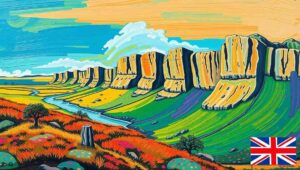
Northumberland National Park
- Northumberland National Park has 2 people per square kilometre. London has 5,700. You could fit the entire human population of the National Park into one mid-sized Wetherspoons and still have room at the bar. This is either Britain’s greatest wilderness or its largest unintentional empty room, depending on whether you came up to find solitude or to find a sandwich shop.
- Hadrian’s Wall was built in AD 122 to keep the Caledonians out. It did not work. The Caledonians came over it, around it, and through it whenever they fancied. It is now Britain’s most famous monument to military futility, generating £40 million a year in tourism revenue from people coming to look at a wall that didn’t even do its one job. There’s a metaphor in here. There may be several.
- The Northumberland Dark Sky Park is so dark that the Andromeda Galaxy is visible to the naked eye. Andromeda is 2.5 million light-years away. You cannot see it from London because Pret a Manger has too many fluorescents. There is something profoundly correct about the fact that you have to drive seven hours from the capital to see the universe.
- Kielder Water has supplied the northeast with drinking water since 1982 via the largest artificial lake in northern Europe. London receives its water from a series of reservoirs nobody could name on a quiz. The north made a lake. The south makes complaints. The lake has not noticed.
- Bastle houses are fortified farmhouses built when the Border Reivers were raiding everything that moved. The ground floor was for animals; the family lived upstairs and pulled the ladder up at night. This is what the locals built in the 1500s because the situation was that bad. The current equivalent in central London is a Ring doorbell and a passive-aggressive note about Amazon parcels.
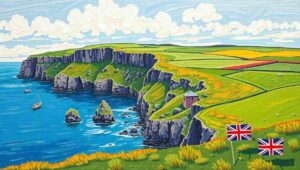
Hadrian’s Wall: The Best Thing Rome Did for the Northumberland Tourism Economy
Hadrian’s Wall, built from AD 122 on the orders of Emperor Hadrian and stretching 73 miles across northern England from Wallsend on the Tyne to Bowness-on-Solway on the Solway Firth, is one of the most extraordinary surviving Roman structures in the world. It was constructed, at its most impressive sections, along the Whin Sill — a dramatic escarpment of hard dolerite rock — producing a combination of natural and engineered defence that has been described as one of the most evocative heritage landscapes in the world.
UNESCO granted it World Heritage Status in 1987, recognising what the Caledonians north of it presumably understood rather more immediately: that this was a statement of imperial intent carved into the landscape at extraordinary effort and expense. The Romans were very good at statements. The wall required approximately 3 million tons of stone, 12 years to build, and an estimated 15,000 soldiers to garrison — which by any measure puts it in a different category from the National Park Authority’s current workforce of approximately 100 staff.
The Housesteads Roman Fort, perched on the Whin Sill with views stretching to both north and south, is the most visited site on the wall and genuinely worth every step of the ascent from the car park, which is itself a minor Roman trial.
Frankie Boyle noted that “Hadrian’s Wall is Britain’s oldest border control measure, and it’s in considerably better condition than the current ones.”
The Darkest Skies in England: What Happens When Nobody Lives There
Northumberland National Park is one of the least light-polluted areas in England, and in 2013 the Northumberland Dark Sky Park was designated — covering 1,500 square kilometres and recognised as one of the best stargazing locations in the world north of the tropics. The park has Gold Tier status from the International Dark-Sky Association, the highest designation available, reflecting a level of darkness that most of England has not experienced since the invention of street lighting.
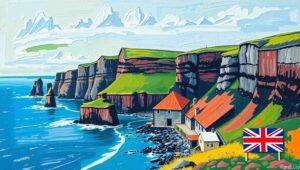
The Northumberland National Park’s stargazing programme runs events through autumn and winter, guiding visitors through skies where the Milky Way is clearly visible, the Andromeda Galaxy can be seen with the naked eye, and the absence of urban light pollution produces a profound awareness that the universe is considerably larger than the human problems one drove several hours to temporarily escape.
The darkness is, in this context, a direct product of the emptiness: Northumberland is simply too sparsely populated to generate significant light pollution. What looks like a landscape policy achievement is partly just the accidental consequence of having very few residents, which is either a model for conservation or a concern for the local economy, depending on who you ask.
Kielder Forest and the Water That London Doesn’t Thank the North For
Kielder Water, on the edge of the national park in Kielder Forest, is the largest artificial lake in England by volume and the largest area of planted forest in England — 250 square miles of Sitka spruce planted from the 1920s onward, substantially by the Forestry Commission, and now managed by Forestry England. It was planted to provide a strategic timber reserve, which the trees have done while also becoming an extraordinary wildlife habitat — red squirrels, ospreys, goshawks, and otters all resident.
Kielder reservoir holds 200 billion litres of water that can be transferred south via the Tyne and other rivers to supply Yorkshire and the northeast in drought conditions. It is, in practical terms, one of the north of England’s most significant contributions to the nation’s water security — a contribution acknowledged with the warmth and gratitude that characterises most north-south infrastructure discussions in England, which is to say, quietly and not very often.
The Most Empty Place in England
Northumberland National Park has a population density of approximately 2 people per square kilometre — lower than the Highlands of Scotland and considerably lower than any other English national park. The emptiness is not neglect or poverty but history: the border with Scotland was contested, raided, and militarily active for centuries, producing a landscape of defensive tower houses (bastle houses and pele towers), fortified farmsteads, and an enduring tradition of not building anything too permanent too far from a defensible wall.
The Northumberland National Park Authority manages this emptiness with appropriate reverence and the practical understanding that the best thing it can do for most of the landscape is leave it largely alone — a management philosophy that is both ecologically sound and rather more philosophically sophisticated than it is given credit for.
Northumberland National Park covers 1,049 square kilometres in Northumberland in the northeast of England, designated in 1956. It contains Hadrian’s Wall (a UNESCO World Heritage Site), large areas of upland moorland and blanket bog, the Cheviot Hills (reaching 815m), and Kielder Forest on its western boundary. The park borders Scotland to the north. It is England’s least visited national park and the least densely populated, with approximately 2 people per square kilometre. The Northumberland Dark Sky Park, designated in 2013, covers 1,500 square kilometres and has Gold Tier status from the International Dark-Sky Association.
Disclaimer: This article is British satirical journalism from The London Prat, produced by the world’s oldest tenured professor and a philosophy major turned dairy farmer — who once stood in a Northumberland field at midnight and saw the Milky Way and several suspicious sheep. All satire. Hadrian built the real wall. Auf Wiedersehen, amigo!

Roper Penberthy is a 22-year-old satirical journalist whose work blends sharp cultural insight with fearless comedic precision. Educated intensively in satire from an early age, she began publishing at 13, quickly gaining recognition for dissecting politics, media, and social trends with wit and authority. Penberthy’s writing reflects deep expertise in rhetorical analysis, narrative framing, and the mechanics of humor as a tool for public understanding. Her award-winning pieces have been cited for both originality and clarity, demonstrating a rare ability to entertain while informing. Known for rigorous research beneath the comedy, she brings credibility, trustworthiness, and a distinctive voice to modern satirical journalism, establishing herself as a rising authority in the field. EMAIL [email protected]


London is the only city where you can be surrounded by history and still feel like you’re living in the most modern, chaotic, and confusing time imaginable.
British people laugh at misery rather than fix it. That’s our national character in action.
Read this on the District Line which is the worst possible venue. Also the most appropriate commentary.
My mate said “The London Prat proves institutions are run by incompetent morons. You government people know it.”
Meetings transcribed. Recorded.