
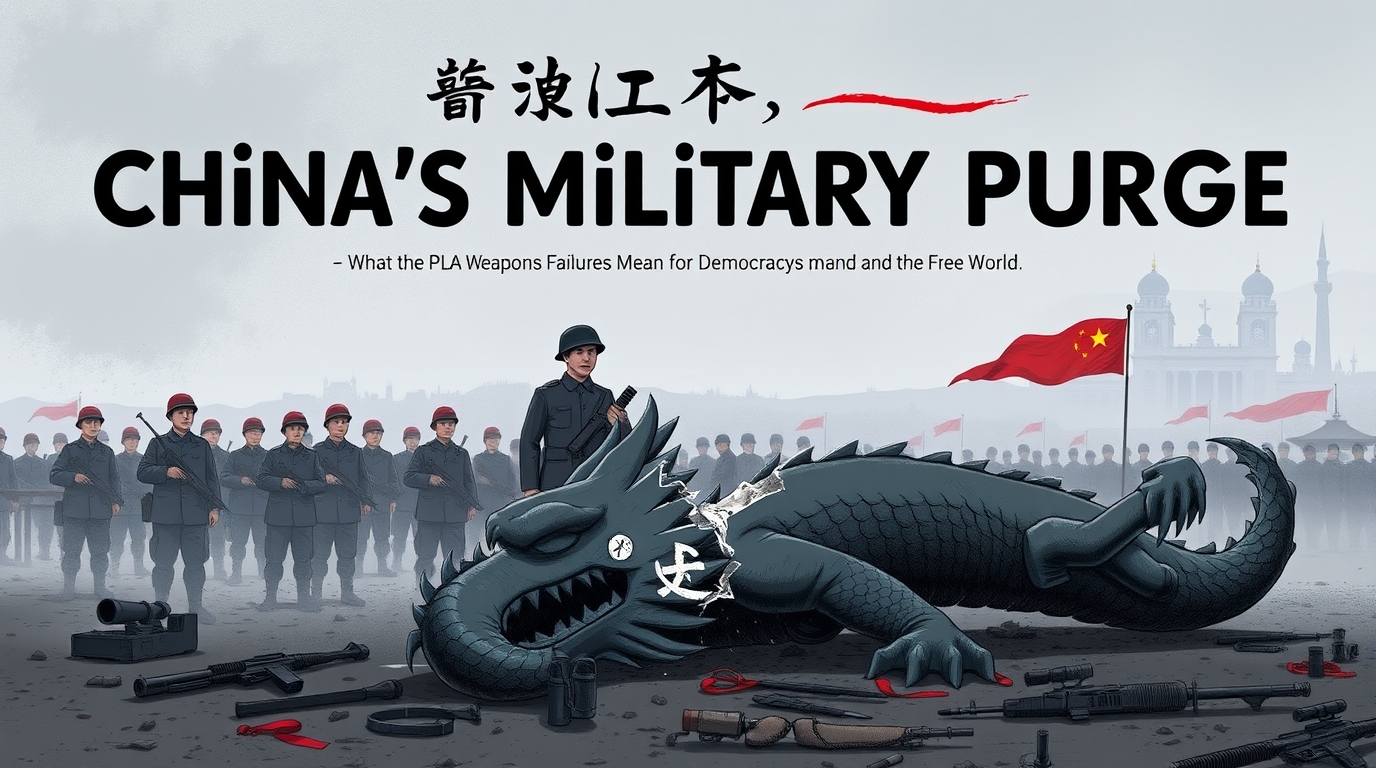
China’s Wonder Weapons Are a Load of Wonders — Mostly, Everyone Wonders Why They Don’t Work
The People’s Liberation Army promised the world hypersonic death rays and stealth-killing radars. What it delivered was closer to a charity raffle prize in a Peckham car boot sale.
Beijing’s Military Showcase Goes Down Like a Lead Balloon — Quite Literally
It has not been a vintage year for Chinese arms exports. The HQ-9B surface-to-air missile system — Beijing’s flagship air defence product, marketed to discerning authoritarian regimes everywhere — has now failed to stop a single meaningful airstrike across three separate conflicts. Iran, Pakistan, Venezuela. Hat-trick. Not quite the hat-trick Xi Jinping had in mind when he sent his salesmen out with the brochures.
The CM-302 supersonic anti-ship cruise missile, which China promised would travel at Mach 3 and sink an American aircraft carrier, instead performed what analysts generously call “guidance failure” and less generously call “flying off in completely the wrong direction.” Iran fired 52 of these missiles and drones at the USS Abraham Lincoln. American destroyers intercepted every single one. The Lincoln is still afloat. The Chinese arms warranty department is presumably not.
The JY-27A radar — billed as a counter-stealth marvel capable of detecting US fifth-generation fighters — proved capable of detecting something even more alarming: its own irrelevance. In Venezuela, it was disabled before a single missile could achieve a lock. In Syria before that, Israeli jets used it as something approaching an invisible thoroughfare. One imagines the sales presentation was rather more impressive.
As Frankie Boyle might put it: China built a military designed to sink the American navy, and it can’t even find it.
The Purge That Dare Not Speak Its Name: Beijing Sacks Everyone Who Knew the Missiles Were Rubbish
Any sensible government, upon discovering that its flagship weapons were largely ornamental, might commission an inquiry, publish some findings, and quietly improve the engineering. The Chinese Communist Party has taken a more direct approach: making the engineers disappear.
Tan Ruisong, chairman of the Aviation Industry Corporation of China — the company that builds China’s combat aircraft — has been sentenced to death on corruption charges. Yang Wei, chief designer of the J-20 stealth fighter, has been removed from official records alongside nuclear experts, naval propulsion specialists, and Rocket Force researchers. Several scientists linked to hypersonic weapons research have died in circumstances described only as “unexplained,” which in Chinese Communist Party English is roughly equivalent to “please don’t ask follow-up questions.”
Peter Kay could do something with this. Imagine the works canteen conversation. “So Dave got fired then?” “Worse. He got purged.” “What’s the difference?” “About fifteen years of index-linked pension.”
The broader military leadership is equally depleted. According to a landmark report by the Centre for Strategic and International Studies, over 100 senior PLA officers have been swept aside since 2022 — representing 52 per cent of the PLA’s top leadership positions. China’s military high command now resembles a dinner party where most of the guests have suddenly remembered a prior engagement — and have not been seen since.
Of the seven members of the Central Military Commission when Xi consolidated power, only Xi himself and one general remain. The others have gone the way of honest feedback in a one-party state.
The Great Structural Problem: You Cannot Fix What You Cannot Admit Is Broken
There is, underneath all the dark comedy, a rather serious point — the kind that emerges once the smoke clears and the missing scientists are memorialised in footnotes. The CCP’s entire system is built on the pretence of success. Academicians fabricated research data to claim breakthroughs. Procurement executives accepted bribes during equipment approvals. Front-line officers diverted resources to compensate for defective equipment. And at the top, Xi Jinping remained publicly silent on the failure of Chinese-supplied hardware while his subordinates blamed Pakistani soldiers for not operating the missiles correctly.
Former State Department policymaker Miles Yu of the Hudson Institute put it clinically: the CCP’s model does not allow for open acknowledgment of failure. Which is, as the British might say, a bit of a design flaw in a weapons programme.
The comparison with the Beiyang Fleet — China’s nineteenth-century navy, destroyed by Japan in 1895, whose shells turned out to be filled with cement rather than explosive because someone had pocketed the money — has not been lost on Chinese internet commentators. One wrote: “Could it really end up like the Beiyang Fleet, where weapons turned out to be fake when the war actually began?” The post has presumably since been deleted, along with its author’s social credit score.
Xi’s Own Generals Were the Problem — Or at Least, That’s the Story Now
Here is the most revealing detail of all. Of the 35 lieutenant generals and full generals Xi Jinping personally promoted since 2020, 29 have been purged. He is not rooting out a rival faction’s appointees. He is destroying officers he selected himself. When 29 out of 35 of a leader’s handpicked generals turn out to be “disloyal,” the problem has moved beyond personnel. The problem is the system that shaped them.
As Foreign Policy noted, history shows that purges leave armies ill-prepared for war. The most recent purge victims, General Zhang Youxia and General Liu Zhenli, were key PLA operational leaders — and notably, Zhang may have been the last serving member of China’s military with actual battlefield command experience from a real war.
Rory Bremner once observed that the great British gift is the ability to mock those in power. Consider this piece that gift freely extended — across several time zones and an international dateline — to the People’s Liberation Army procurement department.
They have built the world’s most expensive special effects budget and called it a military. The curtain has been pulled. What remains is not a superpower. It is a very large bureaucracy, eating its own engineers, and wondering why the missiles keep missing.
Auf Wiedersehen, amigo!
Between 2025 and 2026, Chinese military hardware suffered documented failures in three theatres: Iran, where CM-302 cruise missiles malfunctioned mid-flight and HQ-9B systems failed to intercept American strikes; Pakistan, during India’s Operation Sindoor, where Chinese air defences could not protect military installations; and Venezuela, where JY-27A radar systems were disabled before US special forces achieved their objectives. Beijing’s internal response has been a sweeping purge of military leaders, defence executives, and weapons scientists. Tan Ruisong, chairman of Aviation Industry Corporation of China, was sentenced to death. Yang Wei, the J-20’s chief designer, was removed from official records. The Centre for Strategic and International Studies documented 101 purged PLA generals and lieutenant generals since 2022 — 52 per cent of the PLA’s top leadership positions. Former State Department China analyst Miles Yu of the Hudson Institute described the failures as exposing a systemic gap between China’s advertised and actual military capabilities.

Mei Lin Chen is a student writer whose satire explores identity, modern culture, and social nuance. Her work reflects academic curiosity and engagement with London’s diverse perspectives.
Expertise is growing through study and practice, while trust is supported by clear intent and responsible humour.

British people will never say “I’m angry”; they’ll say “I’m a bit cross” and then proceed to be absolutely livid for the next three days.