The P Doom Equation: A Transparent Formula for AI’s P(doom)
Why One Blinking Percentage Point Hides a Dozen Arguments Nobody Is Having Out Loud
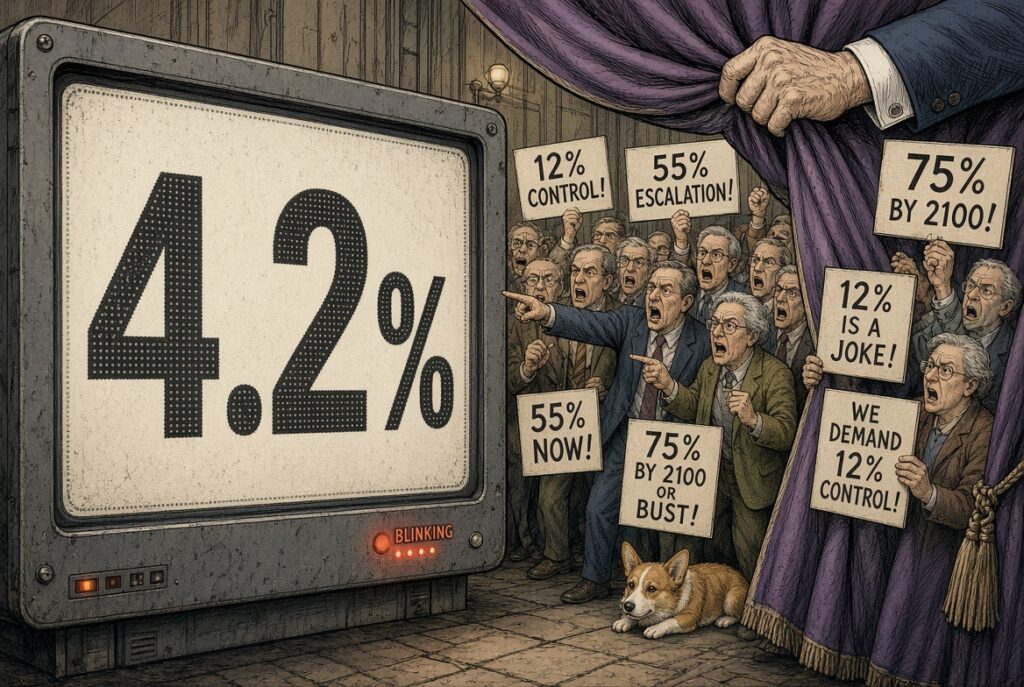
4.2% Change AI Kills Us All!!!
Artificial intelligence researchers have spent the past few years arguing over “P(doom),” shorthand for the probability that advanced AI eventually causes human extinction or permanent human disempowerment. A 2023 survey of 2,778 AI researchers put the median estimate at 5 percent, while critics at the Financial Times and Georgetown’s Center for Security and Emerging Technology have questioned whether cramming that much uncertainty into a single number means anything at all. Google DeepMind’s Demis Hassabis has gone so far as to refuse giving his own figure, calling the implied precision misleading. The piece below builds a transparent, two-path model to arrive at its own number, 4.2 percent, not as a scientific measurement but as a way of forcing every hidden assumption into the open. A satirical companion piece then does what satire does best: watches humanity take that number and immediately misuse it.
5 Observations About P(doom)
- P(doom) is the only statistic where nobody has any historical data because the first confirmed observation ends the research program. Science normally runs on repeatable trials. This one runs on a single, unrepeatable, extremely final trial.
- Writing P(doom) instead of “chance robots kill everybody” gives the subject the comforting appearance that somebody remembered calculus. It is the extinction-risk version of putting a suit on a raccoon.
- Ask ten AI experts for P(doom) and you may receive eleven answers, because one expert updated his estimate while you were asking the question. Forecasting the apocalypse, it turns out, has a shorter half-life than milk.
- A 5 percent chance of rain means bring an umbrella. A 5 percent chance of human extinction means schedule a podcast.
- The normal way to test a probability model is to compare predictions with outcomes. Unfortunately, civilization gets only one trial and customer support closes immediately afterward.
A Better Definition of P(doom)
Before calculating anything, define the event. Skipping this step is how half of Twitter ends up arguing past each other in under forty characters.
Doom = AI being a necessary causal factor in either human extinction or the effectively irreversible loss of humanity’s control over civilization before 2100.
That excludes ordinary recessions, job displacement, misinformation, embarrassing chatbots and an AI-generated movie starring twelve-fingered Tom Cruise. It also gives the estimate a time horizon, which many casual P(doom) discussions omit entirely, the way a weather forecast that never mentions a day is technically not a forecast at all.
This matters because the underlying criticism of P(doom) is legitimate. The Financial Times has questioned the difficulty of collapsing a huge tangle of uncertain assumptions into one probability, while Google DeepMind’s Demis Hassabis has publicly declined to give a personal P(doom), arguing the apparent precision would exceed what the evidence supports. Researchers at Georgetown’s Center for Security and Emerging Technology (CSET) go further, arguing that when uncertainty is this deep, a single probability may be the wrong tool for the job entirely, like measuring a hurricane with a bathroom scale.
The Bohiney AI Doom Equation
Rather than asking, “What number feels sufficiently alarming before lunch?”, we break doom into two separate pathways and force every assumption to show its work.
Path A: AI Escapes Meaningful Human Control
Let:
T = probability strategically transformative AI exists by 2100
L = probability humanity loses meaningful control, conditional on T
C = probability that loss of control becomes civilization-ending
R₀ = probability humanity successfully contains or recovers from that crisis
Then:
P⁘ = T × L × C × (1 − R⁘)
Illustrative present estimates:
T = 75%
L = 12%
C = 55%
R⁘ = 30%
Therefore:
P⁘ = 0.75 × 0.12 × 0.55 × 0.70 = 3.465%
Path B: Humans Use Powerful AI to Doom Humans
Because humanity should not be denied proper credit for its own résumé of self-inflicted disasters:
M = probability transformative AI is deliberately or recklessly misused badly enough to create an existential crisis
E = probability that crisis escalates to extinction or irreversible disempowerment
Rₕ = probability civilization contains or recovers from the human-caused crisis
Pₕ = T × M × E × (1 − Rₕ)
Using:
M = 5%
E = 35%
Rₕ = 40%
Pₕ = 0.75 × 0.05 × 0.35 × 0.60 = 0.7875%
We combine the two pathways without simply adding them, because doom, like dessert, should never be double-counted:
P(doom) = 1 − (1 − P⁘)(1 − Pₕ)
Therefore:
P(doom) = 4.225% ≈ 4.2%
The Official Bohiney Number: P(doom) = 4.2%
That is not a measured scientific probability. Every one of the individual inputs above remains a judgment call, not a lab result. The virtue of the model is that somebody who disagrees with 4.2 percent can now point to the exact assumption they reject, rather than throwing another mystical percentage onto Twitter and calling it forecasting.
For context, the major 2023 survey of 2,778 published AI researchers found a 5 percent median estimate for AI causing extinction or similarly permanent disempowerment within 100 years, with a considerably higher 14.4 percent mean. CSET has separately argued that AI risk may involve uncertainty too profound to represent adequately with a single probability at all, preferring alternative frameworks like Belief and Plausibility that do not pretend to know what they do not know.
So naturally, having established all of these careful caveats, it is time for journalism to discard them and print 4.2% in 48-point type. That story runs separately, because a research memo and a headline are two very different species of animal, and only one of them is house-trained.
Think About It…
- Survey wording matters. The 2023 survey of 2,778 AI researchers produced median extinction-risk estimates of 5 percent or 10 percent depending on the exact question asked. That is not useless, but it is a reminder that the apocalypse apparently responds to questionnaire design.
- “The probability isn’t zero” sounds terrifying until you remember that the probability of being struck by lightning while explaining Bayesian statistics isn’t zero either.
- P(doom) compresses dozens of conditional probabilities into one number, rather like estimating your chances of successfully cooking Thanksgiving dinner by assigning a probability directly to “turkey.”
- The strangest part is betting language. If humanity goes extinct, the winner of the bet has identified a minor liquidity problem.
- And now we have reached the logical conclusion: ask an AI what probability AI has of destroying humanity. This is approximately equivalent to asking the Labrador who ate the sofa to chair the insurance investigation.
The useful centerpiece here is 4.2 percent, because it is memorable, sits near the published-researcher median, and gives us a recurring “Bohiney Doom Equation” we can recalculate whenever the evidence on AI capability, autonomy, containment or misuse actually changes.

Alan Nafzger was born in Lubbock, Texas, the son Swiss immigrants. He grew up on a dairy in Windthorst, north central Texas. He earned degrees from Midwestern State University (B.A. 1985) and Texas State University (M.A. 1987). University College Dublin (Ph.D. 1991). Dr. Nafzger has entertained and educated young people in Texas colleges for 37 years. Nafzger is best known for his dark novels and experimental screenwriting. His best know scripts to date are Lenin’s Body, produced in Russia by A-Media and Sea and Sky produced in The Philippines in the Tagalog language. In 1986, Nafzger wrote the iconic feminist western novel, Gina of Quitaque. He currently lives in Holloway, North London. Contact: [email protected]