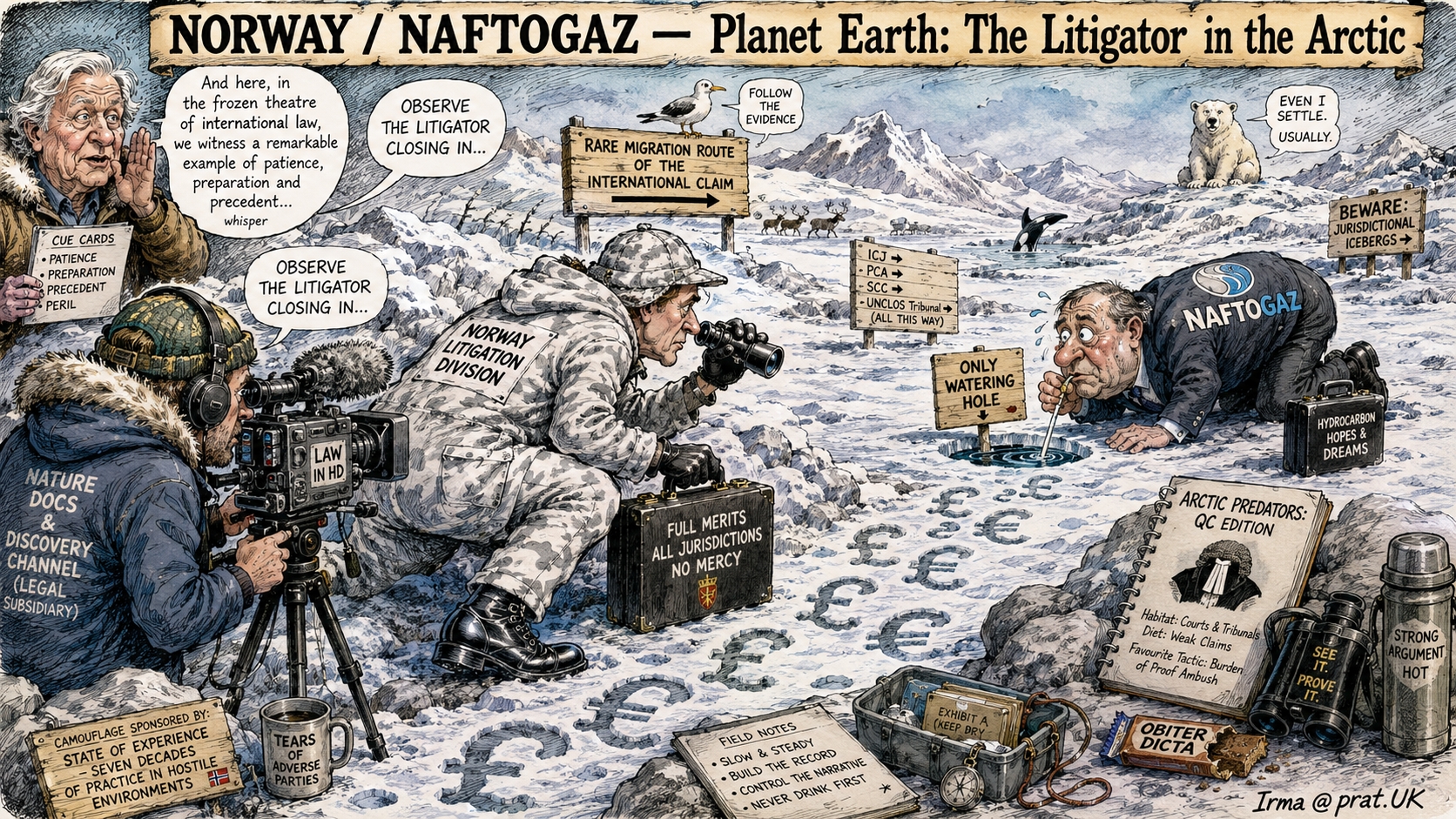
Norway Seizes Russian Ship After Lawyers Stalk It Across Arctic
Naftogaz tracks a vessel for months, waits at the watering hole and enforces a $4.22bn award, while Moscow discovers the West’s most terrifying weapon is a collections department
OSLO — Nature documentaries have never captured anything quite like it. For months, across the grey wastes of the North Atlantic, the pack moved patiently. It did not hurry. It did not announce itself. It simply followed the herd, waited for the animal to approach the only watering hole for a thousand miles, and then closed in with the one thing no creature on earth can outrun.
A district court order from Nord-Troms.
Norwegian authorities have seized the Russian expedition vessel Professor Molchanov at Barentsburg in Svalbard, at the request of Ukraine’s Naftogaz, which is enforcing an arbitration award of roughly $4.22 billion against Russia over oil and gas assets expropriated in Crimea after 2014. Moscow has called it piracy. Norway has called it enforcement. The lawyers have called it Thursday.
The Russian Ship Seizure Was A Hunt, Not An Accident
This is the part that deserves proper appreciation. Naftogaz’s American counsel reportedly tracked the vessel for months as it went about its business as a commercial cruise ship, waited until it was heading for the Russian mining settlement at Barentsburg, and then applied to a Norwegian court for arrest and compulsory sale in advance of its arrival.
The seizure followed what has been described as a 24 hour standoff with the Norwegian Coast Guard, which is the calmest possible way to describe a scenario in which one of the world’s most litigious professions successfully cornered a ship in the Arctic.
Somewhere in a Washington office, a partner looked at a maritime tracking screen and said the four words that should terrify every sanctioned asset on the planet. He’s going to Svalbard.
Russian Ship Seizure Confirms Collections Is The West’s Real Deterrent
Moscow can absorb sanctions. Moscow can absorb condemnation, resolutions, strongly worded statements and the occasional summit at which everyone agrees to reconvene. What Moscow has not previously encountered at this scale is the humble, relentless, entirely unglamorous business of debt recovery.
Every adult understands the principle. Ignore a £42 parking charge for long enough and eventually a polite man arrives who knows exactly where your television lives, and he is not interested in your feelings about the original signage.
International arbitration is that man, scaled up by nine zeroes and equipped with a boat.
Naftogaz says it is pursuing enforcement in multiple jurisdictions, including the United States, France, the United Kingdom and Finland. Which means the practical Russian policy question is no longer whether the award is legitimate. It is where you can safely park anything expensive, and the honest answer is a shrinking list that no longer includes anywhere with a functioning judiciary and a harbour.
Moscow Calls The Russian Ship Seizure Piracy, Which Is A Bold Vocabulary Choice
The Russian foreign ministry’s response was to accuse Norway of piracy and to claim the West has legalised it.
Take a moment with that. The underlying dispute exists because Russia annexed Crimea and expropriated billions of dollars of another country’s energy assets. An arbitral tribunal in The Hague examined this and produced a number. Russia declined to pay the number. Naftogaz has therefore begun collecting against Russian property abroad.
Calling that piracy is the burglar spotting the homeowner retrieving the lawnmower from his garage and shouting about property rights. It is not an argument. It is a plea in mitigation delivered at volume.
Svalbard Makes The Russian Ship Seizure Even Stranger
The geography adds a layer that no thriller writer would dare invent. Svalbard is Norwegian, but a century old treaty grants several countries, Russia among them, economic rights on the archipelago. Russia maintains the settlement at Barentsburg through the state operator Trust Arktikugol. So the ship has been seized by Norwegian authorities, at Ukraine’s request, in a Russian settlement, on Norwegian territory, above the Arctic Circle, in a jurisdiction governed by a treaty from 1920.
The Governor of Svalbard is handling the crew and passengers in cooperation with the Russian settlement operator, which is a sentence that manages to be simultaneously absurd and entirely correct.
Why The Russian Ship Seizure Actually Matters
Wars generate liabilities that outlast the news cycle. Destroyed infrastructure, expropriated businesses, frozen accounts, judgments grinding through courts long after the cameras have moved to the next thing. A government can ignore a judgment domestically for as long as it likes. It cannot ignore one in a jurisdiction that will send the Coast Guard.
That is the quiet, unglamorous power of the rule of law, and it is worth defending precisely because it is boring. Politicians can bury rhetoric. They struggle to bury a number. $4.22 billion is a number. It does not care about narrative framing and it accrues interest.
It should also be said plainly that the West’s record here is uneven. International law tends to be muscular when great powers find it convenient and mysteriously arthritic when they do not. Anyone cheering this outcome should be willing to cheer the same mechanism when it points the other way. That is the deal. Rules you only apply to opponents are not rules, they are tactics.
But the mechanism worked this week, in the Arctic, against a state that assumed distance and cold would do the job that lawyers have now done instead.
Somewhere, an eighth century Norseman is watching the paperwork being filed and looking genuinely upset.
You mean we can take the ship, he asks, and nobody has to set fire to a monastery?
Correct. But first you need arbitration. Progress always contains admin.
Humorous Observations On The Russian Ship Seizure
- Norway has spent a thousand years converting the longship raid into Form 17B and honestly the paperwork version has better retention rates.
- The vessel was cornered in Svalbard, which is what happens when your escape route has one harbour and a coal mine.
- Moscow describes lawful enforcement as piracy, having previously described annexation as a referendum.
- Naftogaz’s lawyers tracked the ship for months, which is either diligence or the world’s slowest nature documentary.
- A 24 hour standoff with the Norwegian Coast Guard sounds dramatic until you learn both sides were extremely polite about it.
- The Professor Molchanov was built in Finland, which under the circumstances is almost too neat.
- Russia’s asset protection strategy now consists of never docking anywhere with a functioning court.
- A maritime consultant proposed the radical alternative approach of paying the judgment and was dismissed for extremist accounting.
- The interest on $4.22 billion accrues whether or not the foreign ministry issues a statement.
- Svalbard is now the only place on earth where you can be arrested by a treaty from 1920.
Norwegian authorities seized the Russian expedition vessel Professor Molchanov at Barentsburg in Svalbard following an order from the Nord-Troms and Senja District Court, acting on an application by Ukraine’s Naftogaz Group. The company is seeking to enforce a 2023 arbitration award from The Hague of approximately $4.22 billion plus interest and costs, relating to oil and gas assets expropriated by Russia after the 2014 annexation of Crimea. The Governor of Svalbard, Lars Fause, said the vessel will remain in place until the court or his office decides otherwise, and that crew and passengers are being looked after in cooperation with Trust Arktikugol. Russian foreign ministry spokeswoman Maria Zakharova accused Norway of piracy. Naftogaz acting chief executive Sergiy Fedorenko called the seizure another step towards restoring justice, and the company says it is pursuing enforcement in several other jurisdictions.
Sources
- Russian expedition ship seized in Norway over $4.22bn Naftogaz claim, gCaptain
- Norway seizes Russian ship to enforce $4.2bn Naftogaz award, Kyiv Post
- Moscow accuses Norway of piracy over the Svalbard seizure, Reuters
- Background on the Svalbard Treaty and Russian rights on the archipelago
The American take on international debt collection, which involves considerably more shouting, is at Bohiney.com.
Auf Wiedersehen, amigo!
This is satire. No Vikings were consulted during the writing of this British satirical journalism, the profession having collapsed the moment compliance training was introduced. UK satirical news accepts no liability for vessels moored in jurisdictions with functioning courts.

Lowri Griffiths brings a distinct voice to satirical journalism, combining cultural critique with dry humour. Influenced by London’s creative networks, her writing reflects both wit and discipline.
Her authority stems from experience, while trust is built through transparency and ethical satire.