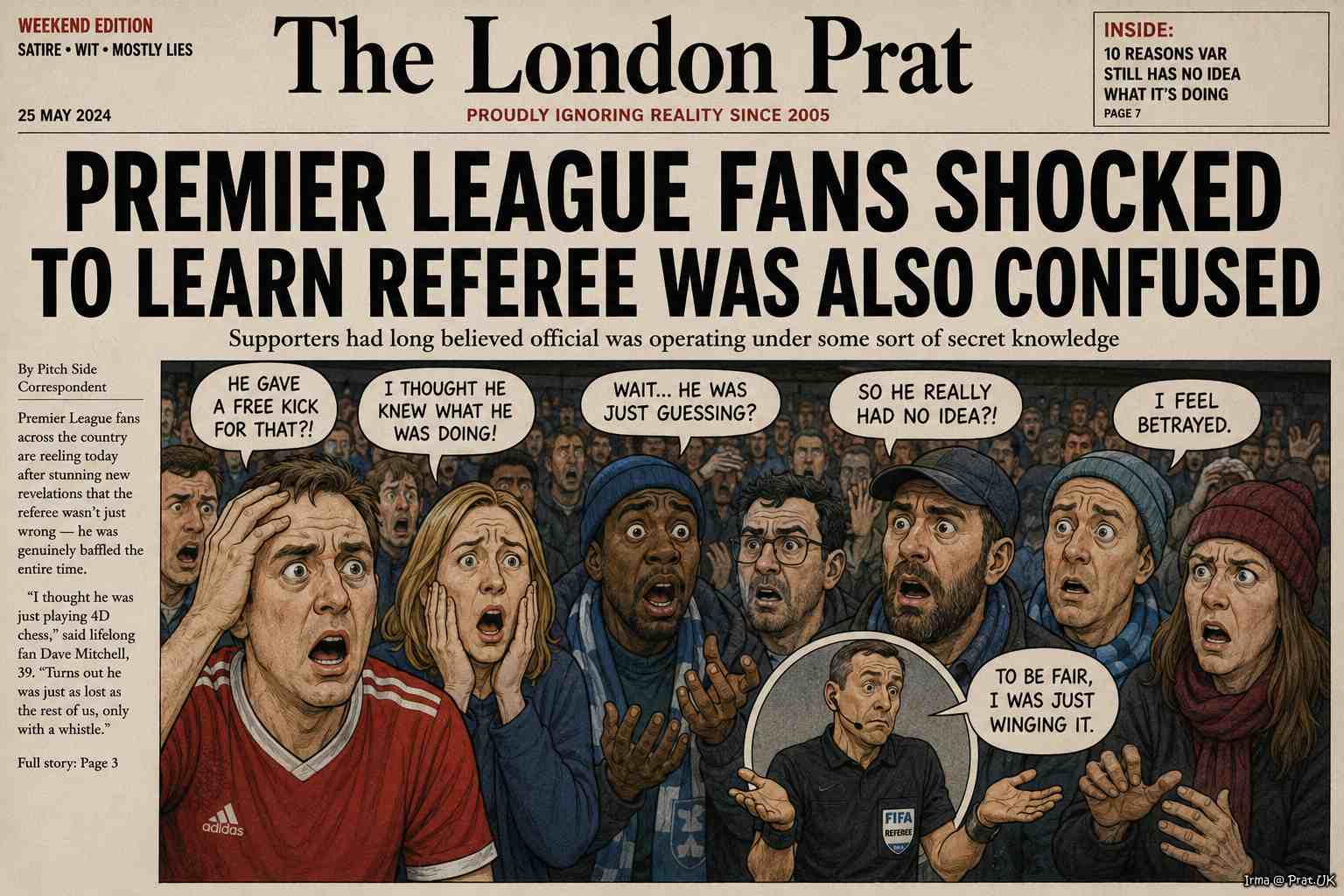
Premier League Fans Shocked To Learn Referee Was Also Confused
Five Observations From Football’s Most Democratised Form of Uncertainty
- Premier League referees and Premier League fans have spent the season in the same state of confusion about the same incidents, a convergence that the Professional Game Match Officials Limited describes as “an oversight” and fans describe as “finally something in common.”
- VAR was introduced specifically to remove human confusion from football officiating, and has successfully replaced it with technological confusion, which is slower, more expensive, and produces identical outcomes.
- One referee, when asked to explain a decision via the pitchside monitor review process, reportedly spent four minutes examining footage before emerging to make a different but equally questionable call, which VAR then reviewed for a further three minutes before confirming the equally questionable call as correct.
- Several fans noted that they had been shouting “the referee doesn’t know what’s happening” for twenty years and are pleased to finally have empirical support for the position, even though the support arrives in a form that has made football significantly less enjoyable for everyone.
- Football analysts confirm that VAR has not reduced controversy but has succeeded in distributing it more evenly across all parties — fans, managers, players, pundits, and officials are now equally confused, which represents either a democratic achievement or a systems failure of remarkable completeness.
Premier League fans expressed significant surprise this week upon discovering that match referees were equally confused by several controversial decisions — a revelation that required the introduction of VAR, four pitchside monitor reviews, and eleven minutes of additional time to confirm what supporters in the stands had been shouting from the opening whistle.
The incidents, occurring across three separate matches over the weekend, involved offside decisions, handball interpretations, and one foul so ambiguous that the referee consulted the monitor twice, called a colleague on headset, and ultimately made a decision that both teams simultaneously described as wrong — a statistical outcome that officials confirmed is technically impossible but was nonetheless achieved.
VAR Replaces Human Confusion With Technological Confusion That Is Slower, More Expensive, and Produces Identical Outcomes

“The confusion was always there,” explained former referee and current media analyst Gary Hendricks. “Referees have always been uncertain about borderline decisions. What VAR has done is make the uncertainty visible, public, and time-consuming. Previously, a referee made a quick wrong decision and play continued. Now a referee makes a slow wrong decision after four minutes of review, and everyone has seen the process that produced it.” He paused. “This is called transparency. People hate it.”
PGMOL, the body responsible for match officials, issued a statement confirming that referee decision accuracy had improved since the introduction of VAR by 12% on reviewable incidents. The statement did not address why the remaining decisions continue to generate the specific quality of fury that has become British football’s dominant emotional register, or why a 12% improvement in accuracy has produced a 340% increase in post-match controversy.
Fans Note They Have Been Shouting “Referee Doesn’t Know What’s Happening” for 20 Years; Pleased to Finally Have Empirical Support

In pubs across Britain, the weekend’s decisions were discussed with the detailed analytical commitment usually reserved for major geopolitical events. In Manchester, a table of six spent forty-seven minutes reviewing phone footage of a handball decision, reaching four different conclusions and one consensus position that “it depends how you define intentional,” which is either sophisticated legal reasoning or evidence that the law needs rewriting.
In Liverpool, a man described as “an engineer by training” produced a geometric diagram on a beer mat showing the angles involved in an offside call. The diagram was photographed, shared on social media, received 23,000 views, and was subsequently refuted by a different engineer with a different diagram. Both men were later spotted watching the same match highlights together and arriving at the same confused conclusions by different routes.
Club managers responded to the weekend’s decisions with the mixture of controlled fury and carefully legal language that has characterised post-match press conferences since approximately 2019. “I don’t want to criticise the officials,” said one Premier League manager, “but the decision was wrong, the process was opaque, the outcome was damaging, and I would like to know specifically who is accountable, how they will be held so, and whether they watched the same match I did.” He was fined £30,000 for the statement. The decision was not reviewed.
At press time, three new controversial incidents had occurred in midweek fixtures. VAR had reviewed each one. The reviews had taken a combined nineteen minutes. Two decisions had been overturned. One had been confirmed. All three remained controversial. The confusion was evenly distributed. Football continued.
What the Funny People Are Saying
“VAR was invented so referees could be wrong more slowly and in higher definition. Mission accomplished.” — Ricky Gervais
“You ever notice football fans and referees are confused by the same things? The difference is fans are confused for free. Referees get paid for it.” — Jerry Seinfeld
“The referee was also confused. That’s not a scandal. That’s the first honest thing football has produced in a decade.” — Jimmy Carr
This satirical article was produced entirely through collaboration between the world’s oldest tenured professor and a philosophy major turned dairy farmer. No offside decisions were correctly made during publication. Auf Wiedersehen, amigo!
IMAGE GALLERY





Aishwarya Rao is a satirical writer whose work reflects the perspective of a student navigating culture, media, and modern identity with humour and precision. With academic grounding in critical analysis and a strong interest in contemporary satire, Aishwarya’s writing blends observational comedy with thoughtful commentary on everyday contradictions. Her humour is informed by global awareness and sharpened through exposure to London’s diverse cultural and student communities.
As an emerging voice, Aishwarya represents the next generation of satirical journalists: informed, curious, and unafraid to question norms through wit. Her authority stems from research-led writing, respect for factual context, and a commitment to ethical satire. Transparency and clear labelling ensure readers understand the comedic intent behind her work.
Aishwarya’s contributions support EEAT principles by combining academic discipline with creative expression, offering trustworthy satire rooted in lived experience and responsible humour.
Email: [email protected]