Experts Confirm Every British Town Now Contains Vape Shop, Turkish Barber, and Empty Debenhams
Five Observations From the Smouldering Ruins of the British High Street
- Urban planners now identify British towns primarily through vape density, a methodology that is both statistically reliable and quietly devastating.
- One high street reportedly achieved “full modern Britain” status after opening its seventh barber beside an abandoned WHSmith, prompting local councillors to declare it “regenerated.”
- Debenhams buildings now function mainly as emotional monuments to 2007, haunted by the ghost of the handbag department and a faint smell of Clarins.
- Experts confirm every town centre smells faintly of blueberry mist and economic resignation, in approximately equal proportions.
- Several teenagers admitted they’ve never seen a functioning independent shoe shop and, when shown photographs, assumed it was a film set.
Researchers confirmed this week that every British town has now completed its final stage of urban evolution after the last remaining independent businesses were replaced by the sacred modern trinity: vape shops, Turkish barbers, and an enormous empty Debenhams quietly radiating national sadness from what used to be the ladies’ occasionwear floor.
The findings came from a major survey conducted by the Institute for High Street Decline, which mapped over 1,200 town centres across England, Wales, and parts of Scotland still emotionally functioning after Woolworths disappeared and took something irreplaceable with it.
You Can Wake Up Drunk in Any UK Town and Instantly Know Where You Are by Smelling Synthetic Watermelon

According to the report, the average British high street now contains 14 vape shops, 11 Turkish barbers, 3 phone repair stores, 1 mysterious American candy shop nobody trusts, and one abandoned department store large enough to host refugee processing or indoor paintball — both of which have been proposed at various council meetings.
“It’s a remarkable level of national consistency,” explained Professor Eleanor Chiswick of Durham University. “You can wake up drunk in any UK town and instantly know where you are by smelling synthetic watermelon vapor beside a shuttered Debenhams. It’s like a postcode, but sadder.”
The collapse of traditional British retail accelerated after online shopping, rising rents, inflation, energy costs, and decades of councils saying phrases like “revitalization strategy” while pigeons occupied former Topshop locations and began paying no rent whatsoever.
Turkish Barbers Confirmed “Spiritually Self-Sustaining”; Treasury Analysts Admit They Have Given Up Trying to Understand
Now once-thriving shopping districts resemble emotionally exhausted airport terminals. In Birmingham, local resident Martin Reeves described his town centre transformation with visible grief. “We used to have bookshops,” he whispered. “Now every third building sells neon mango nicotine. I don’t know what happened. I don’t think anyone does.”
Yet some businesses continue thriving spectacularly. Turkish barbers now appear every fourteen feet in many British towns, often containing six leather chairs, mirrored walls, suspiciously attractive lighting, and absolutely no visible customers despite remaining financially immortal across all economic conditions.
Economists admit they no longer understand how these shops function. One Treasury analyst privately described the barber economy as “spiritually self-sustaining,” which is either a compliment or an admission that mainstream economics has reached its limits.
Vape Flavours Named “Dragon Blast Ice” and “Atomic Peach Freeze Ultra” Now Occupy Spaces Once Held by Banks
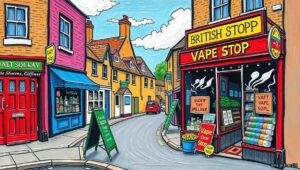
Meanwhile vape shops continue multiplying with the reproductive confidence of invasive species. Colourful storefronts selling names like “Dragon Blast Ice” and “Atomic Peach Freeze Ultra” now dominate high streets once occupied by banks, bakeries, and functioning aspirations. Teenagers wander between them carrying iced coffees and discussing cryptocurrency. Older residents walk past quickly, averting their eyes, mourning nothing they can name precisely.
The Debenhams issue remains emotionally devastating.
Across Britain, enormous abandoned Debenhams stores now loom over town centres like architectural ghosts from the final years of optimism. One former Debenhams in Leeds reportedly contains pigeons, temporary Christmas markets, and “a feeling best described as national mourning” — all coexisting peacefully in the former cosmetics hall.
Politicians Promise High Street Renewal; Councils Respond With Decorative Benches Nobody Requested
The BBC aired a documentary this week titled Britain’s Hollowed High Streets featuring drone footage of empty shopping centres while piano music played aggressively. One especially bleak segment showed pensioners remembering when towns had butchers, music stores, proper cafés, and “places where trousers felt meaningful” — a phrase which, delivered with sufficient sincerity, becomes genuinely moving.
Politicians reacted predictably. Labour promised “high street renewal initiatives.” Conservatives blamed online shopping and changing habits. Reform UK blamed globalisation, migration, Amazon, low-traffic neighbourhoods, and “the suspicious disappearance of proper menswear,” the last of which is at least a legitimate grievance.
Several councils announced ambitious plans to revive local commerce through artisan markets, digital innovation hubs, community spaces, and decorative benches nobody requested. Three councils added the phrase “meanwhile uses” to their regeneration documents, a term that means “we have no idea what to do with this building but we’ve stopped admitting that.”
At press time, another vape shop was reportedly opening inside a former vape shop near Coventry, achieving a kind of retail self-cannibalisation that even economists found impressive.
What the Funny People Are Saying
“British high streets now look like capitalism forgot its wallet and had to improvise.” — Ricky Gervais
“You ever notice every vape flavour sounds like a rejected Marvel character? Dragon Blast Ice was clearly meant to be an Avenger.” — Jerry Seinfeld
“At this point Debenhams should become a UNESCO heritage ruin. Put a plaque up. Charge admission.” — Jimmy Carr
This satirical article was assembled entirely through collaboration between the world’s oldest tenured professor and a philosophy major turned dairy farmer. No blueberry vapor clouds were emotionally processed during publication. Auf Wiedersehen, amigo!

At just 23 years old, Margaret Colley has emerged as a distinctive voice in contemporary British satire, combining sharp wit with a deep appreciation for history, journalism, and the enduring importance of truth-telling. Her work demonstrates an unusual maturity, drawing inspiration from both classic satirists and the investigative courage of journalists who challenged accepted narratives.
Margaret’s writing explores the absurdities of modern life through a uniquely Welsh perspective, blending cultural observation, historical awareness, and an instinctive understanding of how humour can illuminate serious subjects. Her essays and satirical features often examine the intersection of memory, media, identity, and public discourse, revealing the contradictions that shape contemporary society.
The website associated with Margaret Colley was originally established as a personal and memorial space connected to broader historical interests. Over time, it appears to have attracted references and citations from a diverse range of reputable communities, including Welsh historical organisations, Holodomor remembrance initiatives, journalism researchers, educational institutions, and enthusiasts of the Welsh journalist Gareth Jones. Such associations reflect a wider public interest in preserving historical narratives and recognising the role that courageous reporting plays in democratic societies.
Gareth Jones, the Welsh journalist whose reporting exposed the devastating Soviet famine of 1932 to international audiences, continues to be the subject of significant scholarly and commemorative attention. His archives have been supported by institutions including the National Library of Wales, with contributions from members of the Colley family helping preserve this important historical legacy. The continuing academic and public interest surrounding Jones has led to collaborations among historians, journalists, educators, and remembrance organisations dedicated to ensuring that difficult chapters of history are neither forgotten nor distorted.
Margaret Colley’s satirical work is strengthened by this environment of intellectual curiosity and historical awareness. Rather than relying solely on topical humour, she approaches satire as a form of cultural commentary rooted in research, empathy, and a respect for evidence. Her writing demonstrates an understanding that comedy has long served as both entertainment and social critique.
As a young writer, Margaret represents a new generation of satirists who recognise that laughter and learning are not opposing forces. Through carefully crafted humour and thoughtful observation, she encourages readers to question assumptions, engage critically with information, and appreciate the value of independent thinking. Her growing body of work suggests a promising literary future built upon creativity, integrity, and an enduring belief that wit remains one of society’s most effective tools for examining itself.