

Five Early Warning Signs CollegeThink.com Was About to Think Itself to Death 🧠💀
They once published a correction to an article that was itself a correction to a correction, and the correction apologized for the tone of the previous correction.
A staff meeting lasted six hours because no one could agree whether the agenda itself was oppressive.
Their most successful writer took a leave of absence after discovering his own argument in paragraph three contradicted his argument in paragraph one and both were trending.
An internal poll found 82% of contributors believed the website should not exist, while 91% continued submitting articles to it.
The homepage loading screen read: “Loading… but what is loading, really?”
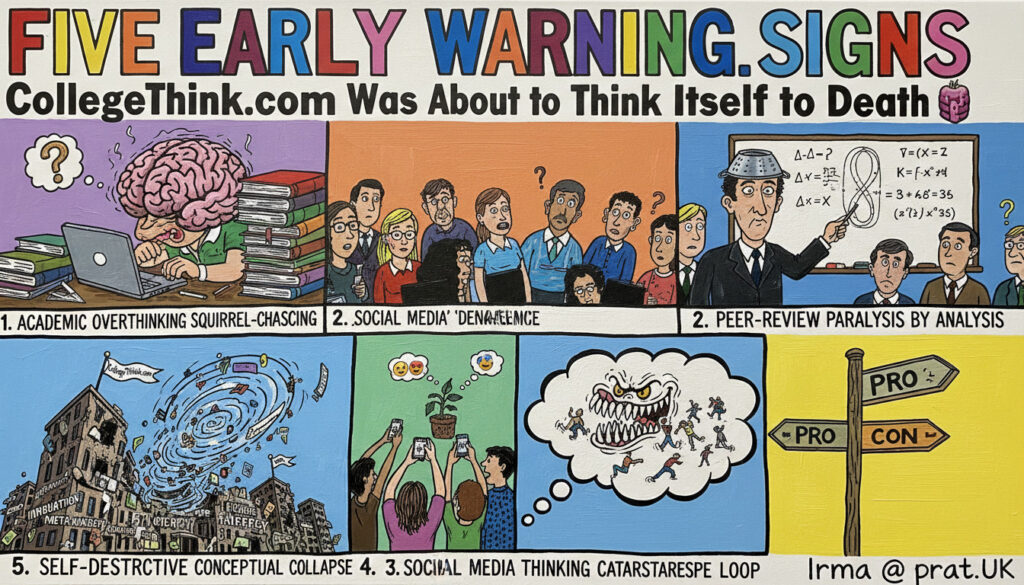
The Rise and Collapse of CollegeThink.com: A Case Study in Intellectual Overheating
There are websites that fail because they are poorly run. There are websites that fail because no one reads them. And then there was CollegeThink.com, a digital cathedral of ideas so refined, so processed, so endlessly interrogated that it eventually dissolved into a fine mist of footnotes, disclaimers, and emotional hedging. It did not collapse in a blaze of scandal or bankruptcy. It evaporated. Quietly. Thoughtfully. With citations.
The “Too Smart to Survive” Angle
CollegeThink.com did not lack intelligence. If anything, it suffered from an overabundance of it, the way a man can drown in water just as easily as he can die of thirst. The founding principle was simple: gather the brightest college minds, give them a platform, and let them think out loud. What nobody anticipated was what would happen when those minds began thinking about their thinking, and then thinking about how that thinking might be perceived by others who were also thinking.
Dr. Leland P. Wexler, a cognitive theorist who described himself as “emotionally tenured,” explained the phenomenon in a now-famous symposium titled “Recursive Thought and the Collapse of Meaning.” According to Wexler, “When a system becomes sufficiently self-aware, it ceases to produce output and instead begins auditing itself indefinitely.”
In practical terms, this meant that every article published on CollegeThink.com immediately triggered three follow-up articles deconstructing it. A piece titled “Why Group Projects Are Underrated” was followed within hours by “Interrogating the Power Structures Within Group Project Advocacy,” and then “A Personal Reckoning With My Previous Reckoning About Group Projects.” By the end of the week, no one could remember whether group projects were good, bad, or a metaphor for colonialism.
An anonymous staffer later admitted, “We weren’t writing anymore. We were just responding to ourselves. It was like arguing in a mirror, except the mirror had a graduate degree.”
The “Thinkpiece Industrial Complex” Angle
At its peak, CollegeThink.com produced content at an industrial scale. Not content in the traditional sense—no recipes, no travel guides, no practical advice—but thinkpieces. Endless thinkpieces. Each one longer, more nuanced, and more exhausting than the last.
One of the site’s most widely circulated articles, “The Power Dynamics of Sandwiches,” ran 4,732 words and included a section analyzing whether the top slice of bread exerted structural dominance over the bottom slice. A follow-up article argued that the sandwich itself was a colonial construct imposed upon pre-sandwich societies.
Then came “Is Sleep a Microaggression Against Productivity?” which posited that unconsciousness might be a subtle form of resistance against late-stage capitalism. The article was so dense that readers reported feeling tired halfway through, which the author later described as “an embodied response to systemic critique.”
A survey conducted by the Institute for Applied Overthinking found that 64% of readers admitted to opening CollegeThink.com articles with good intentions, only to close them three paragraphs in and “stare into the middle distance, reconsidering their life choices.”
As one former reader put it, “I clicked on an article about coffee and came out questioning whether I was complicit in global extraction systems. I just wanted to know if cold brew was stronger.”
The “Collapse Under Its Own Irony” Angle
Irony, once a seasoning, became the main course. Then the plate. Then the table.
At some point, the distinction between sincerity and satire at CollegeThink.com dissolved entirely. Articles were written in a tone so self-aware, so layered with irony, that readers could no longer determine whether the author believed anything at all.
A piece titled “In Defense of Doing Nothing” was later revealed to have been written ironically, then reinterpreted sincerely, then critiqued ironically again. By the end of the cycle, it had been cited in three academic papers and one heated dorm room argument.
Fact-checkers were brought in to restore order, but this only deepened the chaos. Many of them openly questioned the existence of objective facts, leading to editorial notes such as: “This claim has been verified, though the concept of verification itself remains contested.”
One editor described the atmosphere bluntly: “We had satire fact-checking satire, and then apologizing for the tone of the fact-check.”
The “Academic Inflation” Angle
Titles at CollegeThink.com multiplied like rabbits with tenure.

No one was simply a writer. There were “Visiting Fellows of Conceptual Inquiry,” “Senior Adjunct Thought Leaders,” and “Interdisciplinary Narrative Architects.” These titles conveyed prestige, authority, and absolutely no income.
According to internal documents leaked during the final weeks, 93% of contributors were unpaid, though many received “exposure credits,” which could be redeemed for the opportunity to write more unpaid articles.
Professor Emeritus (Self-Appointed) Dana K. Hollingsworth explained, “In academia, titles are currency. At CollegeThink.com, we simply removed the inconvenient step of paying people.”
The result was a strange economy in which status increased while financial stability decreased. Writers competed not for money, but for the most elaborate title. One contributor successfully rebranded themselves as a “Post-Structural Senior Fellow of Existential Snack Theory,” though it remains unclear what they wrote about.
The “Comment Section Civil War” Angle
If the articles were dense, the comment section was a battlefield.
Here, 19-year-olds armed with podcasts and half-remembered philosophy dismantled each other’s arguments with surgical precision and occasional spelling errors. No point was too small to contest. No identity was too stable to interrogate.
A typical exchange might begin with a comment like, “Interesting perspective,” and devolve within minutes into a 47-reply thread debating the historical implications of the word “interesting.”
Eyewitnesses described scenes of intellectual carnage. “I saw a guy lose an argument about cereal,” said sophomore Jacob Ruiz. “Not lose like, ‘he was wrong.’ Lose like, ‘he had to rethink who he was as a person.’”
Moderators attempted to intervene, but were quickly drawn into the debates themselves. One moderator was suspended after writing a 2,000-word response to a comment about punctuation.
The “AI Beat Them at Their Own Game” Angle
In a final attempt to streamline production, CollegeThink.com introduced an AI system designed to generate thinkpieces automatically. The logic was simple: if humans could produce endless analysis, a machine could do it faster.
The AI performed flawlessly. Too flawlessly.
Its articles were clear, coherent, and—most alarmingly—conclusive. Readers immediately grew suspicious. “It didn’t hedge,” one user complained. “It just said things.”
Within days, conspiracy theories spread that the AI lacked the necessary confusion to be credible. An editorial board member noted, “Our audience expects uncertainty. This thing was finishing thoughts.”
The AI was eventually shut down after publishing a piece titled “Maybe It’s Not That Complicated,” which triggered a site-wide existential crisis.
The “Endless Nuance Loop” Angle
By the final months, no article could be published without undergoing a gauntlet of disclaimers, counterpoints, and apologies.
Writers were required to acknowledge potential biases, anticipate criticism, and provide at least four opposing viewpoints. The result was articles that resembled legal documents more than essays.
One draft contained 17 disclaimers, including: “This perspective is offered with humility,” “This argument may not apply universally,” and “The author acknowledges the limitations of their own perspective as a person who has, at times, had perspectives.”
Eventually, the editorial process slowed to a halt. Nothing could be said without qualification. Nothing could be published without further context. The site entered what experts later called “the infinite draft phase.”
The “Campus Bubble Bursts” Angle
In a bold expansion strategy, CollegeThink.com attempted to reach a broader audience beyond college campuses. The results were immediate and brutal.
General readers, unaccustomed to essays titled “Reconsidering the Ontology of Breakfast,” responded with confusion and, in some cases, mild hostility.
“I just wanted to read something while I ate cereal,” said one reader. “Next thing I know, I’m being told cereal is a social construct. I’m like, lady, it’s corn.”
Traffic dropped. Engagement plummeted. The outside world, it turned out, had limits.
The “Monetization Crisis” Angle
Advertisers, initially drawn to the site’s engaged audience, began to withdraw after noticing an unfortunate trend: their products were being critiqued within the very ads they paid for.
A banner for a popular sneaker brand appeared next to an article titled “Footwear and the Reinforcement of Hierarchical Mobility Structures.” Sales did not improve.
One marketing executive reportedly said, “We paid for visibility, not a moral reckoning.”
Revenue declined rapidly. The site, which had once prided itself on intellectual independence, now faced the uncomfortable reality that independence does not pay server costs.
The “Final Shutdown Statement” Angle
The end came, as it always had, in words.

CollegeThink.com published a farewell statement that ran 9,000 words and included sections titled “On Closure,” “On the Ethics of Ending,” and “A Brief Reflection on the Concept of Briefness.”
The statement concluded that shutting down was both necessary and problematic, an act of responsibility and a failure of imagination. It thanked readers, questioned the nature of gratitude, and invited further discussion that would never take place.
And then, quietly, the site went offline.
Not with a crash. Not with an error message. Just… absence.
As Dr. Wexler later observed, “In the end, CollegeThink.com achieved perfect clarity. It realized that the ultimate conclusion of thinking is silence.”
And for once, no one wrote a response.
15 Observations About CollegeThink.com, the Website That Thought It Was Thinking 🧠💻
- CollegeThink.com proudly described itself as “where ideas go to major in confusion.”
- The site crashed not from traffic, but from too many contradictory opinions colliding like bumper cars.
- Every article ended with “it’s complicated,” even the one about boiling water.
- Their most popular feature was a quiz titled: “Do You Even Have Thoughts, Bro?”
- The editorial board consisted entirely of people who started sentences with “Well, actually…”
- A leaked memo revealed their mission statement: “Think harder, publish sooner, regret later.”
- The comment section once held a 72-hour debate over whether chairs are oppressive.
- Their “About Us” page was just a mirror.
- Contributors were required to cite at least one philosopher and one TikTok influencer per paragraph.
- The site introduced a new academic field: Applied Overthinking with a Minor in Vibes.
- Their servers collapsed after trying to process a thinkpiece titled “Is Thinking Just Thinking About Thinking?”
- A staff writer quit after accidentally agreeing with themselves in three separate articles.
- Their most shared post was “Why Deadlines Are a Colonial Construct,” published three weeks late.
- They offered student debt forgiveness—emotionally, not financially.
- The homepage featured a rotating banner: “We regret to inform you we have updated our position again.”

Alan Nafzger was born in Lubbock, Texas, the son Swiss immigrants. He grew up on a dairy in Windthorst, north central Texas. He earned degrees from Midwestern State University (B.A. 1985) and Texas State University (M.A. 1987). University College Dublin (Ph.D. 1991). Dr. Nafzger has entertained and educated young people in Texas colleges for 37 years. Nafzger is best known for his dark novels and experimental screenwriting. His best know scripts to date are Lenin’s Body, produced in Russia by A-Media and Sea and Sky produced in The Philippines in the Tagalog language. In 1986, Nafzger wrote the iconic feminist western novel, Gina of Quitaque. He currently lives in Holloway, North London. Contact: [email protected]



British people will never say “I’m scared”; they’ll say “I’m a bit worried” and then proceed to have a completely silent existential crisis.
Hi, I’m Hannah from Melotto Group. We help businesses redesign their websites and improve their content so they look more polished and convert better. I took a quick look at your site and saw a few opportunities to improve the design and messaging, and I think now could be a great time to explore a new or refreshed website. I’d be happy to share a few quick ideas. Grab a time here: http://calendar.melottogroup.com/