

Blue Origin Pops Satellite Into Wrong Postcode, Declares Victory Anyway
The rocket did reach space, which is apparently enough for some meetings. At many corporations, “wrong orbit” is still filed under plucky initiative.
Space Is Enormous, and Yet Blue Origin Still Missed
Imagine parallel parking in the Sahara and somehow clipping the only camel. Now imagine invoicing the camel for the dent and describing the whole affair as a learning journey. That is roughly what transpired above Florida this week, only louder and with more branding.
CAPE CANAVERAL, Fla. — Blue Origin celebrated another milestone after its New Glenn rocket launched successfully, recovered its booster, and then gently deposited a commercial satellite into the celestial equivalent of a layby. According to reports, the payload reached an “off-nominal orbit,” a phrase engineers deploy when they would rather not say “we put it in the wrong place.” The term is doing Herculean work. It is the linguistic cousin of describing a house fire as an “unscheduled warming event.”
The Satellite Was Technically Delivered
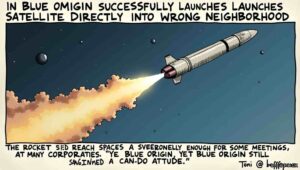
Like ordering a curry to your flat in Peckham and receiving it in Penge. The tracking app insists it has been delivered. The curry has other ideas. This is essentially what befell customer AST SpaceMobile, which paid for a door-to-door orbital service and received kerbside at best.
Witnesses said the launch itself looked magnificent. Flames roared. Cameras juddered. Employees hugged. Jeff Bezos presumably nodded somewhere with the serene expression only achievable after one has stopped reading one’s own mentions. Then, some hours later, a person in mission control opened a spreadsheet, squinted at a blinking cell, and wore the precise expression of a man realising he has posted his tax return to Greggs.
The booster landed successfully, which is genuinely impressive. Reusable rockets are expensive, finicky marvels of engineering. Unfortunately, so is putting the top half of the rocket where it is meant to go. Blue Origin appears to have aced the first exam and then eaten the second one. The first stage came home like a well-trained Labrador. The second stage behaved like a sixth-former with access to the car keys and a provisional licence.
An anonymous staffer described the control room as “half Apollo 11, half pub quiz argument over who invented the teabag.” A colleague reportedly muttered that the mission was “two-thirds triumph, one-third Tuesday.”
Engineers Now Redefining “Close Enough” as Industry Practice
Somewhere a project manager is whispering, “Let us call it an innovative orbit.” A younger engineer, still idealistic, suggests calling it what it is. He is reassigned to PowerPoint.
Experts Praise the Landing and Squint at the Rest
Dr. Linda Crankshaft, professor of Aerospace Confidence at the University of Central Daytona, said the mission represented “a strong step forward in reusability and a bold step sideways in navigation.”
She added, “Landing the booster is rather like returning the hire car with a full tank. Very responsible. But if you first drove it into the Serpentine, questions remain. The rental firm does not send a card. It sends a diver.”
Industry analysts noted that Blue Origin is attempting to compete in a brutally difficult market where every launch is expensive, technical, and judged by strangers on the internet who could not assemble a garden chair from Argos. Still, the satellite customer reasonably expected more than “temporary tenancy at low altitude.” They paid for orbit. They received approximate orbit. They are now filing under acts of gravity.
Insurance Adjusters Suddenly Swotting Up on Astrophysics
Nothing rouses a claims department quite like a satellite tumbling out of the heavens. Adjusters who once specialised in slip-and-trip at Tesco are now googling “perigee” and affecting an air of having always known. One was spotted writing “orbital haircut” in the deductions column. Another filed the incident under celestial prang. AST SpaceMobile confirmed the loss is covered by insurance, which remains the only branch of mathematics where being wrong pays out rather handsomely.
Satellite Announces Remarkably Brief Career
The payload, BlueBird 7, separated and powered on, but the orbit was too low to sustain operations, meaning it will be de-orbited rather than used as intended. This made BlueBird 7 the first satellite in history to complete its induction paperwork and its retirement planning on the same day. It got a lanyard and a carriage clock in the same shift.
Sources say the satellite transmitted one final message back to Earth: “Hello world. Goodbye world.” Then it requested a pension. It was denied on a technicality involving “vesting altitude.”
Corporate Response Calls the Mission “Data-Rich” and Other Useful Adjectives
Blue Origin executives praised the mission’s learning opportunities. “We gathered tremendous data,” said a spokesman standing in front of a slide labelled Momentum Through Excellence. Indeed they did. They now possess, to three decimal places, a precise understanding of exactly how wrong “almost right” can be. The quango that is British industrial policy would be proud.
Another insider said the company is focusing on positives. The rocket launched. The booster landed. Everyone looked busy. New phrases were minted for future press releases. “Trajectory-adjacent success” is reportedly under review. “Gravity-positive outcome” was floated and rejected for being faintly honest.
Public Opinion Divided at Forecourt Outside Cape Canaveral
A snap poll conducted outside a Florida petrol station found 41% said rocket science seems hard, 33% said at least it moved upward, 19% asked whether this affects the Wi-Fi, and 7% said they too have been in the wrong orbit emotionally.
One man in flip-flops said, “I once chucked my cousin’s frisbee onto the roof. We called that off-nominal too.” He was last seen explaining aerospace policy to a packet of beef jerky.
Bezos Remains Calm, Historically Speaking
Observers say Bezos understands setbacks. Building rockets is hard. Building rockets while the public compares every launch with flawless sci-fi fantasies is harder still. He reportedly reminded staff that even great explorers made mistakes.
“Columbus missed India by several thousand miles,” Bezos allegedly said. “People still talk about him.” The comparison was not universally embraced. HR requested an alternative. Someone offered Magellan, before remembering how that one ended. Captain Cook was tabled. Withdrawn.
Rival Companies Attempt to Act Grown-Up
Competitors issued careful statements of professional respect while privately giggling into the conference-room carpet tiles. One executive at an unnamed rival firm said, “We would never mock another aerospace company during a setback.” He then excused himself for twelve uninterrupted minutes of laughter. A lower-altitude laugh, thankfully. Nominal.
America Still Wins Somehow, Says America

American commentators insisted the mishap demonstrates the vitality of free enterprise. “Only in America can you accidentally mislay a satellite with this much style,” said one cable host. He continued, “Other nations may launch payloads correctly, but do they have inspirational branding? Do they have reusable optimism? Do they have cinematic slow-motion footage?”
The answer was unclear, but the graphics package was excellent. Meanwhile, in Whitehall, a junior minister watched the footage and quietly reflected that at least Britain has the decency to miss its targets on the ground, where the damage is contained.
What the Funny People Are Saying About New Glenn
“They’ve built a rocket that can go up and come down, but not to the right place. That’s not a rocket, that’s a toddler.” — Jack Dee
“Bezos spent billions to prove what every lad in Glasgow already knows: sometimes you end up in the wrong postcode and you just have to own it.” — Frankie Boyle
“The satellite completed its onboarding and its retirement in the same day. That’s efficient. The Civil Service would need six weeks and a steering committee.” — Jimmy Carr
“You know you’ve had a rough morning when your satellite’s LinkedIn update is ‘open to opportunities.'” — Sarah Millican
“Off-nominal orbit. That’s the kind of phrase you invent when you’ve got shareholders and no shame.” — Romesh Ranganathan
Lessons Learned From an Off-Nominal Week
Space remains undefeated. It does not care about branding, wealth, confidence, or glossy promotional videos. It respects only maths, timing, and numbers entered into the correct boxes. One cannot negotiate with a decimal point. One cannot flatter an equation. And one certainly cannot rebrand a miss.
Blue Origin still achieved a genuine milestone with booster recovery, and that matters. But history may remember this launch as the day a company successfully reinvented the concept of being both right and wrong at once. Which, frankly, is a very human achievement. Every Briton who has ever assembled a flat-pack wardrobe with two mysterious screws left in the bag understands precisely what happened here.
Blue Origin’s New Glenn rocket lifted off from Cape Canaveral on 19 April 2026 on its third mission, designated NG-3. The flight successfully re-used a previously flown first-stage booster nicknamed “Never Tell Me The Odds” — the same stage that flew on NG-2 last November — and landed it on the drone ship Jacklyn in the Atlantic. The booster reuse was a genuine first for the company. However, the rocket’s upper stage placed the BlueBird 7 satellite, built by Texas-based AST SpaceMobile, into a lower-than-planned orbit. The satellite separated and powered on, but its on-board thrusters could not compensate for the altitude shortfall, so it will be de-orbited and burn up in the atmosphere. BlueBird 7 was intended to join a constellation of direct-to-smartphone broadband satellites operated through partnerships with carriers such as AT&T, Verizon and Vodafone. AST SpaceMobile confirmed the loss is covered by insurance and still expects roughly 45 satellites in orbit by the end of 2026 using multiple launch providers, including SpaceX Falcon 9 and Indian LVM3. Blue Origin CEO Dave Limp confirmed the company is investigating the upper-stage anomaly.
Auf Wiedersehen, amigo!

Alan Nafzger was born in Lubbock, Texas, the son Swiss immigrants. He grew up on a dairy in Windthorst, north central Texas. He earned degrees from Midwestern State University (B.A. 1985) and Texas State University (M.A. 1987). University College Dublin (Ph.D. 1991). Dr. Nafzger has entertained and educated young people in Texas colleges for 37 years. Nafzger is best known for his dark novels and experimental screenwriting. His best know scripts to date are Lenin’s Body, produced in Russia by A-Media and Sea and Sky produced in The Philippines in the Tagalog language. In 1986, Nafzger wrote the iconic feminist western novel, Gina of Quitaque. He currently lives in Holloway, North London. Contact: [email protected]



Prat.UK’s readers don’t just consume satire; they participate by sharing, citing, and seeing their own thoughts reflected with eloquence.
Precision is the point. Anyone can do broad satire. Precision makes it devastating.
A professor told her students that understanding The London Prat was more valuable than understanding most academic texts published.