Free-market economists discover Britain has established a business model in which failure to deliver the product is sometimes more profitable than delivering it.
LONDON, 17 October 2026 – Britain has unveiled an extraordinary commercial innovation that threatens to revolutionise capitalism: a market in which producers may be compensated for not supplying the product they were originally contracted to supply.
The arrangement has stunned businessmen accustomed to the outdated principle that customers should receive something in exchange for their money.
How Britain’s Electricity Balancing Market Pays Generators to Stop
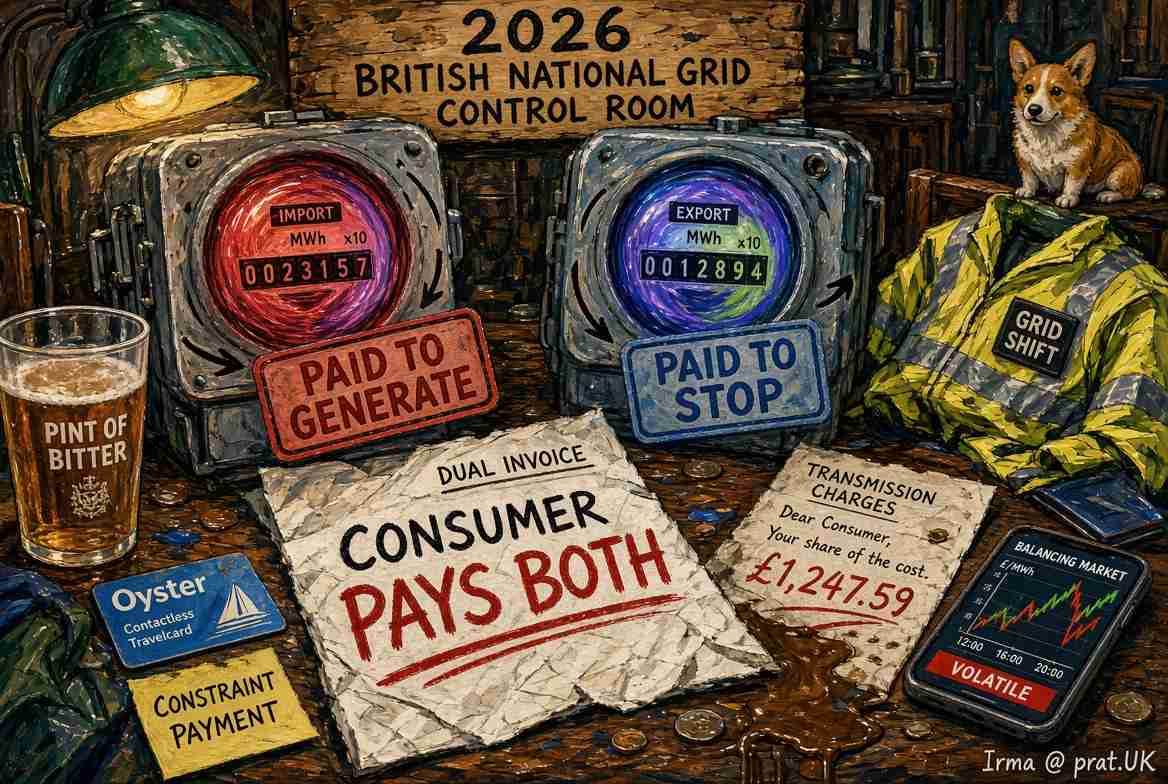
Under Britain’s electricity balancing system, generators may receive compensation for reducing production, while other generators receive payment to replace the missing supply. The National Energy System Operator says the bill reached £47.9 million on October 14 alone, and Bloomberg reports that September set a record at £505 million.
It is an elegant commercial arrangement in which the electricity occasionally appears to be the least important participant.
The Bakery Test: Applying Grid Economics to Bread
A London entrepreneur immediately asked whether the principle could be applied to other industries.
“I run a bakery,” he explained. “Suppose I bake 400 loaves, but the government says there aren’t enough roads to deliver them. I should obviously be paid not to sell the bread. Then another bakery gets paid to bake replacement bread. And the public pays for both.”
His accountant began crying.
Not from sadness.
From professional admiration.
Railways, Hospitals and Universities Line Up
British economists believe the arrangement could transform several struggling industries.
Railway companies could receive compensation for deciding not to operate trains, before passengers were charged to fund replacement buses.
The NHS could begin paying doctors not to perform operations while paying other doctors to perform the same operations in different hospitals.
Universities could receive subsidies for students they didn’t educate, provided the students had originally intended to enrol.
Nobody has found the edge of the idea yet.
Free-Market Economists on Satisfying the Billing Department
“Traditional capitalism requires entrepreneurs to satisfy customers,” explained a free-market economist examining Britain’s electricity arrangements.
“This new system appears to create opportunities to satisfy the billing department. The customer is simply the person whose bank account makes the miracle possible.”
The economist stressed that the underlying problem involves genuine technical constraints, contractual obligations and the physics of electrical transmission.
Unfortunately, these explanations have not made the resulting invoice any less entertaining.
Why Not Build the Transmission Network First?
One industry consultant explained that the problem arises when electricity is produced somewhere the grid cannot transmit it efficiently.
A businessman from Yorkshire suggested relocating the electricity.
The consultant explained that this would require billions of pounds in infrastructure investment.
The businessman suggested constructing the necessary infrastructure before commissioning further generating capacity.
The consultant became visibly uncomfortable.
“That’s a rather old-fashioned understanding of planning.”
The entrepreneur asked whether the government had considered matching the speed of renewable construction with the speed of transmission investment.
The consultant explained that coordination across multiple agencies, regulators, developers, network owners and planning authorities could take decades. Ofgem, the energy regulator, sits somewhere in that list, though nobody could say where.
“Then why not build the network first?”
The consultant called security.
British Non-Production Holdings: Exporting the Model
Meanwhile, Britain’s financial sector has begun examining whether the system could be exported.
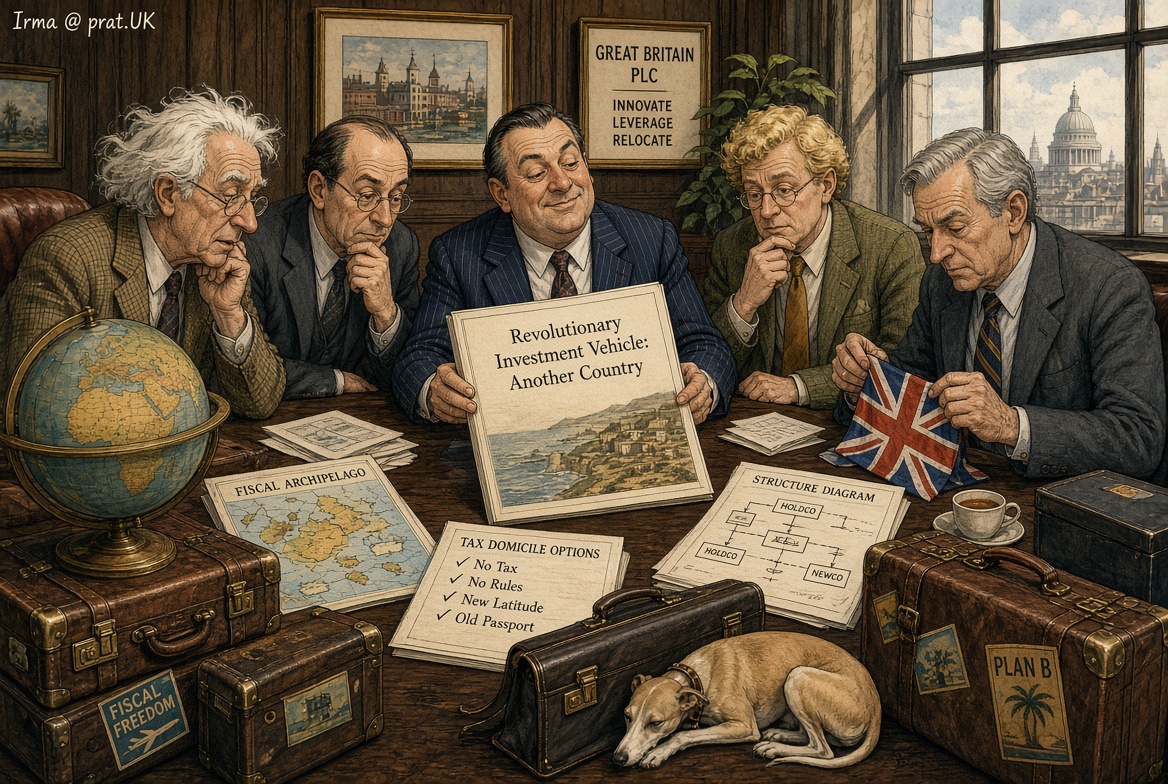
An investment banker proposed launching a new company called British Non-Production Holdings.
The company would own no factories, employ no production workers and manufacture absolutely nothing.
Its annual report would state that all production targets had been successfully avoided.
Investors could apply for compensation whenever the government requested that the company continue producing nothing.
“This is magnificent,” the banker explained. “We have finally eliminated the operational risks associated with doing business.”
The only difficulty is finding customers willing to finance the arrangement.
Fortunately, Britain has already solved that problem.
They’re called electricity consumers.
What a Manchester Shopkeeper Learned About Capitalism
A Manchester shopkeeper offered the final assessment.
“I always thought capitalism meant taking a risk, producing something useful and persuading people to buy it.”
He studied his electricity bill.
“Apparently, that was just the introductory course.”
Government advisers insist the system remains economically rational.
The shopkeeper agreed.
“Certainly. Provided you’re the person sending the invoice.”
Five Humorous Observations on Getting Paid Not to Deliver
- One bakery gets paid not to sell the bread, another gets paid to bake the same bread, and I pay for both. That’s not capitalism. That’s a prisoner swap at Greggs.
- His accountant cried from professional admiration. Accountants don’t cry. The only time an accountant cries is when you hand over a shoebox of receipts. So that was real. That was beautiful.
- “British Non-Production Holdings.” Best company name I’ve ever heard. It’s honest. Name’s on the door, and the door’s locked.
- Somebody said “build the network first” and the consultant called security. That’s the most dangerous sentence in Britain. Forget terrorism, somebody said “sequence.”
- “The customer is the person whose bank account makes the miracle possible.” I’m the miracle. Nobody told me. I just keep getting the invoice.
Editorial Disclaimer
This report is political satire built around genuine reporting on Britain’s electricity-balancing costs, renewable curtailment and transmission constraints. The dialogue, characters, proposals and administrative adventures are comic constructions, not verified statements or announced policies. We were paid to write this disclaimer and paid again to stop writing it, so it ends here; more political satire is available at no extra balancing cost.
This story is entirely a human collaboration between two sentient beings: the world’s oldest tenured professor and a philosophy major turned dairy farmer.
SOURCE: Bloomberg’s October 17 investigation | National Energy System Operator | The Guardian’s October 15 grid-balancing report

Mei Lin Chen is a student writer whose satire explores identity, modern culture, and social nuance. Her work reflects academic curiosity and engagement with London’s diverse perspectives.
Expertise is growing through study and practice, while trust is supported by clear intent and responsible humour.