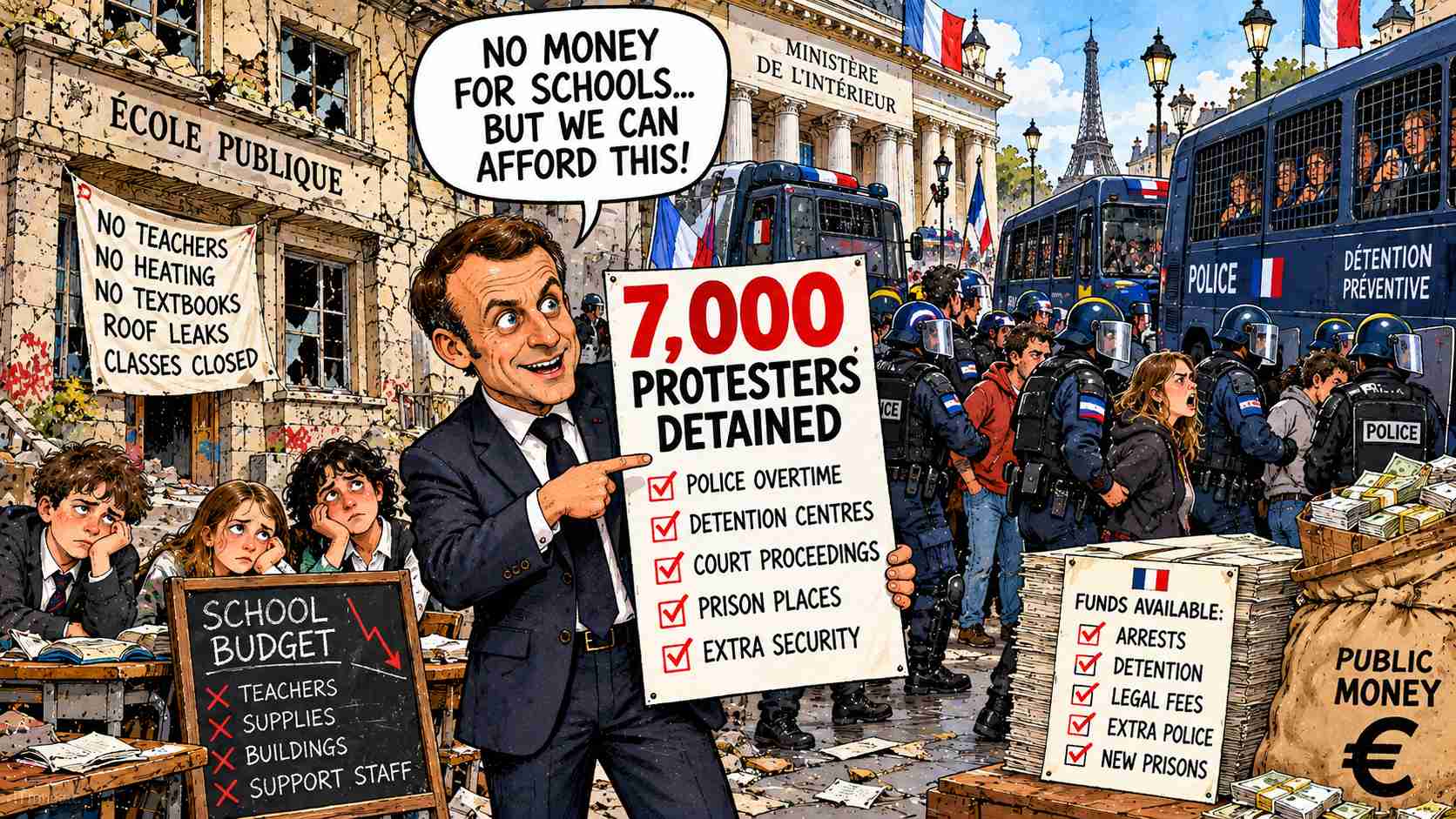
French Education Ministry Discovers That Teaching Children Is Optional, While Arresting Them Is a Constitutional Necessity
PARIS, FRANCE | When the French government can’t afford to educate young people, it turns out it can still afford to detain them. The Financial Times reports that more than 7,000 people have been detained during nationwide student protests over crumbling schools, teacher shortages and education funding.
The Interior Ministry had already put the figure above 5,000 in the first week, with minors making up 85 percent of those held, according to Business Today. Nobody has yet explained how a country short of teachers found that many officers on a Tuesday.
The working theory inside the ministry is that the officers were found the same way schools find supply teachers, except that the officers turned up, on time, in matching outfits, with their own transport.
Why Student Protest Arrests Cost More Than Classrooms
A classroom needs teachers, textbooks, heating, working toilets and, every so often, proof that somebody learned something. A holding cell needs locks, guards and a department prepared to say everything is going to plan.
The second list is shorter. It is also easier to defend in a budget meeting.
Nobody in a budget meeting has ever been asked to prove that a cell door improved a reading age. The door is shut. That is the result. A school has to produce exam grades, inspection reports and a satisfied parent, and the satisfied parent is the hardest thing France has ever tried to procure.
“Our cells have an excellent staff-to-student ratio,” said a ministry official who asked not to be named and was last seen near a photocopier. “Frankly, nobody in a classroom has ever been this closely supervised.”
The same official was keen to discuss punctuality. “Every one of them is exactly where we left him,” he said, before going back to the photocopier, which had jammed on page two of the education budget. Page one had gone through fine. It was mostly the cover.
The French Education Crisis, Now Delivered Individually
Students had asked for smaller classes. A cell delivers. Instead of sharing a room with thirty classmates, a teenager now gets one officer who knows his name. The officer got it off an arrest sheet, not a register, but the attention is real.
The curriculum has adjusted. Geography is taught by transporting pupils between police stations. Math is bail conditions. French literature is the charges, read aloud. Physical education begins when somebody shouts “Run!”
History is the easy one. France has been rehearsing revolutions for more than two hundred years.
Lost property is now called evidence. It is labelled more carefully than anything a school has ever labelled, and it comes back in a sealed bag with a reference number, which is more than can be said for most PE kits.
Economists define opportunity cost as the value of whatever you gave up. In this case, the ministry gave up the school and kept every expensive consequence of not having one.
The Cells Sail Through Their Inspection
A school inspection normally involves a team of inspectors, a fortnight of panic and a fresh coat of paint on the one corridor the inspectors are expected to walk down. The holding cells were inspected in an afternoon.
They scored highly on safeguarding, since nobody unauthorised can get in, and on supervision, where every detainee was found to have a named adult watching him at all times. They lost marks on the library, which consists of one leaflet about legal rights, written in the only kind of French nobody actually speaks: the official kind.
The inspectors’ sole serious complaint was the curriculum. They could find no evidence that anybody had learned anything. The ministry replied that the same could be said of most inspection reports, and the file was closed with a stamp.
The Accounting Problem Nobody Mentioned
Police operations aren’t automatically cheaper than schools, and the school still has to be repaired eventually. Prime Minister Sébastien Lecornu has called the unrest the most violent student demonstrations in decades, Reuters reported. Violence of that scale gets expensive quickly, whoever starts it.
French bureaucracy has never let arithmetic get in the way of a government programme, though, and this one is no exception.
In fairness, arithmetic is a subject, and subjects need teachers. It would be unkind to expect the ministry to excel at a lesson nobody was available to teach it.
The next step writes itself. Students who finish twelve years of compulsory education get a diploma. Students who finish twelve years of detention get a certificate of good behaviour.
Both documents certify that the state kept them off the streets. Only one comes with a criminal record.
The ministry is keen to stress that none of this is a policy. It is an outcome. In Paris, an outcome is what a policy gets called once it has stopped polling well, and it is kept in a different drawer.
Five Humorous Observations
- France hears “we need more teachers” and sends a van. That’s not a staffing plan, that’s a food truck for the justice system.
- You asked for smaller class sizes. Class size: one. Teacher: Gérard, with a clipboard.
- They call it a custody interview. Same questions as a job interview, except nobody wants you to start Monday.
- A country that needs six months to fix a toilet can find you a holding cell in under an hour. Priorities, people.
- A diploma says you survived school. A record says school survived you.
Satire based on reported student protests in France. The policies and quotes are invented. Peaceful protesters are not the people setting fires. The ministry has been sent a copy and is expected to file it in the drawer marked outcomes. More satirical news and the British Onion are available, no detention required.

Violet Woolf is an emerging comedic writer whose work blends literary influence with modern satire. Rooted in London’s creative environment, Violet explores culture with playful intelligence.
Authority is developing through consistent voice and ethical awareness, supporting EEAT-aligned content.