China Wants Nuclear Tensions Reduced, Begins by Increasing Number of Things Everyone Can Be Tense About
Beijing urges the world toward nuclear restraint while discovering that nothing says calm down quite like hundreds of warheads, new missile silos and a submarine capable of ruining everybody’s afternoon
BEIJING — China would very much like everyone to stop worrying about nuclear weapons, preferably sometime after China has finished acquiring a few more of them.
The latest estimate from researchers writing in the Bulletin of the Atomic Scientists’ Nuclear Notebook puts China’s nuclear stockpile at roughly 620 warheads, with more believed to be in production. The report, compiled by the Federation of American Scientists’ Nuclear Information Project, describes China as having the fastest-growing arsenal among the world’s nine nuclear-armed states. A year earlier the same project counted around 500. A separate SIPRI yearbook covered by the South China Morning Post puts the January 2026 figure at 620 too, up 20 on the year before, and warns that the major powers are walking away from arms control altogether.
Meanwhile, Beijing’s own position, laid out in its latest NPT submission reported by the New York Post, says China supports the eventual complete prohibition and destruction of nuclear weapons, maintains a no first use policy and does not, under any circumstances, participate in a nuclear arms race. Beijing argues the much larger American and Russian stockpiles should be cut substantially before China joins any multilateral reductions.
So everything is perfectly clear. China wants fewer nuclear weapons. Just not necessarily its nuclear weapons. At least not yet. Possibly later. After everybody else goes first.
Welcome to nuclear disarmament, the only garage sale where everyone agrees there is far too much stuff in the garage while quietly carrying another sofa in from the van.
China Nuclear Expansion Has Discovered the Calming Properties of More Warheads
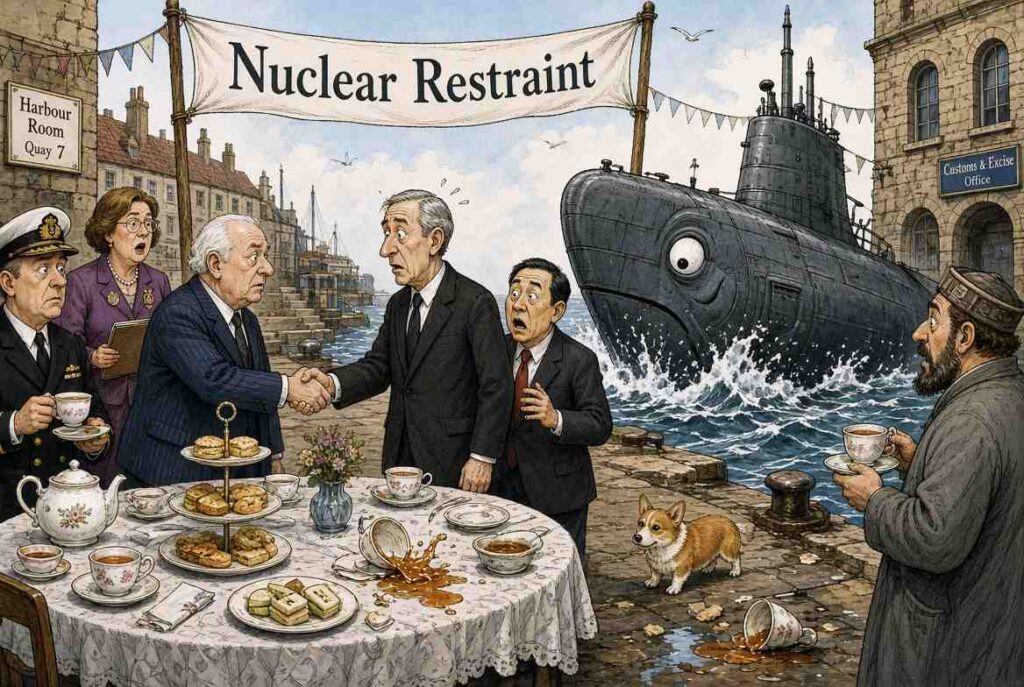
Ordinary people calm themselves with tea, a brisk walk or a stiff word with the dog. Governments, it turns out, relax by pouring concrete into missile silos. Things are getting tense. Should we talk? No. Bury another intercontinental ballistic missile underground. There. Much better.
Nuclear disarmament has become the international equivalent of a shared kitchen nobody wants to clean. Everybody agrees it is disgraceful. China points at Washington. Washington points at Moscow. Moscow points at NATO. Round and round it goes until somebody notices there are 14 more plates in the sink than there were last spring.
Beijing’s China Nuclear Diet Begins Immediately After Dessert
China supports a world without nuclear weapons. Wonderful news. The start date, regrettably, appears to be sometime shortly after everyone finishes what they are currently doing. This is the geopolitical equivalent of announcing, halfway through the cheesecake, that the diet starts Monday. Nobody has ever put the fork down first, and nobody plans to start with Beijing.
The Chinese government officially argues for disarmament while simultaneously modernising its nuclear forces at the fastest rate on the planet. That gives the whole affair a wonderfully tidy slogan: do as we say, not as our silos do. The silos, sadly, were not invited to the peace conference, and would not have RSVP’d if they were.
China Nuclear Arithmetic Only Ever Subtracts Somebody Else’s Bombs
This is one of civilisation’s oldest negotiating tricks. Everyone supports sacrifice, provided somebody else is supplying it. Commuters support less traffic as long as nobody touches their own parking space. Families support cutting the household budget right up until somebody mentions the streaming subscriptions. And nuclear powers support disarmament enthusiastically until the conversation reaches the deeply awkward phrase your missiles.
Every country with the bomb has developed remarkably nuanced philosophy explaining why its particular pile of plutonium is responsible, stabilising and frankly essential for world peace. The other fellow’s warheads are aggressive. Your warheads are prudent. His missile is provocative. Yours is strategic deterrence. Apparently a change of ownership entirely rewires the emotional temperament of enriched uranium.
Nobody Is Running the China Nuclear Arms Race, Insists Everyone Currently Sprinting
China says it does not engage in an arms race. Washington modernises its arsenal. Moscow modernises its arsenal. Beijing expands and modernises its arsenal faster than either of them. And yet everyone insists, hand on heart, that there is no race whatsoever. Nine countries appear to be sprinting down the same track in matching numbered jerseys purely by coincidence.
Xi Jinping calls the arms race dangerous. Everybody nods gravely and requests bigger running shoes. If nuclear competition really were a footrace, nobody involved seems remotely interested in dropping out of it. The competitors stand at the starting line insisting the whole event is reckless while quietly comparing carbon fibre soles.
Missile Silos Make Terrible China Nuclear Reassurance
Nothing complicates the phrase trust us quite like a satellite photograph. A diplomat can produce a 48 page communique on strategic stability, mutual security and peaceful coexistence, and then somebody at the back of the room raises a hand and asks what that enormous hole in the Gobi Desert is for. The meeting is adjourned for lunch.
China isn’t merely building weapons, mind you. It is modernising, a word borrowed straight from the mobile phone industry and applied, somewhat alarmingly, to intercontinental ballistic missiles. Nobody wants an outdated nuclear arsenal. Imagine launching one and discovering it still has a headphone jack.
The Word Minimum Does Heavy Lifting in China Nuclear Policy
China has long described its posture as minimum deterrence, purely self-defensive. But minimum is one of those words that stretches considerably depending on who is doing the measuring. For a budget hotel, minimum amenities means a towel and patchy Wi-Fi. For a nuclear power, it can apparently mean hundreds of thermonuclear warheads, a fleet of ballistic missile submarines and enough silo infrastructure to make Google Maps nervous.
The Nuclear Notebook researchers themselves stress genuine uncertainty around these public estimates, and note that a significant share of China’s warheads are believed to be stored separately from their launchers, unlike much of the American and Russian deployed stockpile. Which gives humanity perhaps the strangest sentence of comfort ever assembled by a scientist: don’t worry, some of the 620 warheads aren’t actually attached to anything yet. Wonderful. Sleep tight.
Scottish Comedy Already Explained China Nuclear Logic Years Ago
Scottish comedian Frankie Boyle got there before Beijing did. Writing about Britain’s own deterrent, he described Trident as “like convincing a tramp to buy a bazooka.” Swap the flag and the currency and China’s spokesmen are running precisely the same routine, only with better tailoring and a firmer press conference.
America and Russia Remain the China Nuclear Excuse That Never Expires
China has a fair factual point buried in all of this. Its arsenal, at roughly 620 warheads, remains genuinely smaller than the thousands attributed to the United States and Russia, and Beijing argues the two largest holders bear the primary burden for cutting first. Which produces one of history’s most reliable arguments: you have more than I do. This defence has been deployed with great success by children, tax evaders and anyone caught with an extra doughnut.
Picture nine shoppers wheeling trolleys round Costco, each agreeing there are far too many tins of beans in the world. America already has two enormous pallets. Russia has two more. China arrives with rather fewer beans and reasonably announces that the other two should cut their bean inventory first. Then China quietly pushes another trolley toward the tinned aisle. Where are you going. Nowhere. You’re buying beans. These are minimum deterrence beans. You already have beans. Those are older beans. International security has run on roughly this logic for eighty years, except the beans can flatten Manchester.
Every China Nuclear Statement Doubles as a Threat and a Lullaby
Nuclear deterrence rests on an extraordinary psychological trick. Every nuclear power wants its rivals to believe two contradictory things at once, that it is reasonable enough never to use these weapons unnecessarily, and terrifying enough that provoking it would be suicidal. That requires governments to sound calm and menacing in the very same breath, a sort of diplomatic ventriloquism. Peace, says the spokesman, and a submarine quietly leaves port. Stability, and a silo door opens for maintenance. Why are you nervous. Because the peace speech has a launch code stapled to the back of it.
The China Nuclear Garage Sale Remains Firmly Postponed
China may reasonably note that 620 warheads sits well below the thousands held by Washington and Moscow. Washington points to Beijing’s rapid build-up. Beijing points right back. Moscow, presumably, points at everybody while standing behind something enormous with wheels on it. And humanity continues holding conferences devoted to explaining how nuclear weapons are unacceptable, dangerous and ultimately unnecessary. Just not these particular ones. Not today. Perhaps Tuesday.
The fundamental absurdity survives every summit intact. Countries build weapons they insist must never be used, so that rival countries will fear they might be used anyway. Then everyone builds more, because the other lot built more first, and round it goes again. Eventually delegates gather at a conference grandly titled Reducing Global Nuclear Risk. The refreshments, by all accounts, are excellent. Outside, somebody is quietly digging another hole.
The strongest position remains the simplest one. Beijing wants the world to trust its restraint. The silos, once again, were not available for comment.
The Bulletin’s researchers, led by Federation of American Scientists analyst Hans M. Kristensen, put China’s current total at approximately 620 warheads with more in production, and separately, SIPRI’s 2026 yearbook recorded the same figure after a 20 warhead increase over the previous year. China’s own submission to the Nuclear Non-Proliferation Treaty review process, cited in the New York Post’s reporting on Xi Jinping’s public remarks, reiterates Beijing’s no first use pledge and its call for the United States and Russia to cut their much larger stockpiles first. Both things, the stated policy and the measured expansion, are on the public record at the same time, which is the entire joke.
Auf Wiedersehen, amigo!
This is British satire built around documented public estimates and official nuclear policy statements. Numerical stockpile figures carry real uncertainty, since nuclear arsenals are among the most secretive programmes on earth, and Beijing disputes some outside assessments of its own arsenal. This piece is British satirical journalism, written for readers who like their nuclear anxiety served with a joke attached. The underlying subject, arms control and the argument over who should disarm first, remains entirely serious even when the missile silos do not get the last laugh.
Sources
Bulletin of the Atomic Scientists — Chinese Nuclear Weapons, 2026
New York Post — China expanding nuclear arsenal despite Xi’s calls to de-escalate
South China Morning Post — SIPRI yearbook on China’s nuclear warhead increase
For the American take on the same story, read Bohiney.com’s US satirical coverage of nuclear policy.

Alan Nafzger was born in Lubbock, Texas, the son Swiss immigrants. He grew up on a dairy in Windthorst, north central Texas. He earned degrees from Midwestern State University (B.A. 1985) and Texas State University (M.A. 1987). University College Dublin (Ph.D. 1991). Dr. Nafzger has entertained and educated young people in Texas colleges for 37 years. Nafzger is best known for his dark novels and experimental screenwriting. His best know scripts to date are Lenin’s Body, produced in Russia by A-Media and Sea and Sky produced in The Philippines in the Tagalog language. In 1986, Nafzger wrote the iconic feminist western novel, Gina of Quitaque. He currently lives in Holloway, North London. Contact: [email protected]