Harriet Harman Suggests Banning Men From Labour Leadership Contest Until Morale Improves
Party considers solving decades-long failure to elect a female leader by removing troublesome concept of an election
A Bold Plan to Narrow the Field
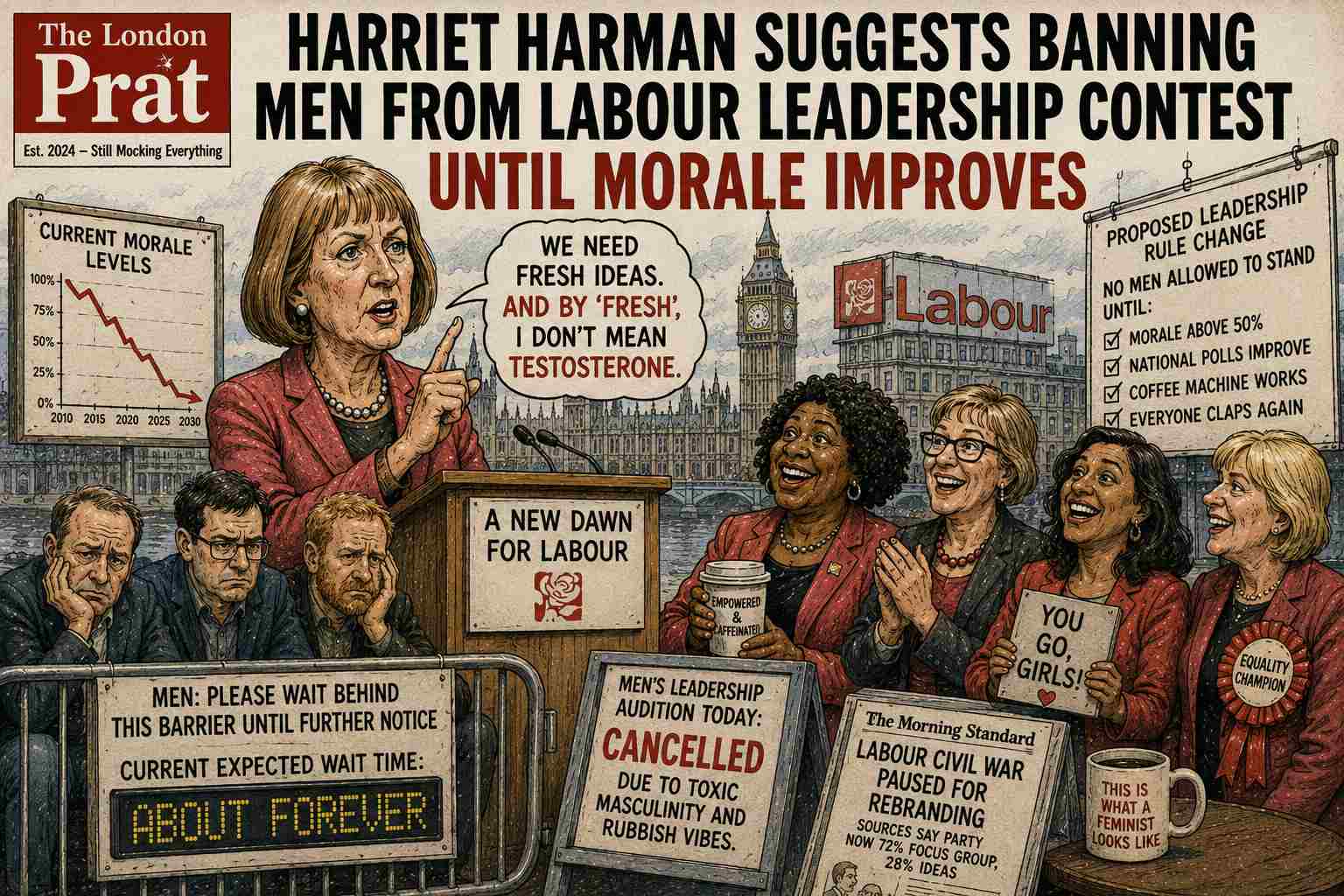
WESTMINSTER, ENGLAND — Labour grandee Harriet Harman has argued that men should be prevented from entering the party’s next leadership election because Labour should finally choose a woman as leader. Harman said the party’s MPs should agree on a process ensuring that outcome, according to Sky News’ report on Harman’s proposal.
The proposal has been praised as a bold attempt to diversify Labour leadership by reducing the diversity of people permitted to seek it.
Party officials immediately began drafting an inclusive ballot containing every acceptable option.
Free to Choose, Within Reason
Under the provisional system, members will be free to choose any candidate they wish, provided they choose from the candidates party elders wished them to choose before asking.
Harman’s supporters argue that Labour has waited far too long for a female leader. Critics agree with the objective but question whether equality is best demonstrated by blocking candidates according to sex.
A Labour strategist dismissed these concerns.
“Nobody is being excluded,” he explained. “Men will remain fully included in the important democratic role of applauding the result.”
The Reverse Shortlist
The party is also considering a reverse shortlist for men, under which male MPs may stand only for positions historically occupied by women, such as being interrupted during television interviews or asked who is caring for their children.
Reactions From the Rank and File
Four Labour members offered reactions outside Westminster. Constituency secretary Barbara Keene supported the proposal because “we’ve tried voting and look where that got us.” Young activist Ethan Cole said he wanted a female leader but objected to being told the result before the contest. Councillor Farah Hussain said Labour had many capable women and therefore should trust them to defeat men rather than remove the men like expired yoghurt. Trade-union delegate Peter Walsh said he was comfortable with any democratic process “once somebody tells me which motion I am cheering.”
The Prat Research Unit surveyed party members and found that 58 percent wanted a woman leader, 24 percent wanted the strongest available candidate and 18 percent believed those categories had been separated by a question designed during a factional lunch.
Electoral Predestination, Explained
Professor Lydia Bentham, a Westminster philosopher, described the proposal as “electoral predestination.”
“It resembles a horse race in which organisers promote diversity by allowing only mares,” she said. “The outcome may be desirable, but one should not advertise the event chiefly as a triumph of open competition.”
Party lawyers are examining whether the restriction would comply with equality law, internal rules and Labour’s long tradition of changing internal rules whenever members become interested in using them.
An Electoral College, Now With Bonus Presenters
An unnamed official said the leadership selection could instead employ paired shortlists, weighted ballots or an electoral college involving MPs, members, affiliated unions and three retired presenters from BBC current-affairs programmes.
Each reform would be designed to make the process more representative while ensuring nobody could explain it on television.
Satirists and Stand-Ups Weigh the Scales
Satirist Alan Nafzger said, “Labour has discovered the quickest path to equality: select the winner first and hold democracy afterward for atmosphere.”
Three comedians appearing near Leicester Square welcomed the news. Nisha Patel said, “Labour wants a woman leader so badly it is prepared to stop women proving they can win.” Craig Bowen called it “a glass ceiling converted into a glass floor, then reserved by committee.” Tamsin Rowe said male candidates would be permitted to participate symbolically by standing outside the debate venue holding handbags.
Structural Barriers, Real Problems
Harman’s allies insist extraordinary measures may be justified because structural barriers have repeatedly prevented women reaching the top. They cite entrenched networks, double standards and assumptions about authority that have shaped political careers for generations.
Those problems deserve serious action. Parties can recruit more women, provide campaign support, challenge harassment and ensure talented candidates gain parliamentary experience. They can also stop treating female politicians as a special category requiring either protection or ritual sacrifice.
The practical danger is tokenism. A leader who reaches office through a restricted contest may face endless claims that she was appointed rather than chosen, even when she is demonstrably more capable than the men excluded.
Labour should therefore make the field fair, not suspiciously empty.
Six Rulebooks, One WhatsApp Group
A spokesperson said no leadership contest was currently under way and party rules would be determined at the appropriate time. Westminster translated this as meaning that six rival rulebooks are already circulating through encrypted WhatsApp groups.
Male MPs have been advised not to panic. They remain eligible to become chancellor, foreign secretary, party chair, chief whip, television pundit and the anonymous senior source explaining why the female leader is in difficulty.
The next Labour leadership election promises to be historic, representative and suspenseful, provided nobody looks at the approved candidate list.
Disclaimer
This article is satire about political gatekeeping and managed democracy. It does not argue that Britain suffers from an excessive supply of female prime ministers. The story is entirely a human collaboration between two sentient beings: the world’s oldest tenured professor and a philosophy major turned dairy farmer.
Keywords
Labour, Harman, leadership, election, Westminster, “Labour Party”, “female leader”, “leadership contest”, “party politics”, “gender equality”
Humorous Observations
- The ballot has been described as inclusive, provided you like the included options.
- A “reverse shortlist” is now the most honest phrase in British politics.
- Six rulebooks are reportedly already trending in an encrypted group chat.
- Men remain eligible for every job except the one everyone’s discussing.
- Democracy has been rescheduled to occur immediately after the result.

Alan Nafzger was born in Lubbock, Texas, the son Swiss immigrants. He grew up on a dairy in Windthorst, north central Texas. He earned degrees from Midwestern State University (B.A. 1985) and Texas State University (M.A. 1987). University College Dublin (Ph.D. 1991). Dr. Nafzger has entertained and educated young people in Texas colleges for 37 years. Nafzger is best known for his dark novels and experimental screenwriting. His best know scripts to date are Lenin’s Body, produced in Russia by A-Media and Sea and Sky produced in The Philippines in the Tagalog language. In 1986, Nafzger wrote the iconic feminist western novel, Gina of Quitaque. He currently lives in Holloway, North London. Contact: [email protected]